
Evolutionary Race: Pathogens vs Hosts
🌱 Introduction
Pathogens and hosts are constantly adapting to outcompete each other. As hosts evolve stronger defence systems, pathogens evolve new ways to evade or suppress these defences. This ongoing back-and-forth process is known as an evolutionary race.
🧩 Why It Is Called an Evolutionary Race
- Both depend on survival and reproduction.
- Hosts aim to detect and destroy pathogens.
- Pathogens aim to infect, replicate and spread.
- Each adaptation in one side creates pressure for the other to counter-adapt.
- Occurs across many generations.
🛡️ Host Defences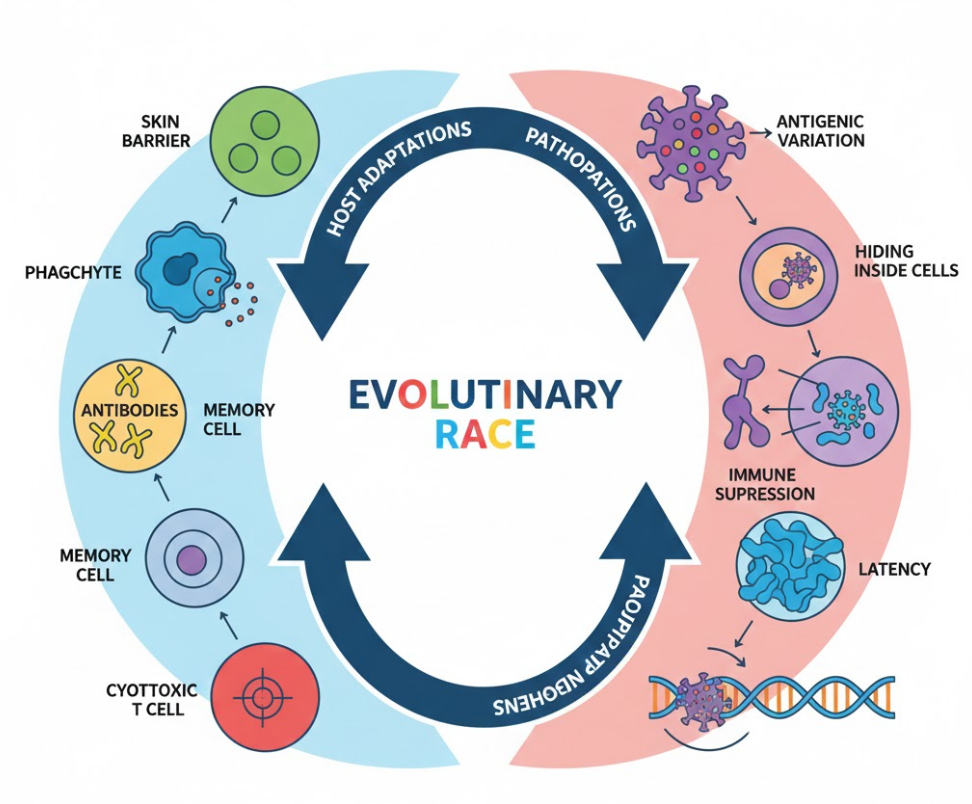
- Physical barriers like skin and mucus.
- Chemical barriers such as stomach acid and lysozyme.
- Immune responses including:
- Phagocytosis
- Antibodies
- Memory cells
- Cytotoxic T cells
- These create pressure on pathogens to evolve new evasion strategies.
🧠 Pathogen Evasion Mechanisms (Evidence for the Race)
Antigenic Variation
- Pathogens change their surface antigens so antibodies cannot recognise them.
- Seen in viruses like influenza and HIV.
- Host must produce new antibodies each time.
Why it shows the race: Host forms memory cells → pathogen evolves new antigens to escape detection.
Hiding Inside Host Cells
- Some pathogens live inside body cells to avoid immune attack.
- Examples: HIV hiding in T helper cells, TB bacteria hiding in macrophages.
Why it shows the race: Host develops cell-mediated immunity → pathogens evolve intracellular survival.
Inhibiting Immune Responses
- Pathogens release molecules that interfere with immune signalling.
- HIV suppresses T helper cells.
- Some bacteria block phagocytosis.
Why it shows the race: Host improves immune coordination → pathogens disrupt it.
Mimicry (Camouflage)
- Pathogens imitate host molecules to look like self.
- Some parasitic worms cover themselves with host proteins.
Why it shows the race: Host evolves better recognition → pathogens evolve better disguise.
Latency (Dormancy)
- Some viruses stay inactive inside host DNA.
- Examples: HIV, Herpes, lambda phage.
- Remain hidden until reactivated.
Why it shows the race: Host attempts to clear infected cells → pathogen hides and waits.
📋 Summary Table
| Pathogen Strategy | How It Works | Example | Why It Proves Evolutionary Race |
|---|---|---|---|
| Antigenic variation | Changes surface antigens | HIV, Influenza | Counters host antibodies |
| Hiding inside cells | Lives within host cells | TB bacteria | Avoids detection |
| Immune suppression | Damages or blocks immune signals | HIV | Weakens host defences |
| Camouflage (mimicry) | Appears like host tissues | Parasitic worms | Prevents recognition |
| Latency | Becomes dormant | HIV, Herpes | Escapes immune attack |
Evolutionary race = continuous adaptations between hosts and pathogens.
Hosts evolve stronger immunity, pathogens evolve stronger evasion.
Key strategies: antigenic variation, hiding inside cells, immune suppression, mimicry and latency.
Each mechanism shows pathogens adapting to stay ahead of host defences.