
Role of Microorganisms in Decomposition and Carbon Recycling
🌱 Introduction
Microorganisms like bacteria and fungi are the main decomposers in ecosystems. They break down dead plants, animals and waste materials, releasing nutrients back into the environment. Their activity is essential for the carbon cycle, helping carbon move between living organisms and the atmosphere.
🦠 Microorganisms as Decomposers
1. Which Microorganisms Are Involved?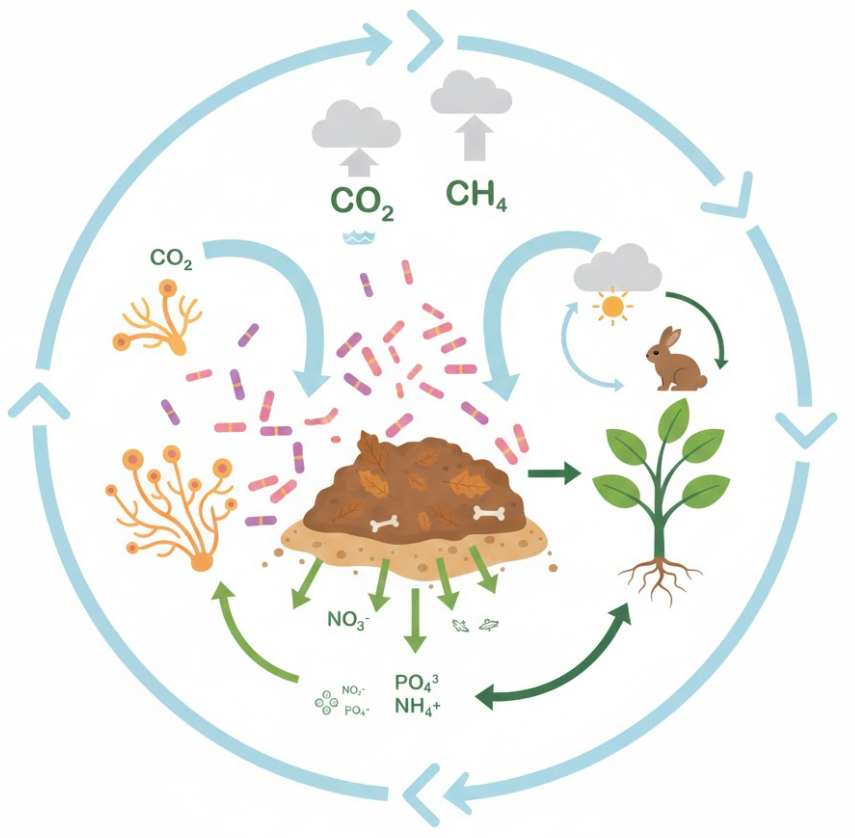
- Bacteria: Fast decomposers that break down soft tissues and simple organic molecules.
- Fungi (e.g. moulds, mushrooms): Break down tougher materials like cellulose and lignin and thrive in low-nutrient environments.
2. How Decomposition Happens
Microorganisms feed on dead organic matter using extracellular enzymes.
- Enzyme secretion: Microbes release enzymes like cellulases and proteases onto dead material.
- Breakdown: Large insoluble molecules are converted into small, soluble molecules.
- Absorption: Microbes absorb these small molecules for respiration and growth.
- Release of products: Mineral ions and gases return to the environment.
Products Released During Decomposition
- Carbon Dioxide (CO₂): Released during aerobic respiration and enters the atmosphere for photosynthesis.
- Methane (CH₄): Formed in anaerobic, waterlogged conditions by anaerobic bacteria.
- Mineral Ions: Nitrates, phosphates and ammonium ions that return to soil for plant uptake.
Microorganisms and the Carbon Cycle
Key Roles in Carbon Recycling
- Decomposition: Converts carbon compounds in dead matter into CO₂ or CH₄.
- Respiration: Microbial respiration is a major contributor to atmospheric CO₂.
- Feeding relationships: When decomposers are eaten, carbon moves through food webs.
- Carbon storage: Slow decomposition in acidic or waterlogged soils traps carbon as peat.
📋 Summary Table
| Process | Microbial Role | Carbon Outcome |
|---|---|---|
| Decomposition | Break down dead matter using enzymes | Releases CO₂ or CH₄ |
| Aerobic respiration | Bacteria and fungi respire | CO₂ returned to atmosphere |
| Anaerobic respiration | Bacteria in low-oxygen environments | Methane production |
| Soil nutrient release | Mineral ions returned to soil | Supports plant growth |
| Peat formation | Slow microbial activity | Carbon stored long term |
🧠 Quick Recap
Microorganisms are key decomposers, breaking down dead matter.
They use enzymes to digest organic materials outside their bodies.
Decomposition releases CO₂ (aerobic) or CH₄ (anaerobic).
This returned carbon is reused by plants for photosynthesis.
Microbes keep the carbon cycle moving and prevent carbon buildup in dead organisms.
Microorganisms are key decomposers, breaking down dead matter.
They use enzymes to digest organic materials outside their bodies.
Decomposition releases CO₂ (aerobic) or CH₄ (anaerobic).
This returned carbon is reused by plants for photosynthesis.
Microbes keep the carbon cycle moving and prevent carbon buildup in dead organisms.