
PCR: Polymerase Chain Reaction
🌱 Introduction
PCR is a lab method used to make millions of copies of a specific DNA fragment. It is useful when only a tiny amount of DNA is available, such as in forensic samples, medical tests or genetic studies.
🟣 What PCR Needs (Basic Requirements)
Template DNA
- The DNA that contains the target sequence to be copied.
Primers
- Short single-stranded DNA pieces that bind to each end of the target sequence.
DNA nucleotides (A, T, C, G)
- Building blocks used to make new DNA strands.
Taq DNA polymerase
- A heat-tolerant enzyme from Thermus aquaticus.
- Remains active even at high temperatures.
Thermocycler
- A machine that repeatedly changes temperature for each stage of PCR.
🔵 The Three Main Stages of PCR
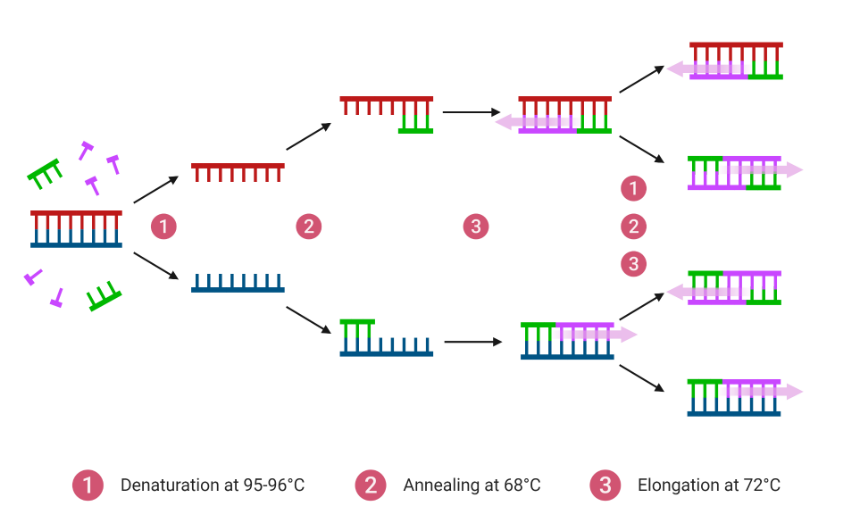
1. Denaturation (about 95°C)
- Double-stranded DNA is heated.
- Hydrogen bonds break.
- DNA separates into two single strands.
2. Annealing (about 55°C)
- Temperature is lowered.
- Primers bind to complementary sequences on each target DNA end.
- This step decides which region will be copied.
3. Extension (about 72°C)
- Taq polymerase adds nucleotides to primers.
- New complementary strands form.
- Each cycle doubles the target DNA.
🟢 How PCR Achieves Amplification
- One cycle doubles DNA quantity.
- After n cycles, amount = \(2^n\) times the original.
- 30–40 cycles produce millions of copies.
- Makes PCR extremely sensitive and fast.
🟠 Uses of PCR (Why It’s Important)
- Detecting infections (e.g., viral DNA or RNA after reverse transcription).
- Forensic DNA analysis.
- Genetic testing and diagnostics.
- Research: cloning genes, preparing DNA for sequencing.
- Identifying GM organisms or pathogens.
📋 Summary Table
| Stage | Temperature | What Happens |
|---|---|---|
| Denaturation | ~95°C | DNA strands separate |
| Annealing | ~55°C | Primers bind to target sequence |
| Extension | ~72°C | Taq polymerase synthesises new DNA |
🧠 Quick Recap
PCR amplifies DNA using repeated temperature cycles.
Needs template DNA, primers, nucleotides and heat-stable Taq polymerase.
Three stages: 95°C (separate), 55°C (primers bind), 72°C (new strands form).
Each cycle doubles the DNA → millions of copies after multiple cycles.
PCR amplifies DNA using repeated temperature cycles.
Needs template DNA, primers, nucleotides and heat-stable Taq polymerase.
Three stages: 95°C (separate), 55°C (primers bind), 72°C (new strands form).
Each cycle doubles the DNA → millions of copies after multiple cycles.