
Methods for Measuring the Growth of Microorganisms
🌿 Introduction
Microorganisms multiply quickly, so we need reliable techniques to measure their growth. Different methods measure different things: total cells, living cells, biomass or turbidity. These techniques are widely used in research labs, food microbiology, medicine and industry.
1. Cell Counts (Direct Microscopic Counting)
What this measures
- Total number of cells, including both living and dead.
 How it is done
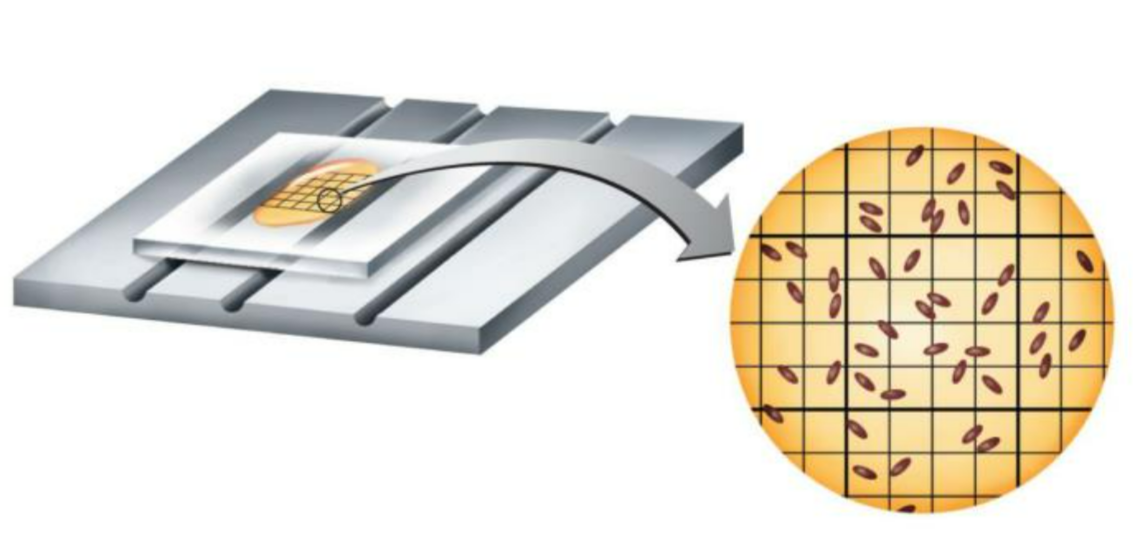
- A sample is placed on a haemocytometer, a special slide with a ruled grid.
- Cells within selected squares are counted using a microscope.
- Calculations convert these counts into cells per unit volume.
Advantages
- Quick results.
- No incubation needed.
- Useful when immediate estimates are required.
Limitations
- Cannot distinguish live from dead cells.
- Difficult if cells clump together.
- Accuracy depends on even distribution of cells on the slide.
2. Dilution Plating (Viable Count Method)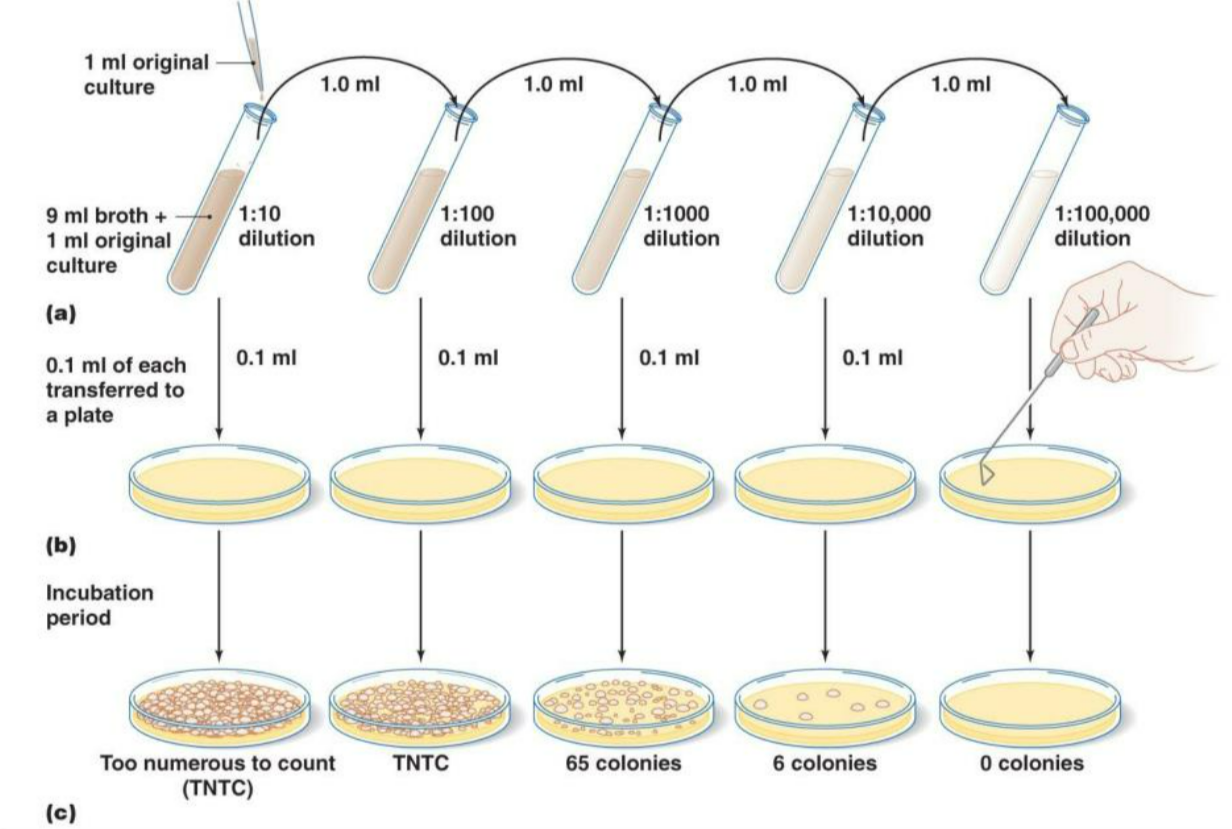
What this measures
- Number of living cells that are capable of forming colonies.
How it is done
- The sample is diluted in steps (e.g., 1 in 10 serial dilutions).
- A known volume from each dilution is spread on nutrient agar.
- After incubation, colonies are counted.
- Each colony arises from a single viable cell.
- Colony count × dilution factor gives the number of living cells in the original culture.
Advantages
- Measures only viable cells.
- Very accurate for assessing living population size.
Limitations
- Time-consuming because of incubation.
- Some microbes do not grow well on agar.
- Requires clean, aseptic handling.
3. Mass Measurement (Biomass Estimation)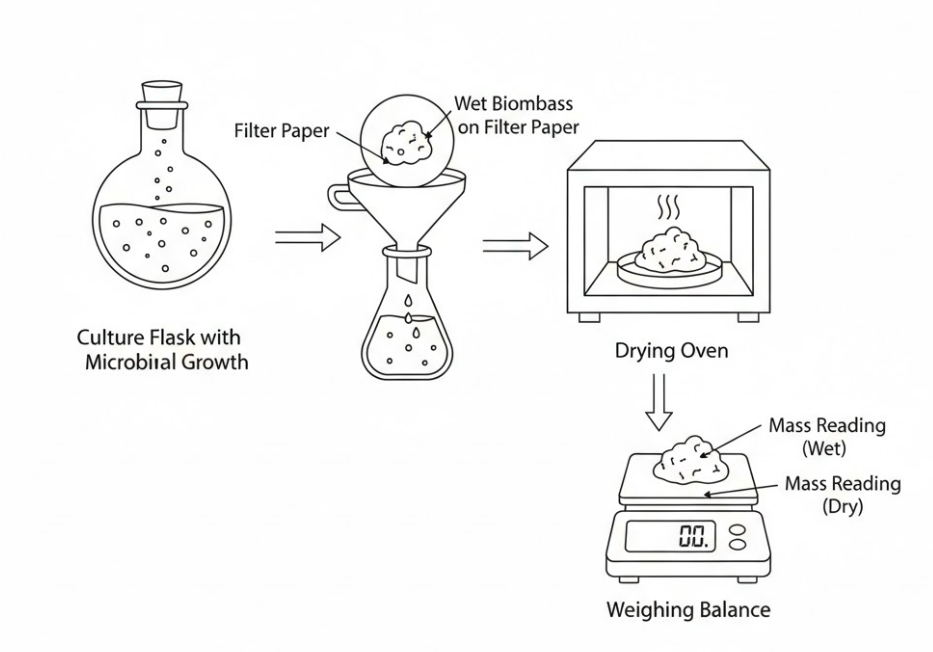
What this measures
- Total mass of microbial material, either wet or dry.
Wet Mass
- Cells are collected and weighed without removing water.
- Quick but less accurate due to variable water content.
Dry Mass
- Cells are filtered and dried completely in an oven.
- The remaining solid mass is weighed.
- More accurate but takes longer.
Advantages
- Suitable for organisms that grow as clumps or filaments (e.g., fungi).
- Good for large-scale cultures.
Limitations
- Destructive method.
- Wet mass is unreliable.
- Dry mass requires extra equipment and time.
4. Optical / Turbidity Method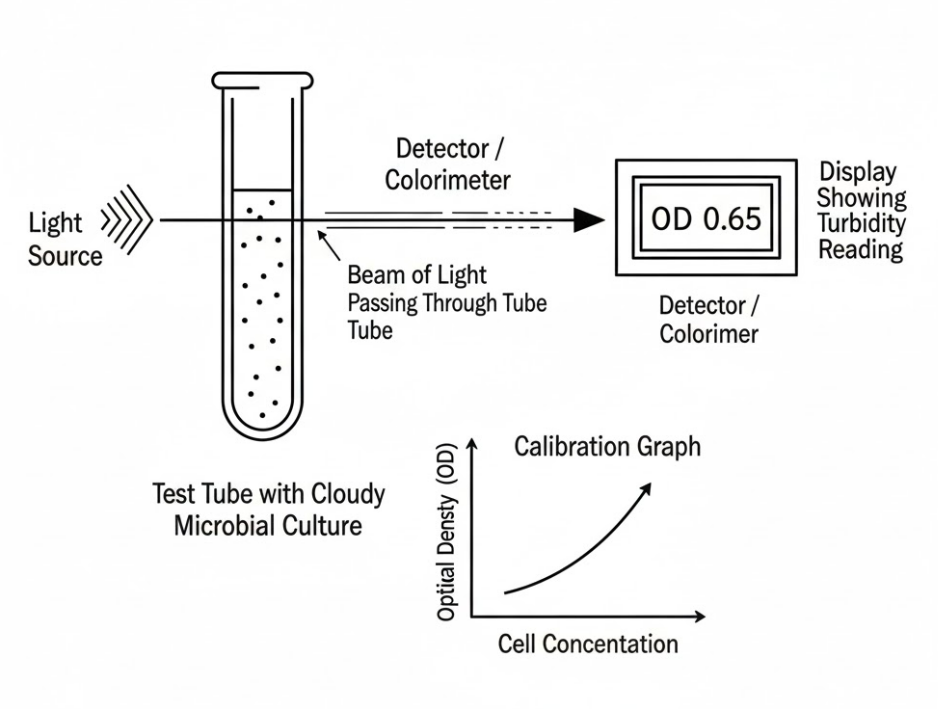
What this measures
- Cloudiness (turbidity) of a culture, which increases as cell numbers increase.
How it is done
- A colorimeter or spectrophotometer passes light through the culture tube.
- Microbial cells scatter the light.
- Higher turbidity means more cells.
- Turbidity values can be converted to estimated cell numbers using a calibration graph.
Advantages
- Very fast and non-destructive.
- Allows continuous monitoring of growth over time.
- Easy to perform.
Limitations
- Measures both living and dead cells.
- Needs a calibration curve for accuracy.
- Not reliable with organisms that form clumps or biofilms.
Summary Table
| Method | Measures | Strength | Limitation |
|---|---|---|---|
| Cell count | Total cells under microscope | Quick, no incubation | Cannot separate live/dead |
| Dilution plating | Living, viable cells | Very accurate | Slow, needs sterile technique |
| Wet/Dry mass | Biomass | Good for fungi | Destructive, wet mass unreliable |
| Turbidity | Cloudiness linked to cell number | Fast and easy | Includes dead cells, needs calibration |
Quick Recap
Cell counts → microscope → total cells.
Dilution plating → colonies → living cells only.
Mass measurement → weigh biomass → best for fungi.
Turbidity → light scattering → quick but includes dead cells.
Choose the method based on speed, accuracy, and organism type.