
Non-Specific Responses of the Body to Infection
🌱 Introduction
Non-specific defences are the body’s general, fast responses to any pathogen. They do not depend on the type of microbe and act immediately to prevent spread. These include inflammation, lysozyme, interferon, and phagocytosis.
🔥 Inflammation
What Triggers It
- Happens when tissues are damaged or pathogens enter.
- Mast cells release histamine.
What Histamine Does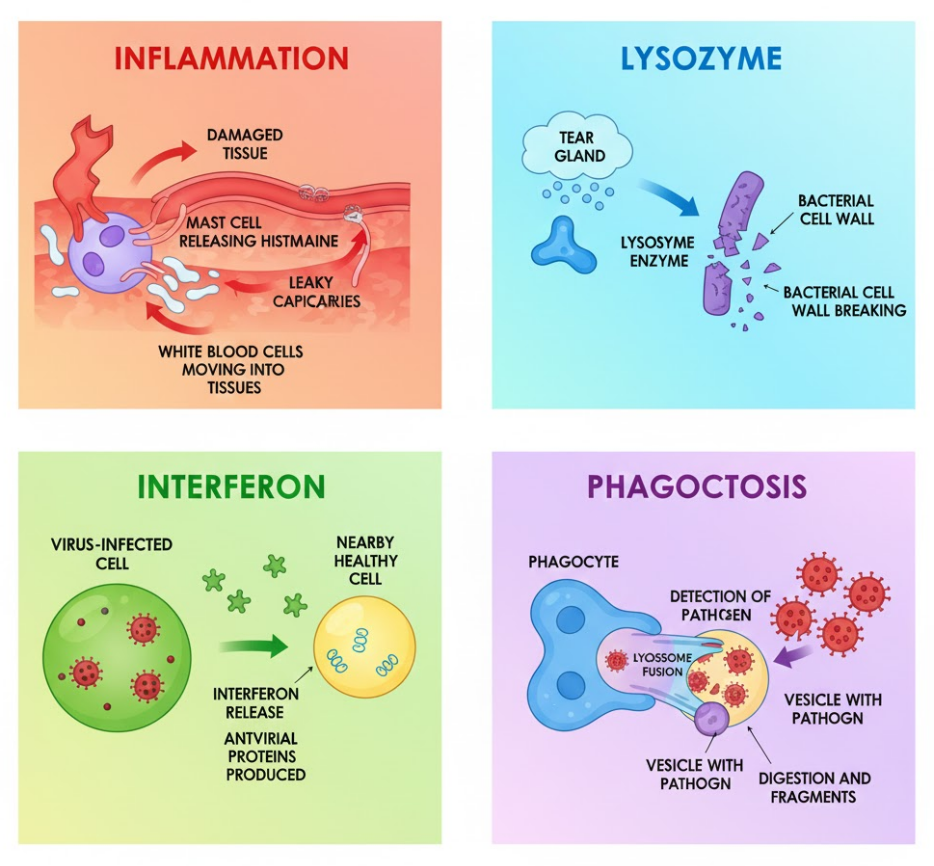
- Blood vessels dilate → more blood flow.
- Capillaries become leaky → white blood cells move into tissues.
- Area becomes red, warm, swollen, and painful.
Purpose
- Brings more immune cells to the site.
- Helps remove pathogens and damaged cells.
- Prevents microbes from spreading.
🧪 Lysozyme Action
What It Is
- An enzyme found in tears, saliva, mucus, sweat and nasal secretions.
How It Works
- Breaks down peptidoglycan in bacterial cell walls.
- Causes bacteria to burst (lysis).
Purpose
- Provides immediate chemical defence against bacteria entering through eyes, mouth, or nose.
🧫 Interferon
What It Is
- A signalling protein made by virus-infected cells.
How It Works
- Warns nearby cells that a virus is present.
- Makes neighbouring cells produce antiviral proteins.
- These proteins prevent viruses from replicating.
Purpose
- Slows down viral spread in early infection.
- Gives the immune system time to respond.
🦠 Phagocytosis
Which Cells Do It
- Mainly neutrophils and macrophages.
Steps of Phagocytosis
- Detection: Phagocyte recognises pathogen’s antigens.
- Engulfing: Cell surrounds and engulfs pathogen into a vesicle.
- Digestion: Lysosomes fuse with the vesicle and release digestive enzymes.
- Destruction: Pathogen is broken down into harmless fragments.
- Antigen presentation (macrophages): Some macrophages display antigens to help activate specific immunity.
Purpose
- Removes microbes rapidly.
- Prevents infection from spreading to healthy tissues.
📋 Summary Table
| Defence | Type | What It Does | Main Purpose |
|---|---|---|---|
| Inflammation | Non-specific | Histamine increases blood flow, leaky capillaries | Brings immune cells to infection site |
| Lysozyme | Chemical | Breaks bacterial cell walls | Kills bacteria entering via eyes/mouth |
| Interferon | Antiviral protein | Makes cells produce antiviral substances | Slows viral replication |
| Phagocytosis | Cellular | Engulfs and digests pathogens | Removes microbes quickly |
🧠 Quick Recap
Inflammation = histamine causes redness, heat, swelling, pain.
Lysozyme = enzyme that destroys bacteria by breaking cell walls.
Interferon = warns nearby cells during viral infection.
Phagocytes = neutrophils and macrophages engulf and digest pathogens.
All are non-specific, acting against any pathogen.
Inflammation = histamine causes redness, heat, swelling, pain.
Lysozyme = enzyme that destroys bacteria by breaking cell walls.
Interferon = warns nearby cells during viral infection.
Phagocytes = neutrophils and macrophages engulf and digest pathogens.
All are non-specific, acting against any pathogen.