
Antigens, Antibodies and the Immune Response
🌱 Introduction
The immune system protects the body by recognising and destroying pathogens. It relies on antigens, antibodies, and the activity of macrophages, antigen-presenting cells, and plasma cells. This topic explains how they all link together in one coordinated defence.
🔍 Antigens
What Antigens Are
- Antigens are unique molecules found on the surface of pathogens.
- Usually proteins or glycoproteins.
- The immune system recognises them as foreign.
Role of Antigens
- Act as signals telling the immune system that an invader is present.
- Trigger the production of specific antibodies.
- Help the body distinguish between self and non-self.
🧪 Antibodies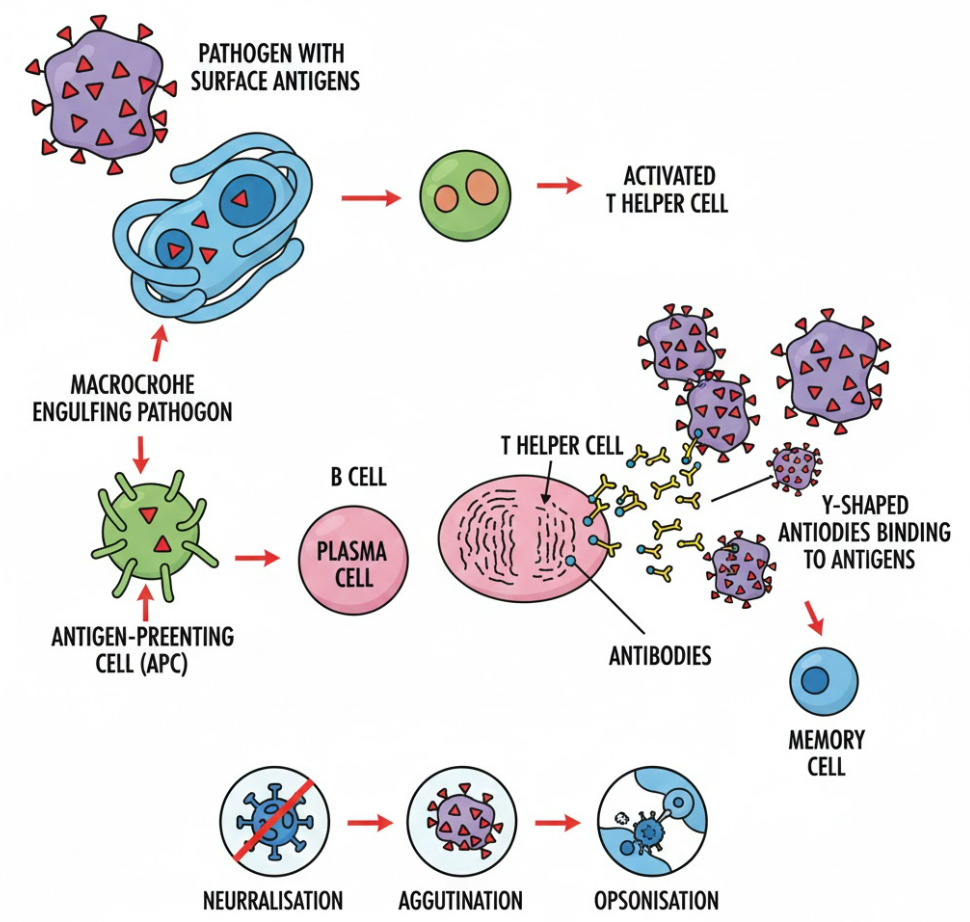
What Antibodies Are
- Y-shaped proteins made by plasma cells.
- Each type of antibody fits one specific antigen (like a key and lock).
How Antibodies Work
- Neutralisation: bind to pathogens or toxins to block their action.
- Agglutination: clump pathogens together to make them easier to engulf.
- Opsonisation: tag pathogens so phagocytes recognise them faster.
- Activation of complement proteins: helps destroy pathogens.
Role of Antibodies
- Make pathogens easier to kill.
- Prevent pathogens from entering or damaging cells.
- Allow phagocytes to clear infections quickly.
🧬 Key Cells in the Immune Response
Macrophages
- Large phagocytes found in tissues.
- First to respond to infection.
- Engulf and digest pathogens.
- After digesting pathogens, they display the pathogen’s antigens on their surface.
Antigen-Presenting Cells (APCs)
- Cells that hold the pathogen’s antigens on their membrane.
- Includes macrophages, dendritic cells, and B cells.
- Present antigens to T helper cells, activating the specific immune response.
Why APCs Are Important
- They link the non-specific response (phagocytosis) to the specific response (antibody production).
- Without antigen presentation, T helper cells cannot activate B cells.
Plasma Cells
- Activated B cells differentiate into plasma cells.
- Plasma cells produce large quantities of antibodies.
- They release antibodies into the blood and tissues.
- Short-lived but extremely active during infection.
🧷 Putting It All Together: Sequence of Immune Response
Step-by-step
- Pathogen enters the body and macrophages engulf it.
- Macrophage becomes an antigen-presenting cell by placing antigens on its surface.
- APC interacts with a T helper cell, activating it.
- Activated T helper cell stimulates B cells.
- B cells differentiate into plasma cells.
- Plasma cells release specific antibodies matching that antigen.
- Antibodies neutralise pathogens, help phagocytes, and stop infection.
- Leads to pathogen clearance and formation of memory cells.
📋 Summary Table
| Component | What It Is | Role in Immunity |
|---|---|---|
| Antigen | Foreign molecule on pathogens | Stimulates immune response |
| Antibody | Y-shaped protein from plasma cells | Neutralises and tags pathogens |
| Macrophage | Phagocyte | Engulfs pathogens, becomes APC |
| Antigen-presenting cell | Macrophage or B cell with displayed antigen | Activates T helper cells |
| Plasma cell | Activated B cell | Produces large amounts of antibodies |
🧠 Quick Recap
Antigens trigger the immune response.
Antibodies match specific antigens and neutralise pathogens.
Macrophages engulf pathogens and present their antigens.
APCs activate T helper cells.
Plasma cells make large amounts of antibodies.
All steps link together to clear infection.
Antigens trigger the immune response.
Antibodies match specific antigens and neutralise pathogens.
Macrophages engulf pathogens and present their antigens.
APCs activate T helper cells.
Plasma cells make large amounts of antibodies.
All steps link together to clear infection.