
Mammalian Skeletal Muscle Fibres
🌟 Introduction
Skeletal muscles are the ones that move bones. They are made of long fibres specially adapted for contraction, force generation and endurance. Different fibres are adapted for different types of movement.
🧩 (i) Structure of a Mammalian Skeletal Muscle Fibre
A skeletal muscle fibre is basically one long, cylindrical, multinucleated cell packed with contractile proteins.
🌱 Key Structural Features
1. Sarcolemma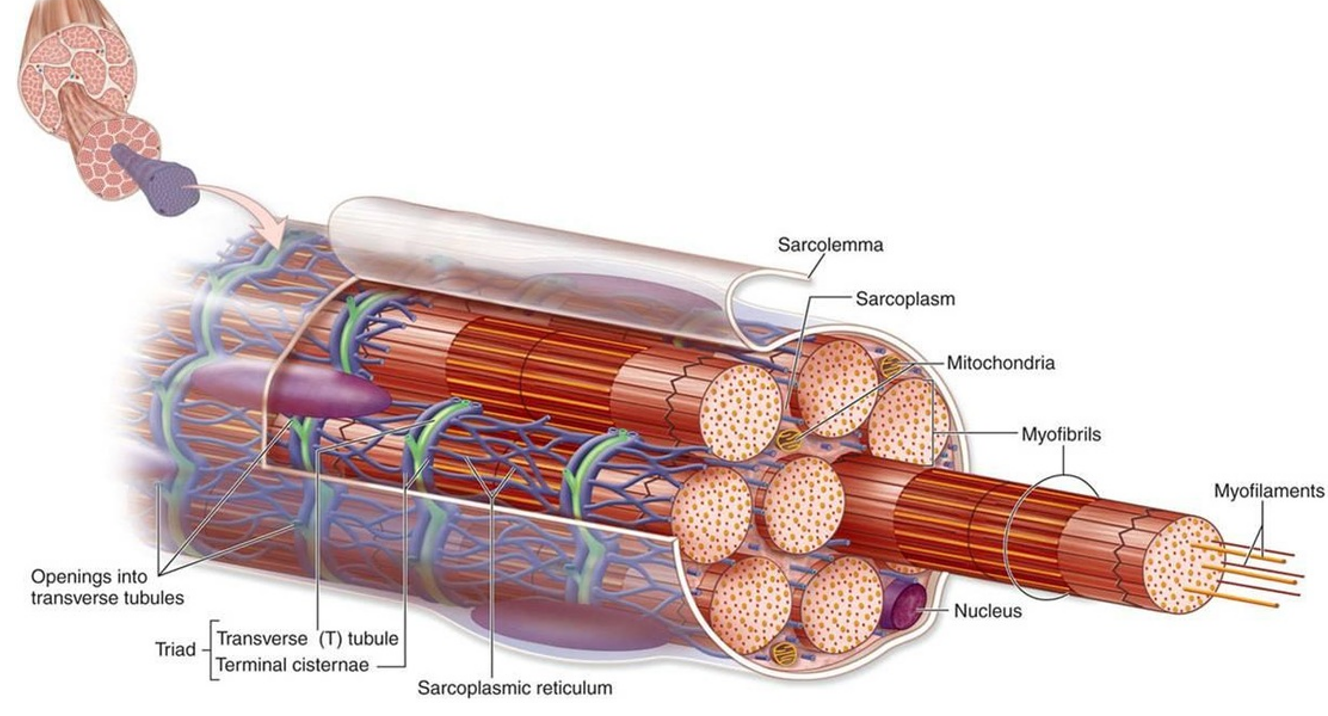
- The cell’s outer membrane.
- Conducts electrical impulses across the fibre.
2. Sarcoplasm
- Muscle cell cytoplasm.
- Contains glycogen, mitochondria and enzymes needed for contraction.
3. Myofibrils
- Long protein threads filling most of the fibre.
- Made of sarcomeres, the contractile units.
- Two main filaments:
- Actin (thin filament)
- Myosin (thick filament)
- These slide over each other to shorten the muscle (sliding filament theory).
4. Sarcoplasmic Reticulum (SR)
- Stores and releases calcium ions, which are essential for contraction.
5. T tubules (Transverse tubules)
- Infoldings of the sarcolemma.
- Carry impulses deep inside the fibre to trigger contraction evenly.
6. Mitochondria
- Many present, depending on fibre type.
- Produce ATP for contraction.
7. Multiple Nuclei
- Helpful for controlling the huge cell and managing protein synthesis.
8. Banding/Striations
- Visible stripes due to the arrangement of actin and myosin.
- Classic feature of skeletal muscles.
⚡ (ii) Fast Twitch vs Slow Twitch Muscle Fibres
Muscles contain two major fibre types, each specialised for different roles. One works like a “sprint mode”, the other like an “endurance mode”.
Fast Twitch Muscle Fibres (Type II)
Structural Features
- Fewer mitochondria
- Less myoglobin (paler colour)
- Less blood supply
- Large stores of glycogen
- Thicker fibres
- Very efficient SR for fast Ca²⁺ release
- Fatigue quickly
Physiological Features
- Contract rapidly and with a lot of force.
- Short bursts of activity.
- Anaerobic respiration is dominant.
- Produce lactate during intense work.
Best For
- Sprinting
- Weightlifting
- Jumping
- Sudden powerful movements
🟦 Slow Twitch Muscle Fibres (Type I)
Structural Features
- Many mitochondria
- High myoglobin (deep red colour)
- Rich blood supply
- Thinner fibres
- Lots of respiratory enzymes
- Fatigue resistant
Physiological Features
- Contract slowly but endure for long periods.
- Use mainly aerobic respiration.
- Produce steady amounts of ATP.
- Excellent for continuous activities.
Best For
- Long distance running
- Posture muscles
- Cycling
- Swimming
📌 Summary Table: Fast vs Slow Twitch
| Feature | Fast Twitch (Type II) | Slow Twitch (Type I) |
|---|---|---|
| Colour | Pale (low myoglobin) | Red (high myoglobin) |
| Mitochondria | Few | Many |
| Blood supply | Low | High |
| Contraction | Fast, powerful | Slow, steady |
| Respiration | Mostly anaerobic | Mostly aerobic |
| Fatigue | Quick | Slow |
| Best for | Sprint, power | Endurance |
Skeletal muscle fibres are long, multinucleated, striated cells packed with myofibrils.
Key parts: sarcolemma, sarcoplasm, myofibrils, SR, T-tubules, mitochondria.
Fast twitch fibres: strong, quick, anaerobic, fatigue fast.
Slow twitch fibres: endurance, aerobic, fatigue slow.
Different sports depend on different fibre dominance.