
Cardiovascular and Respiratory Control
🌟 Introduction
The body must deliver oxygen (O₂) to tissues and remove carbon dioxide (CO₂) efficiently. This is achieved by adjusting cardiac output and ventilation rate, which are controlled by centres in the medulla oblongata.
🧮 (i) Cardiac Output
Definition: Cardiac output (CO) is the volume of blood pumped by the heart per minute.
Formula
CO = SV × HR
Where:
Stroke Volume (SV): Blood pumped per beat (mL)
Heart Rate (HR): Beats per minute (bpm)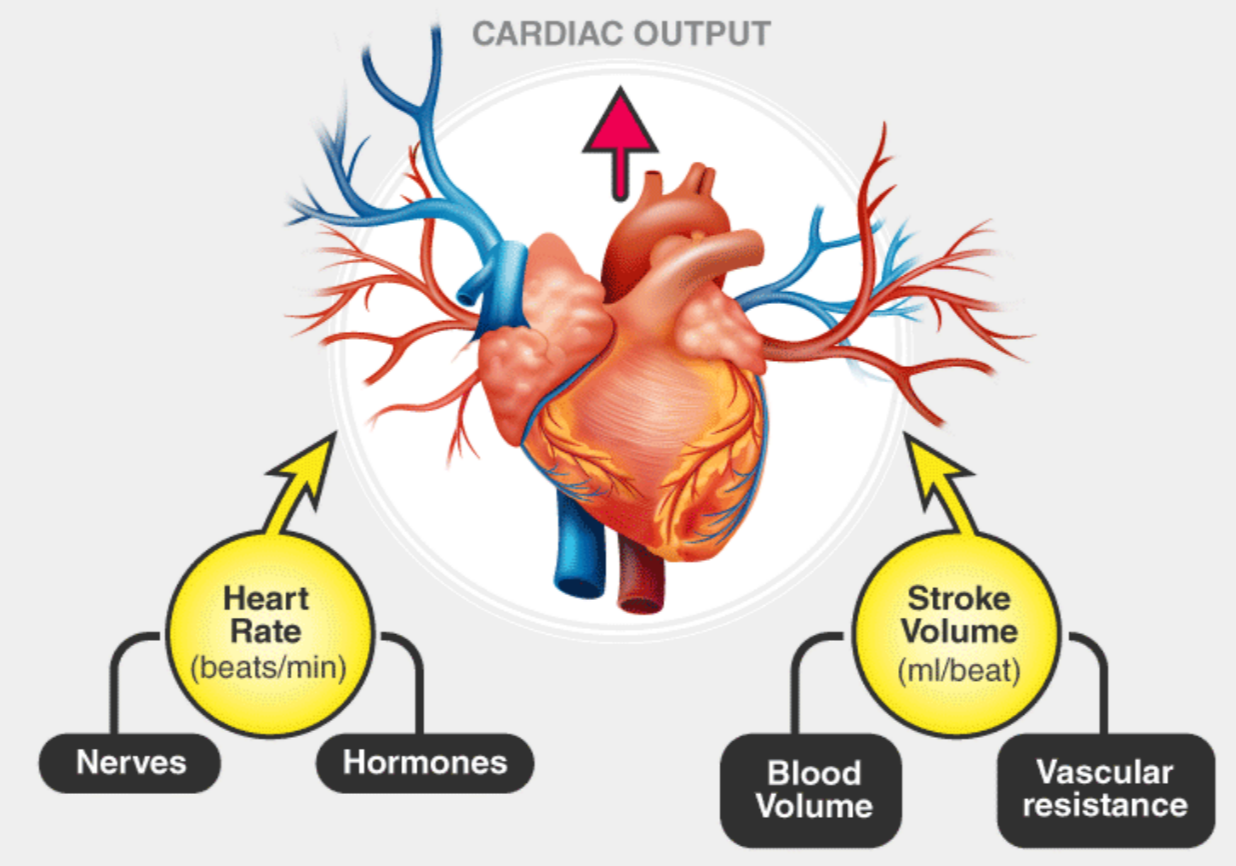
Example Calculation
SV = 70 mL
HR = 75 bpm
CO = 70 × 75 = 5250 mL/min ≈ 5.25 L/min
Key point: CO increases during exercise to meet higher oxygen demand.
⚡ (ii) Variations in Ventilation and Cardiac Output
Purpose
- Rapid O₂ delivery to tissues.
- Efficient CO₂ removal from tissues.
Mechanisms
- Increased Heart Rate (HR): Pumps more blood per minute.
- Increased Stroke Volume (SV): More blood per beat.
- Increased Ventilation Rate (Breathing Rate): Brings in more O₂ and removes CO₂ faster.
Result: Oxygen delivery rises, CO₂ is removed quickly, sustaining aerobic respiration during activity.
🧠 Control of Heart Rate and Ventilation
1. Cardiovascular Control Centre (Medulla Oblongata)
– Monitors blood pressure, blood O₂ and CO₂ levels.
– Sends autonomic signals to heart:
- Sympathetic nervous system: Increases HR
- Parasympathetic nervous system: Decreases HR
2. Ventilation Centre (Medulla Oblongata)
– Controls rate and depth of breathing.
– Responds to:
- High CO₂ → increases breathing rate
- Low O₂ → increases breathing rate (less sensitive than CO₂)
– Sends signals to respiratory muscles (diaphragm, intercostals) to adjust ventilation.
🔹 Integration During Exercise
- Muscles produce more CO₂ and use more O₂.
- Chemoreceptors detect changes in blood chemistry.
- Medulla increases HR and ventilation rate.
- Cardiac output rises, and oxygen delivery matches demand.
Memory tip: “More CO₂ → faster breath; more activity → faster heart.”
📌 Summary Table
| Parameter | Definition / Role | How it changes to meet demand |
|---|---|---|
| Cardiac Output (CO) | Blood/min pumped by heart | Increases with HR & SV during exercise |
| Heart Rate (HR) | Beats per minute | Controlled by cardiovascular centre |
| Stroke Volume (SV) | Blood/beat | Increases with exercise intensity |
| Ventilation Rate | Breaths/min | Controlled by ventilation centre in medulla |
| Chemoreceptors | Detect O₂ & CO₂ in blood | Stimulate medulla to adjust HR & ventilation |
CO = HR × SV
Exercise → ↑ HR, ↑ SV, ↑ ventilation → O₂ delivery ↑, CO₂ removal ↑
Cardiovascular centre: Adjusts heart rate via autonomic nerves
Ventilation centre: Adjusts breathing rate/depth via medulla
Chemoreceptors: Detect blood gases, trigger responses
Coordinated changes maintain tissue oxygenation during rest and activity.