
CORE PRACTICAL 17
Effects of Exercise on Breathing Using a Spirometer
🌱 Introduction
A spirometer records breathing as a trace. From this trace we can calculate tidal volume, breathing rate, respiratory minute ventilation, and oxygen consumption before and after exercise. Exercise increases ATP demand, so the respiratory system adjusts these values to meet the increased requirement.
🧬 Key Definitions
- Tidal Volume (TV): Air breathed in or out in one normal breath. From trace: height of one wave.
- Breathing Rate (BR): Number of breaths per minute. From trace: count peaks in 60 seconds.
- Respiratory Minute Ventilation (RMV): Air breathed per minute. RMV = TV × BR.
- Oxygen Consumption: Rate of O₂ uptake. Seen as downward drift of trace baseline because CO₂ is absorbed by soda lime.
🧪 Equipment Setup
- Spirometer with soda lime to absorb CO₂.
- Water-filled chamber with floating lid.
- Mouthpiece and nose clip.
- Kymograph or digital sensor to record trace.
- Stopwatch for exercise timing.
Safety: Fresh mouthpiece, check soda lime, ensure spirometer filled with medical-grade oxygen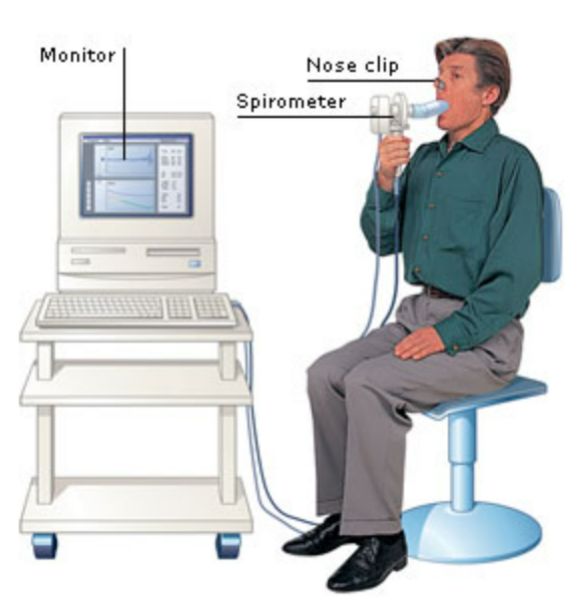
🔬 Method
- Subject sits calmly and breathes into spirometer.
- Record resting trace for about 1 minute.
- Subject removes mouthpiece and performs exercise (e.g., step-ups) for a fixed time.
- Reconnect and immediately record post-exercise trace.
- Use both traces to calculate TV, BR, RMV, and O₂ consumption.
📊 How to Calculate Values from the Trace
- 1. Tidal Volume: Measure height of several breaths and average.
- 2. Breathing Rate: Count waves in 60 seconds (or 30 seconds × 2).
- 3. RMV: Use RMV = TV × BR. Expect a large increase after exercise.
- 4. Oxygen Consumption: Measure downward shift in baseline over time. Drift occurs because soda lime removes CO₂, so only O₂ loss reduces total gas volume.
🫀 Expected Results After Exercise
| Parameter | Resting Value | After Exercise | Why It Changes |
|---|---|---|---|
| Tidal Volume | Lower | Higher | Deeper breaths increase oxygen intake |
| Breathing Rate | Moderate | Higher | Faster breathing improves gas exchange |
| RMV | Low | Much Higher | Combination of ↑TV and ↑BR |
| Oxygen Consumption | Low | Higher | Rapid respiration in muscles increases O₂ demand |
🧠 Biological Reasoning
During exercise, muscles use ATP rapidly. Aerobic respiration increases, requiring more O₂ and producing more CO₂. The brain’s respiratory centre increases breathing depth and rate. These changes appear clearly on spirometer traces.
Spirometer trace gives TV, BR, RMV, and O₂ uptake.
RMV = TV × BR.
Soda lime removes CO₂, so downward baseline shows O₂ use.
Exercise increases all parameters, especially RMV.
Changes reflect higher ATP demands in active muscles.