
Urea Formation & Removal from the Blood
🌱 Introduction
The body cannot store excess amino acids.
So the liver converts them into urea, a safe, soluble waste product.
The kidneys then remove urea from the blood by ultrafiltration.
🧬 Part 1: How Urea Is Made in the Liver
Why amino acids cannot be stored
- They contain nitrogen, which is toxic if allowed to accumulate.
- Extra amino acids must be broken down safely.
Step 1: Deamination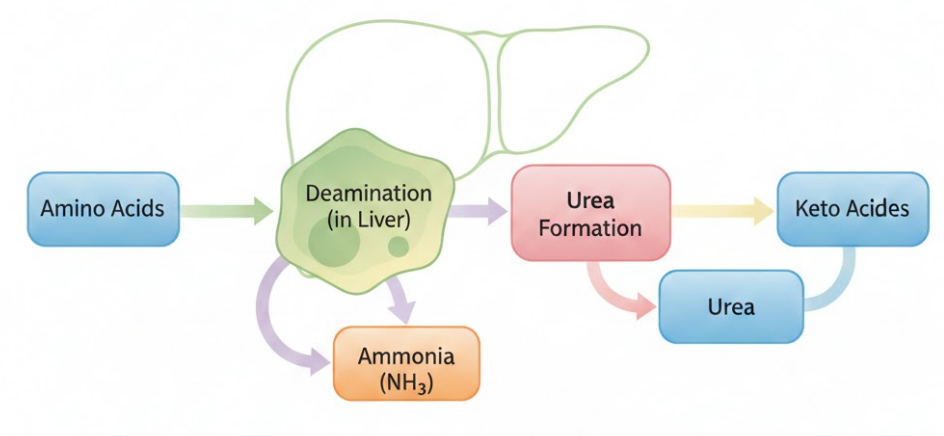
This happens in liver cells.
- The amine group (NH₂) is removed from the amino acid.
- This produces ammonia (NH₃) which is highly toxic.
- The rest of the molecule becomes keto acids, which can be used for:
- respiration
- glucose production
- fat synthesis
Simple equation
Amino acid → ammonia + keto acid
Step 2: Conversion of ammonia to urea
- The liver converts ammonia to urea, which is less toxic and safe to transport in the bloodstream.
- (You do not need the ornithine cycle steps.)
Why urea is useful
- Non-toxic
- Highly soluble in blood
- Easily removed by the kidneys
💧 Part 2: How Urea Is Removed by the Kidneys (Ultrafiltration)
Urea is removed at the Bowman’s capsule in each nephron.
🔍 What is Ultrafiltration?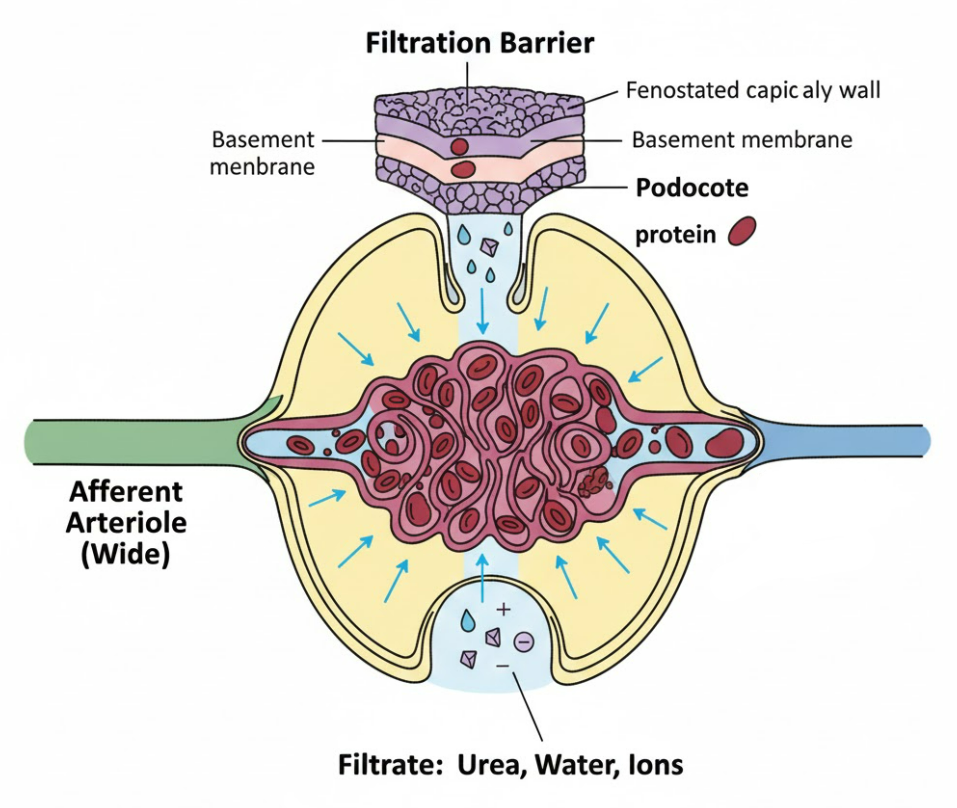
A high-pressure filtering process that pushes small molecules out of the blood and into the kidney tubule.
Includes
- urea
- water
- glucose
- ions
Does NOT include
- proteins
- blood cells
(They’re too large to pass through the filtration barrier.)
🔬 How Ultrafiltration Works (Step-by-Step)
1. High pressure in the glomerulus
- Afferent arteriole is wider than the efferent arteriole.
- This creates high hydrostatic pressure.
2. Filtration barrier
Made of three layers:
- Capillary endothelium
- Basement membrane (main filtering layer)
- Podocytes (special cells in Bowman’s capsule)
These layers allow small molecules through but block large ones.
3. Filtrate enters the Bowman’s capsule
This filtrate contains:
- urea
- water
- glucose
- salts
Urea stays in the filtrate and eventually becomes part of urine.
🚰 What Happens Next?
- Glucose, amino acids, and most water are reabsorbed in the nephron.
- Urea is not reabsorbed significantly, so it passes into the collecting duct and ureter.
- Finally excreted as urine.
📊 Summary Table
| Process | Location | Key Idea |
|---|---|---|
| Deamination | Liver | Removes NH₂, forming ammonia + keto acids |
| Ammonia → Urea | Liver | Converts toxic ammonia into safe urea |
| Ultrafiltration | Bowman’s capsule | High pressure forces small molecules out of blood |
| Fate of urea | Nephron | Not reabsorbed much, becomes urine |
Excess amino acids cannot be stored → broken down in the liver.
Deamination removes NH₂, forming toxic ammonia.
Liver converts ammonia into urea (safe, soluble).
Urea removed from blood by ultrafiltration in the kidney.
High pressure pushes urea into Bowman’s capsule.
Urea passes through nephron and is excreted as urine.