
Selective Reabsorption & the Countercurrent Multiplier
🌱 Introduction
After ultrafiltration, the filtrate entering the nephron contains useful substances like glucose, amino acids, ions, and water.
The nephron must reabsorb these.
Two main regions are involved:
- Proximal Convoluted Tubule (PCT)
- Loop of Henle
🧬 1. Selective Reabsorption in the Proximal Convoluted Tubule (PCT)
The PCT is the main site of reabsorption.
Around 70 percent of the filtrate is reabsorbed here.
🔍 Why the PCT is so effective
- Cells have microvilli, giving large surface area.
- Lots of mitochondria for ATP.
- Close contact with capillaries for rapid transport.
- Co-transport proteins and carrier proteins.
📌 What Gets Reabsorbed (and How)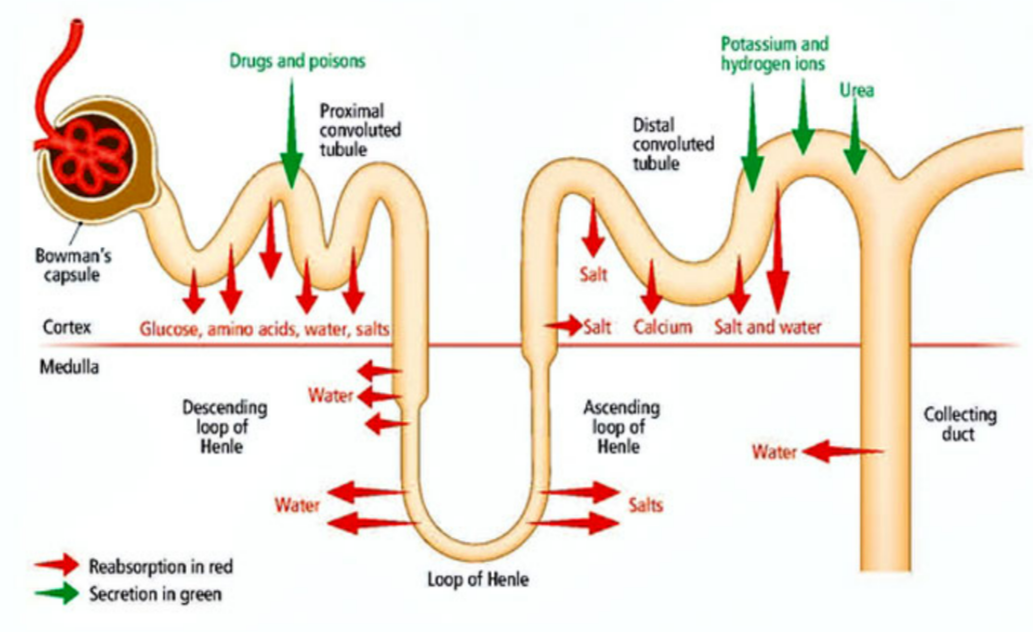
Glucose and Amino Acids
- Reabsorbed by co-transport with sodium ions.
- Sodium moves down its gradient into the cell, pulling glucose or amino acids with it.
- Actively transported into the blood.
Sodium Ions
- Pumped out of PCT cells by active transport using the sodium-potassium pump.
- This maintains the gradient for all co-transport processes.
Water
- Follows by osmosis because the filtrate becomes more dilute as solutes leave.
- PCT is highly permeable to water.
Chloride Ions
- Follow passively due to electrical attraction to sodium.
Urea
- Small amount diffuses back, but most remains and is excreted.
🌀 2. Loop of Henle as a Countercurrent Multiplier
The Loop of Henle creates a salt concentration gradient in the medulla.
This gradient allows the collecting duct to reabsorb large amounts of water.
This process is called a countercurrent multiplier.
🧩 Key Idea
The descending and ascending limbs have opposite properties.
Descending limb
- Permeable to water
- Impermeable to ions
→ Water moves out by osmosis into the salty medulla.
Ascending limb
- Impermeable to water
- Pumps sodium and chloride ions out
→ Makes the medulla even saltier.
🔁 Why It’s Called “Countercurrent”
- The two limbs flow in opposite directions.
- This keeps a steep concentration gradient along the whole loop.
🔁 Why It’s a “Multiplier”
- Each small movement of ions is multiplied into a very strong medulla salt gradient.
💧 Final Outcome
Because the medulla becomes very salty, the collecting duct (later in the nephron) can reabsorb large amounts of water, especially when ADH is present.
This is essential for:
- Producing concentrated urine
- Preventing dehydration
📊 Summary Table
| Structure | Key Features | What Happens |
|---|---|---|
| PCT | Microvilli, mitochondria, co-transport | Most solutes reabsorbed; water follows by osmosis |
| Descending limb | Water-permeable | Water leaves filtrate |
| Ascending limb | Pumps out ions, water-impermeable | Salt gradient created |
| Countercurrent multiplier | Opposite flow in limbs | Strengthens medulla gradient, enabling water reabsorption |
PCT reabsorbs glucose, amino acids, sodium, chloride, and water.
Uses co-transport, active transport, and osmosis.
Loop of Henle sets up a salt gradient in the medulla.
Descending limb loses water; ascending limb pumps out ions.
Countercurrent multiplier strengthens the gradient.
Enables collecting duct to reabsorb water, concentrating urine.