
Negative Feedback Control of Plasma Concentration and Blood Volume
🌟 Introduction
Mammals keep their blood plasma concentration and blood volume steady using a negative feedback loop. The key players are:
- Hypothalamus (osmoreceptors)
- Pituitary gland
- ADH (antidiuretic hormone)
- Kidneys
🧬 Main Concepts
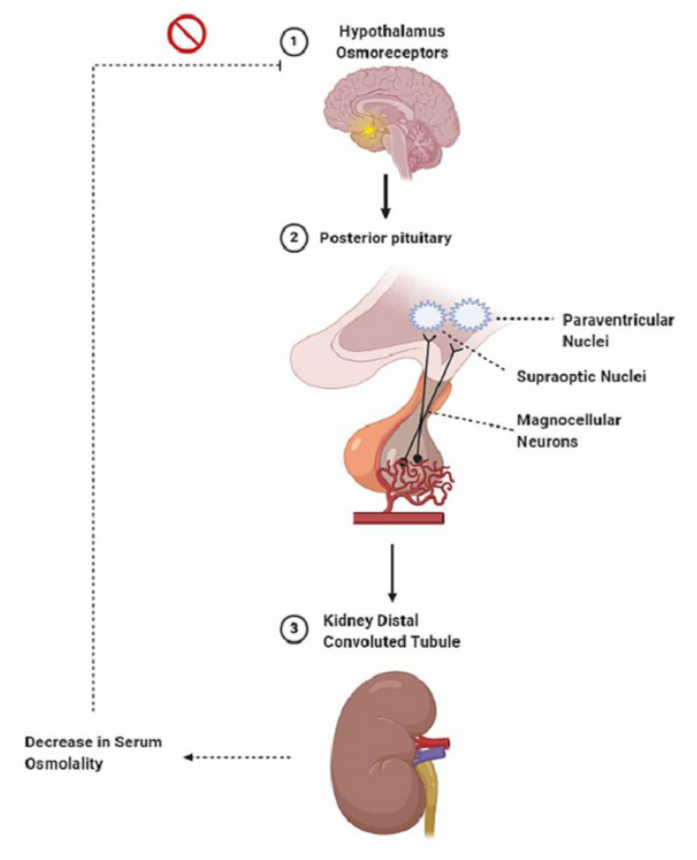
1. Osmoreceptors in the Hypothalamus
- Sensitive to changes in blood water concentration.
- If blood becomes too concentrated (low water), they shrink.
- If blood becomes too dilute (high water), they swell.
2. Role of the Pituitary Gland
- Hypothalamus signals the posterior pituitary.
- Pituitary releases ADH depending on water balance signals.
3. ADH (Antidiuretic Hormone)
- Travels in blood to the kidneys.
- Makes collecting ducts more permeable to water.
- More ADH means more water reabsorbed, less urine.
- Less ADH means less reabsorption, more urine.
🔁 Negative Feedback Mechanism
Case 1: Plasma too concentrated (low blood volume)
- Osmoreceptors detect low water.
- Hypothalamus sends message to pituitary.
- More ADH released.
- Collecting ducts reabsorb more water.
- Blood becomes dilute again.
- System returns to normal.
Case 2: Plasma too dilute (high blood volume)
- Osmoreceptors detect too much water.
- Pituitary reduces ADH release.
- Collecting ducts become less permeable.
- More water lost in urine.
- Blood concentration rises back to normal.
📌 Summary Table
| Condition | ADH Level | Kidney Response | Effect on Blood |
|---|---|---|---|
| Blood concentrated | High | More water reabsorbed | Dilutes plasma |
| Blood dilute | Low | Less water reabsorbed | Concentrates plasma |
🧠 Quick Recap
Osmoreceptors monitor blood concentration.
Pituitary adjusts ADH release.
ADH controls water reabsorption in kidneys.
System works as a negative feedback loop to stabilise plasma concentration and blood volume.
Trick: “High concentration = High ADH” (both high).
Osmoreceptors monitor blood concentration.
Pituitary adjusts ADH release.
ADH controls water reabsorption in kidneys.
System works as a negative feedback loop to stabilise plasma concentration and blood volume.
Trick: “High concentration = High ADH” (both high).