
Link Reaction & Krebs Cycle
🌱 Introduction
After glycolysis, pyruvate (3C) is the end product in the cytoplasm. To fully release energy from glucose, pyruvate must be completely oxidised in the mitochondria.
Link reaction converts pyruvate to acetyl-CoA, feeding the Krebs cycle.
These steps generate CO₂, ATP, and reduced coenzymes (NADH, FADH₂).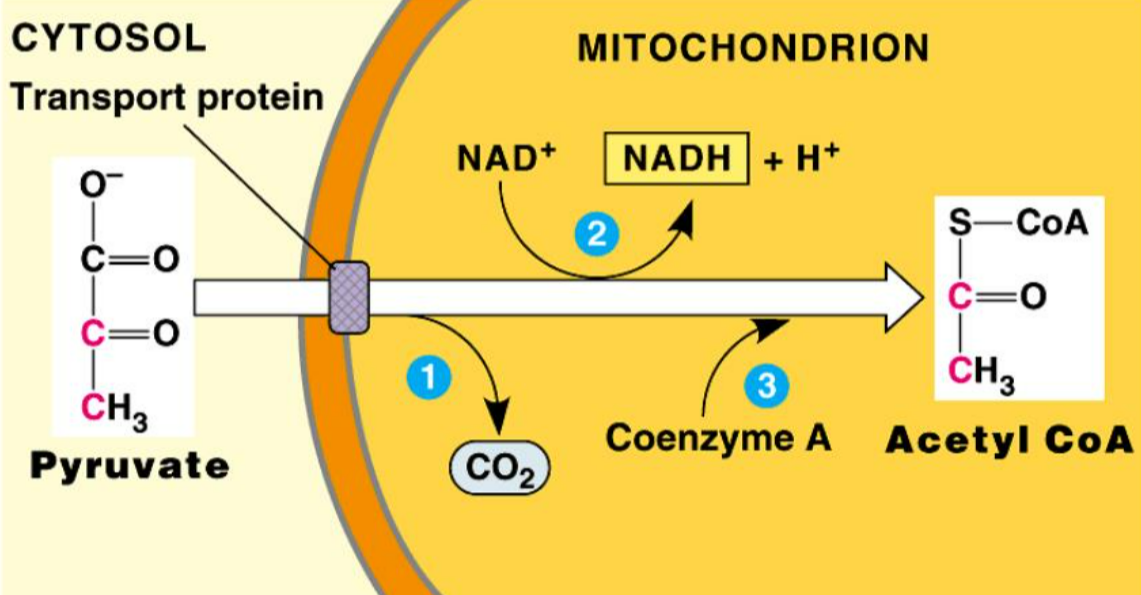 Occur in the mitochondrial matrix, unlike glycolysis in the cytoplasm.
1. Link Reaction
- Purpose: Prepares pyruvate for the Krebs cycle.
- Process: Pyruvate (3C) loses one carbon as CO₂ (decarboxylation). Hydrogen is removed from pyruvate → reduces NAD⁺ to NADH (dehydrogenation). Remaining 2-carbon molecule forms acetyl-CoA, which enters Krebs cycle.
- Key Outputs per pyruvate: 1 CO₂, 1 NADH, 1 acetyl-CoA.
- For 1 glucose (2 pyruvates), double the outputs.
2. Krebs Cycle (Citric Acid Cycle)
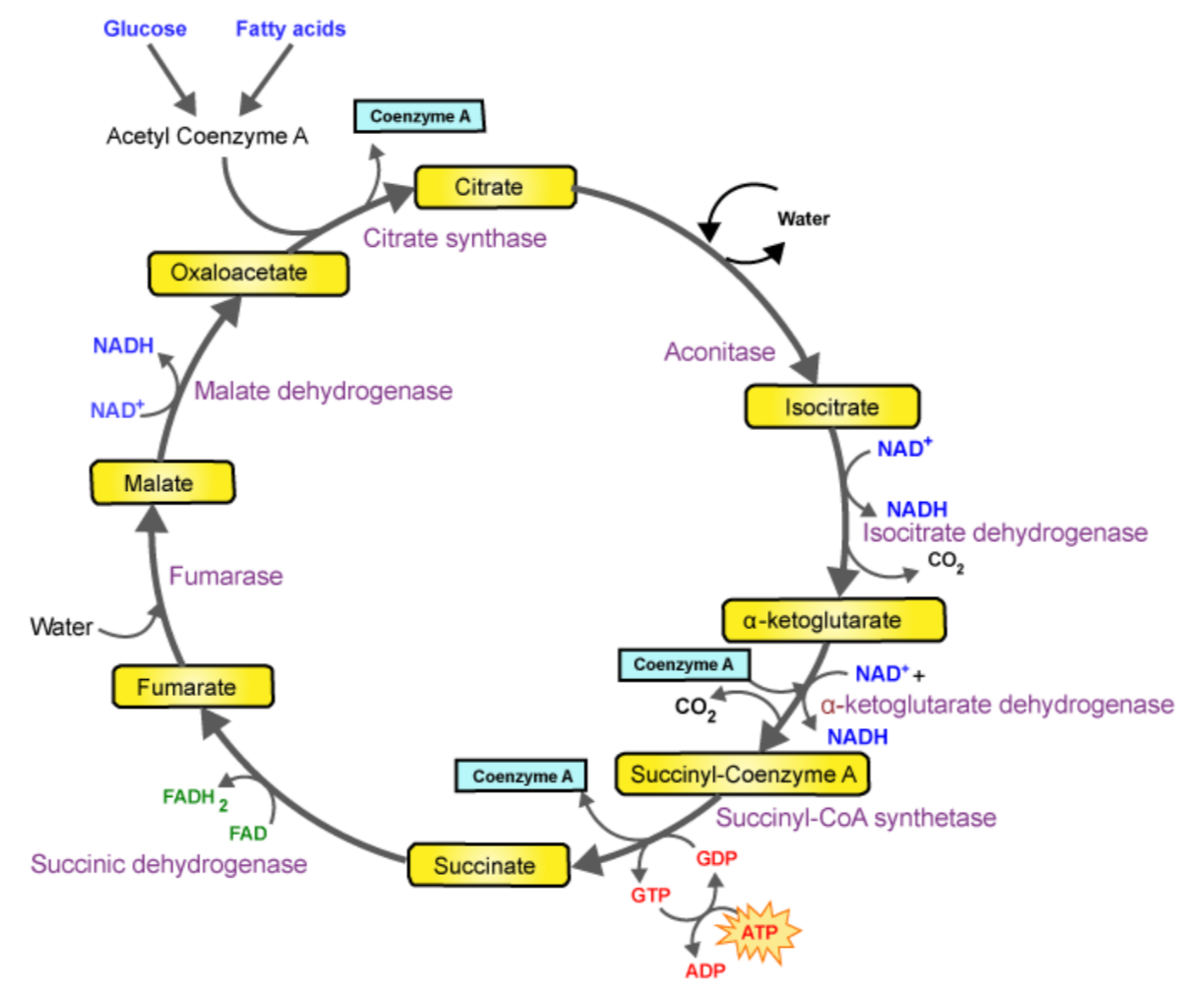
- Purpose: Complete oxidation of acetyl-CoA to CO₂. Generate energy-rich molecules for the electron transport chain.
- Process Overview: Acetyl-CoA enters mitochondrial matrix. Stepwise oxidation occurs. Carbon is released as CO₂ (decarboxylation). Hydrogen is removed → reduces NAD⁺ and FAD to NADH and FADH₂ (dehydrogenation). A small amount of ATP is produced directly (substrate-level phosphorylation).
- Key Outputs per acetyl-CoA: 2 CO₂, 3 NADH, 1 FADH₂, 1 ATP.
- For 1 glucose (2 acetyl-CoA), all outputs are doubled.
🟢 Importance of These Steps
- Complete glucose oxidation: All carbon from pyruvate released as CO₂.
- Energy capture: Reduced NAD and FAD carry electrons to electron transport chain, producing the majority of ATP.
- ATP supply: Substrate-level phosphorylation gives immediate energy.
- Mitochondrial location: Ensures proximity to electron transport chain for oxidative phosphorylation.
📋 Summary Table
| Step | Location | Main Events | Key Outputs (per glucose) |
|---|---|---|---|
| Link reaction | Mitochondrial matrix | Pyruvate → Acetyl-CoA, decarboxylation, dehydrogenation | 2 CO₂, 2 NADH, 2 acetyl-CoA |
| Krebs cycle | Mitochondrial matrix | Acetyl-CoA fully oxidised, decarboxylation, dehydrogenation, ATP formation | 4 CO₂, 6 NADH, 2 FADH₂, 2 ATP |
🧠 Quick Recap
Link reaction: pyruvate → acetyl-CoA + CO₂ + NADH.
Krebs cycle: acetyl-CoA → CO₂ + ATP + NADH + FADH₂.
Both steps are mitochondrial, unlike glycolysis in cytoplasm.
NADH & FADH₂ → carry electrons for oxidative phosphorylation, producing majority of ATP.
Decarboxylation = CO₂ release; dehydrogenation = reduced coenzymes.
Link reaction: pyruvate → acetyl-CoA + CO₂ + NADH.
Krebs cycle: acetyl-CoA → CO₂ + ATP + NADH + FADH₂.
Both steps are mitochondrial, unlike glycolysis in cytoplasm.
NADH & FADH₂ → carry electrons for oxidative phosphorylation, producing majority of ATP.
Decarboxylation = CO₂ release; dehydrogenation = reduced coenzymes.