
ATP Synthesis by Oxidative Phosphorylation
🌱 Introduction
Oxidative phosphorylation is the final and most energy-yielding stage of aerobic respiration. It occurs on the inner mitochondrial membrane, folded into cristae to increase surface area. Reduced coenzymes (NADH and FADH₂) made earlier supply electrons for ATP production. Two components work together: the electron transport chain (ETC) and chemiosmosis.
Reduced Coenzymes Enter the Pathway
- NADH and FADH₂ form during glycolysis, link reaction and Krebs cycle.
- They carry high-energy electrons and hydrogen ions.
- These are delivered to the inner mitochondrial membrane to begin oxidative phosphorylation.
Role of NADH and FADH₂
- NADH donates electrons to the first ETC carrier.
- FADH₂ enters later in the chain, so it produces less ATP.
- Electron movement releases energy used to pump protons.
Electron Transport Chain (ETC)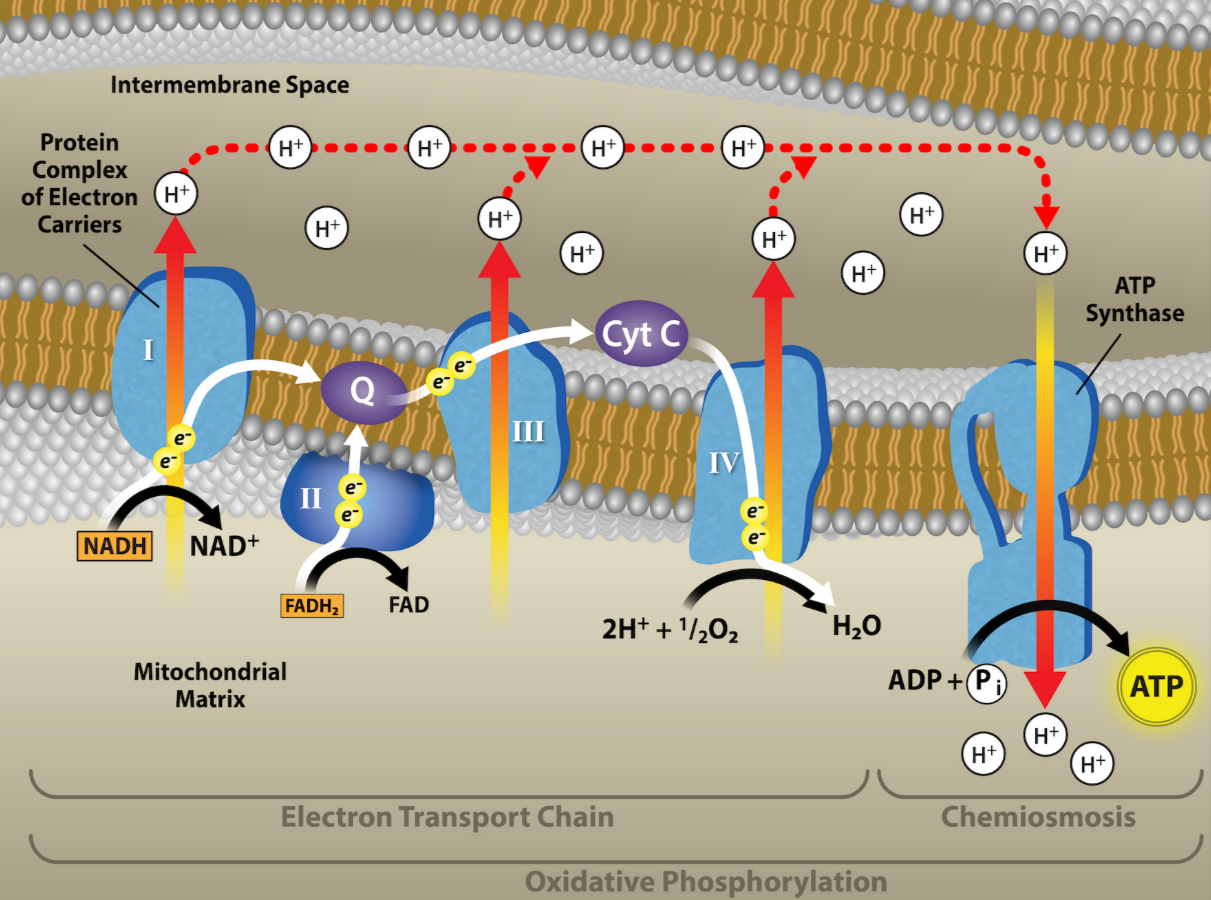
The ETC is a sequence of electron-carrier proteins in the inner membrane.
🔁 Stepwise Electron Transfer
- NADH releases H⁺ and electrons into the matrix.
- Electrons pass through carriers one by one.
- Each transfer releases energy.
- Energy drives proton pumping into the intermembrane space.
🌊 Formation of the Proton Gradient
- Continuous proton pumping raises H⁺ concentration outside the matrix.
- An electrochemical gradient forms: high H⁺ outside, low inside.
- This gradient stores potential energy for ATP production.
Chemiosmosis and ATP Synthase
Chemiosmosis is the flow of protons down their gradient back into the matrix.
⚙️ How ATP Is Formed
- Protons pass through ATP synthase, a membrane enzyme.
- It spins like a turbine as H⁺ flows through.
- ADP + Pi are forced together to make ATP.
- This process is called oxidative phosphorylation.
- NADH gives about 2.5–3 ATP; FADH₂ gives about 1.5–2 ATP.
Oxygen: The Final Electron Acceptor
📌 What Oxygen Does
- Accepts electrons at the end of the ETC.
- Combines with H⁺ to form water.
Formula:
\[ O_2 + 4e^- + 4H^+ \rightarrow 2H_2O \]
Why Oxygen Is Essential
- If oxygen is absent, electrons back up and the ETC stops.
- No proton gradient forms.
- ATP synthesis collapses quickly.
📋 Summary Table
| Process | Location | What Happens | Key Products |
|---|---|---|---|
| ETC | Inner mitochondrial membrane | Electrons move through carriers, pumping H⁺ out | Proton gradient |
| Chemiosmosis | ATP synthase in inner membrane | H⁺ flows back into matrix | ATP |
| Terminal step | Matrix | Oxygen accepts electrons and H⁺ | Water |
| Overall output | Mitochondria | Oxidative phosphorylation | Large ATP yield |
NADH and FADH₂ supply electrons for the ETC.
ETC pumps protons into intermembrane space → gradient builds.
Protons return through ATP synthase → ATP made (chemiosmosis).
Oxygen accepts electrons → water formed.
This stage makes most of the ATP in aerobic respiration.