
Movement in Animals: Muscles, Tendons, Skeleton and Ligaments
🌟 Introduction
Movement happens because the muscles and skeleton work together as one coordinated system. Bones provide structure, muscles create force, and connective tissues keep everything stable.
🧬 1. Muscles
Definition: Soft contractile tissues made of long muscle fibres.
Key idea: Muscles contract and relax but cannot push. They only pull.
Important Points
- Contraction shortens the muscle and pulls the bone.
- Relaxation lengthens the muscle back.
- Muscles work in pairs to produce opposite actions.
- Two special types control joints:
- Flexors: bend the joint
- Extensors: straighten the joint
Example:
At the elbow: biceps (flexor) bends the arm, triceps (extensor) straightens it.
🔗 2. Tendons
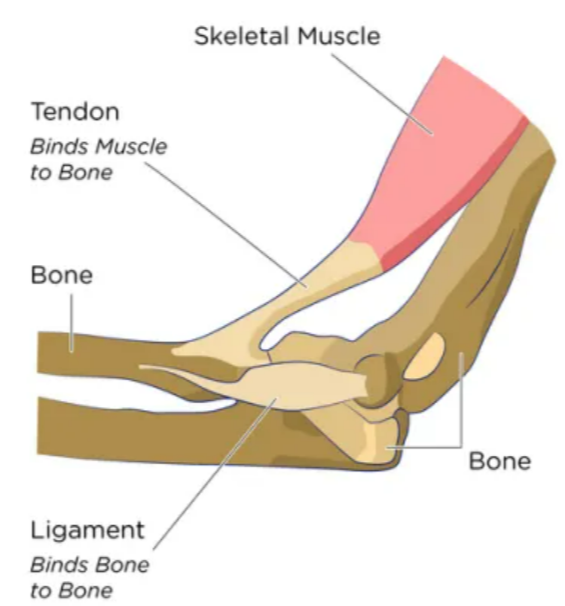
Definition: Tough, fibrous cords attaching muscle to bone.
Key Features
- Non elastic and very strong.
- Transmit the pulling force from muscle to bone.
- Essential for moving bones at a joint.
Memory line: Tendon = ties muscle to bone.
🦴 3. Skeleton
Definition: The body’s framework made of bones.
What It Does
- Supports body shape.
- Protects organs (skull, ribs, spine).
- Provides levers that muscles pull on.
- Joints between bones allow flexibility and movement.
Example:
Elbow joint is a hinge joint used for bending and straightening.
🧷 4. Ligaments
Definition: Strong connective tissue joining bone to bone at joints.
Key Features
- Slightly elastic to allow limited movement.
- Prevent bones from dislocating.
- Keep joints aligned and stable during motion.
Memory line: Ligament = links bones.
🔁 5. Antagonistic Muscle Pairs
Muscles usually work in pairs because one muscle alone can only pull in one direction.
Definition
Two muscles that work opposite to each other at the same joint.
How They Work
- When one contracts, the other relaxes.
- Produces smooth, controlled joint movement.
- Prevents jerky or uncontrolled motion.
✔ Elbow Example
| Action | Flexor | Extensor |
|---|---|---|
| Bending | Biceps contracts | Triceps relaxes |
| Straightening | Triceps contracts | Biceps relaxes |
📌 Summary Table
| Component | Definition | Key Role |
|---|---|---|
| Muscles | Contractile tissues | Pull bones to produce movement |
| Tendons | Muscle to bone connectors | Transfer muscle force |
| Skeleton | Bone framework | Support, protection, lever system |
| Ligaments | Bone to bone connectors | Stabilise joints |
| Flexor | Muscle that bends joint | Example: biceps |
| Extensor | Muscle that straightens joint | Example: triceps |
| Antagonistic pair | Muscles working oppositely | Smooth movement control |
Muscles pull, never push.
Tendons join muscle to bone; ligaments join bone to bone.
Bones act as levers for movement.
Flexors bend a joint, extensors straighten it.
Antagonistic pairs provide smooth, controlled motion.
Classic example: biceps and triceps at the elbow.