
Microarrays and Gene Activity
🌱 Introduction
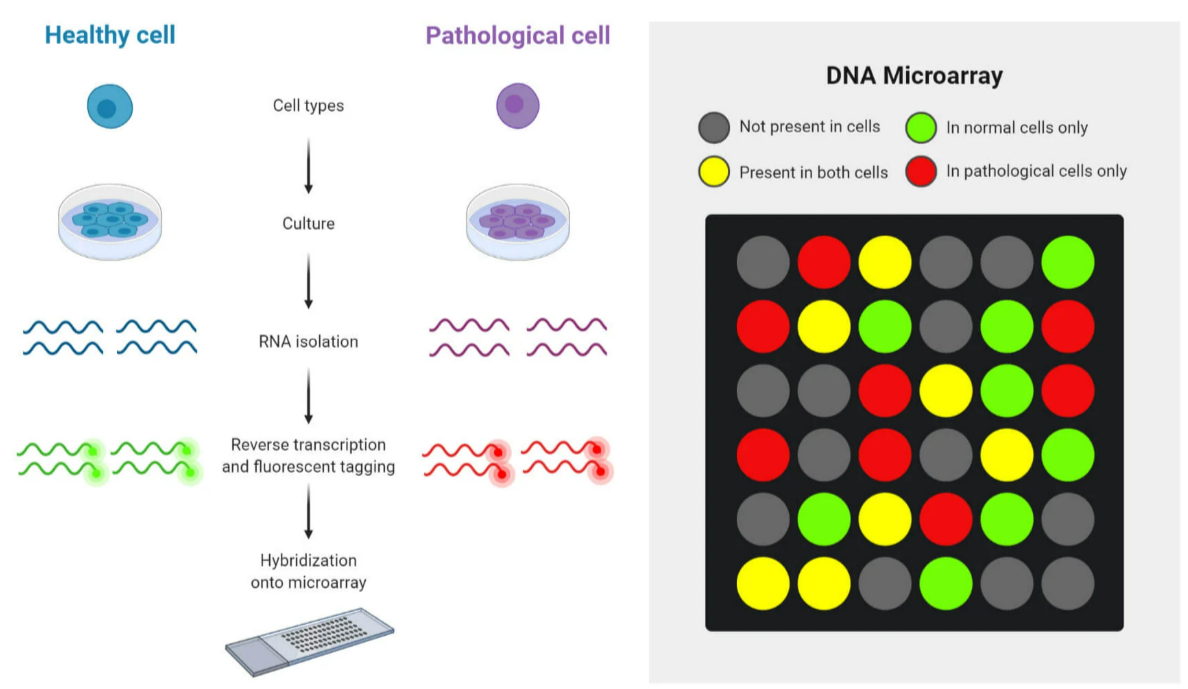
A microarray is a glass slide or chip with thousands of DNA probes fixed in a grid. It is used to detect which genes are active (expressed) in a cell at a particular time. Active genes produce mRNA, which can be measured using microarrays.
How Microarrays Work
1. Sample Preparation
- Extract mRNA from the cells/tissue being studied.
- Convert mRNA into complementary DNA (cDNA) using reverse transcriptase.
- Label cDNA with fluorescent dyes.
2. Hybridisation
- Apply labelled cDNA to the microarray.
- cDNA binds (hybridises) to matching DNA probes on the chip.
3. Detection
- Scan the microarray with a laser.
- Fluorescent spots indicate which genes are active.
- Brightness/intensity reflects level of gene expression.
Key Points
- Microarrays can compare gene activity between healthy vs diseased cells, different stages of development, or cells under different conditions (e.g., stressed vs normal).
- Helps identify genes that are switched on or off, or overexpressed/underexpressed.
Example Uses
- Cancer research: find genes active in tumour cells.
- Drug testing: see which genes respond to treatment.
- Developmental biology: identify genes active in embryos.
📦 Quick Recap
Microarray = DNA chip with thousands of gene probes.
Purpose: identify active genes by detecting mRNA levels.
Steps: mRNA → cDNA → fluorescent label → hybridise → detect fluorescence.
Applications: compare gene expression in healthy vs diseased cells, drug response, developmental studies.
Microarray = DNA chip with thousands of gene probes.
Purpose: identify active genes by detecting mRNA levels.
Steps: mRNA → cDNA → fluorescent label → hybridise → detect fluorescence.
Applications: compare gene expression in healthy vs diseased cells, drug response, developmental studies.