
Spinal Reflex Arc & Spinal Cord Structure
🌱 Introduction
A reflex arc is the simplest pathway for a rapid, automatic response to a stimulus.
It allows quick reactions without the delay of routing impulses through the brain.
The spinal cord contains grey and white matter which are essential for processing and transmitting these impulses.
🔍 1. Structure of a Spinal Reflex Arc
Components (5 Key Parts)
Receptor
- Detects the stimulus (e.g., heat, pressure).
- Converts it into an electrical impulse.
Sensory Neurone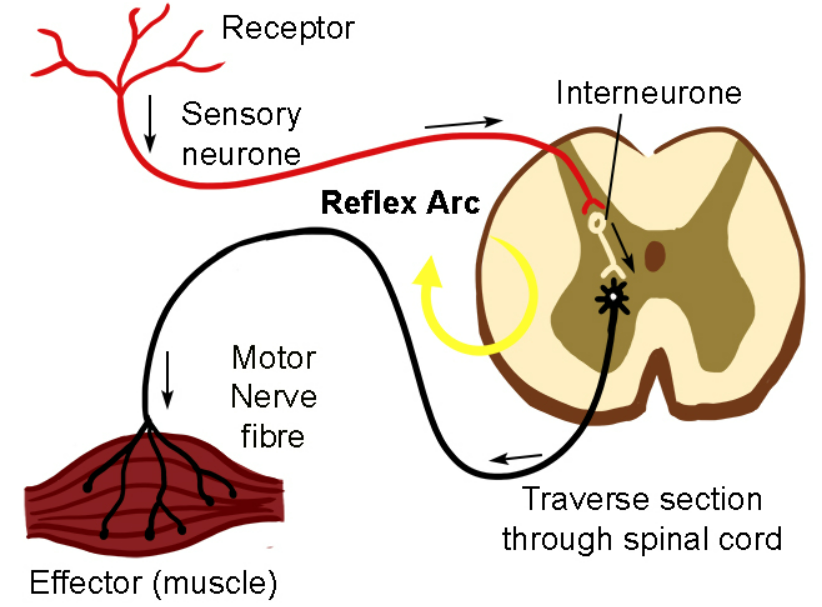
- Carries the impulse from the receptor to the spinal cord.
Relay (Inter) Neurone
- Located in grey matter of the spinal cord.
- Connects sensory neurone to motor neurone.
- Integrates the response.
Motor Neurone
- Carries impulse from spinal cord to the effector.
Effector
- Muscle or gland that carries out the response (muscle contracts, gland secretes).
Tip: Reflex arcs are usually monosynaptic (sensory → motor) or polysynaptic (sensory → relay → motor).
🔍 2. Grey Matter and White Matter of the Spinal Cord
Grey Matter
- Shape: Butterfly or H-shaped in cross-section.
- Contains: Cell bodies of neurones, dendrites, and relay neurones.
- Function: Processes incoming impulses, forms synapses for reflex arcs.
- Location: Centre of spinal cord.
White Matter
- Contains: Myelinated axons of sensory and motor neurones.
- Function: Transmits impulses up and down the spinal cord.
- Location: Surrounds grey matter.
🧩 How a Reflex Works (Example: Knee-Jerk Reflex)
- Tap patellar tendon → stimulus detected by stretch receptor.
- Impulse travels along sensory neurone to spinal cord.
- Monosynaptic reflex: sensory neurone synapses directly with motor neurone.
- Motor neurone stimulates quadriceps → leg kicks.
- Happens without involving the brain → very fast.
📊 Summary Table
| Component | Structure | Function |
|---|---|---|
| Receptor | Sensory ending | Detects stimulus |
| Sensory neurone | Dendron + axon | Carries impulse to spinal cord |
| Relay neurone | Grey matter | Connects sensory → motor |
| Motor neurone | Axon from CNS | Sends impulse to effector |
| Effector | Muscle/gland | Responds to stimulus |
| Grey matter | Cell bodies, dendrites | Processes impulse, site of synapses |
| White matter | Myelinated axons | Carries impulses up/down spinal cord |
📦 Quick Recap
Reflex arc = receptor → sensory → (relay) → motor → effector.
Grey matter: processes impulses, forms synapses.
White matter: transmits impulses along the cord.
Reflexes are fast, automatic responses that protect the body.
Reflex arc = receptor → sensory → (relay) → motor → effector.
Grey matter: processes impulses, forms synapses.
White matter: transmits impulses along the cord.
Reflexes are fast, automatic responses that protect the body.