
Conduction of a Nerve Impulse (Action Potential)
🌱 Introduction
A nerve impulse is an electrical signal transmitted along a neurone.
It is caused by the movement of ions across the neurone membrane and involves rapid depolarisation and repolarisation.
🔍 Key Terms
- Resting potential: ~-70 mV, inside of axon is negative relative to outside.
- Depolarisation: Membrane becomes less negative as sodium enters.
- Repolarisation: Membrane returns to resting potential as potassium exits.
- Threshold potential: Minimum stimulus needed to trigger an action potential (~-55 mV).
🧬 Step-by-Step Conduction Along an Axon
1. Resting Potential
- Sodium-potassium pump maintains high Na⁺ outside, high K⁺ inside.
- Membrane is polarised: inside negative, outside positive.
- Axon is ready to fire.
2. Stimulus and Depolarisation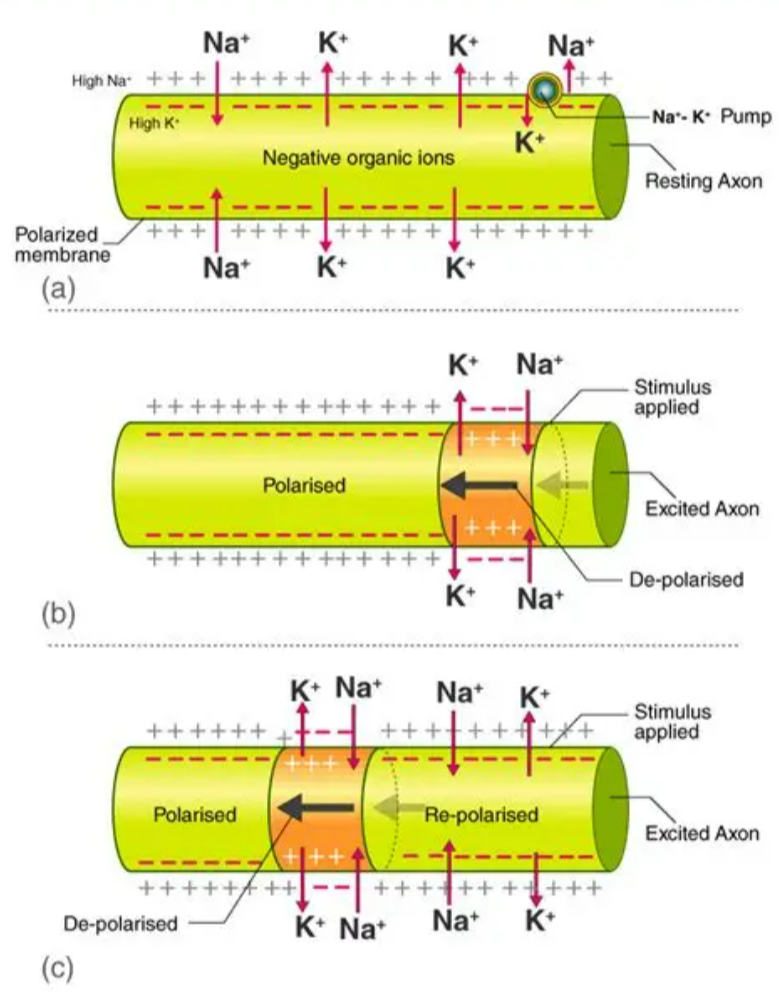
- Stimulus opens sodium channels.
- Sodium ions (Na⁺) rush into the axon.
- Inside becomes less negative → depolarisation.
- If threshold is reached, an action potential is generated.
3. Repolarisation
- Sodium channels close.
- Potassium channels open, K⁺ ions move out of the axon.
- Membrane potential becomes negative again → repolarisation.
4. Hyperpolarisation
- Too many K⁺ ions exit → inside becomes slightly more negative than resting.
- Sodium-potassium pump restores resting potential.
5. Propagation Along the Axon
- Local depolarisation causes adjacent regions of the membrane to depolarise.
- Impulse moves as a wave along the axon.
- In myelinated axons, impulse jumps between nodes of Ranvier → saltatory conduction, faster and more efficient.
📌 Important Points
- Action potential is all-or-nothing: once threshold is reached, full impulse occurs.
- Direction of impulse is from dendrite → axon → axon terminals.
- Myelin sheath increases speed; unmyelinated axons are slower.
- Sodium-potassium pump restores ionic balance after the impulse.
📊 Summary Table
| Stage | Ion Movement | Membrane Potential |
|---|---|---|
| Resting | Na⁺ out, K⁺ in (via pump) | -70 mV |
| Depolarisation | Na⁺ in | Positive inside |
| Repolarisation | K⁺ out | Returns negative |
| Hyperpolarisation | K⁺ continues out | Slightly more negative |
| Return to rest | Na⁺/K⁺ pump restores | -70 mV |
📦 Quick Recap
Impulse = wave of depolarisation along axon.
Na⁺ enters → depolarisation, K⁺ exits → repolarisation.
Threshold must be reached for action potential.
All-or-nothing principle: full impulse once triggered.
Myelin + nodes of Ranvier → faster conduction.
Impulse = wave of depolarisation along axon.
Na⁺ enters → depolarisation, K⁺ exits → repolarisation.
Threshold must be reached for action potential.
All-or-nothing principle: full impulse once triggered.
Myelin + nodes of Ranvier → faster conduction.