
Role of Myelination in Saltatory Conduction
🌱 Introduction
Myelin is a fatty sheath produced by Schwann cells around axons in the PNS (or oligodendrocytes in CNS).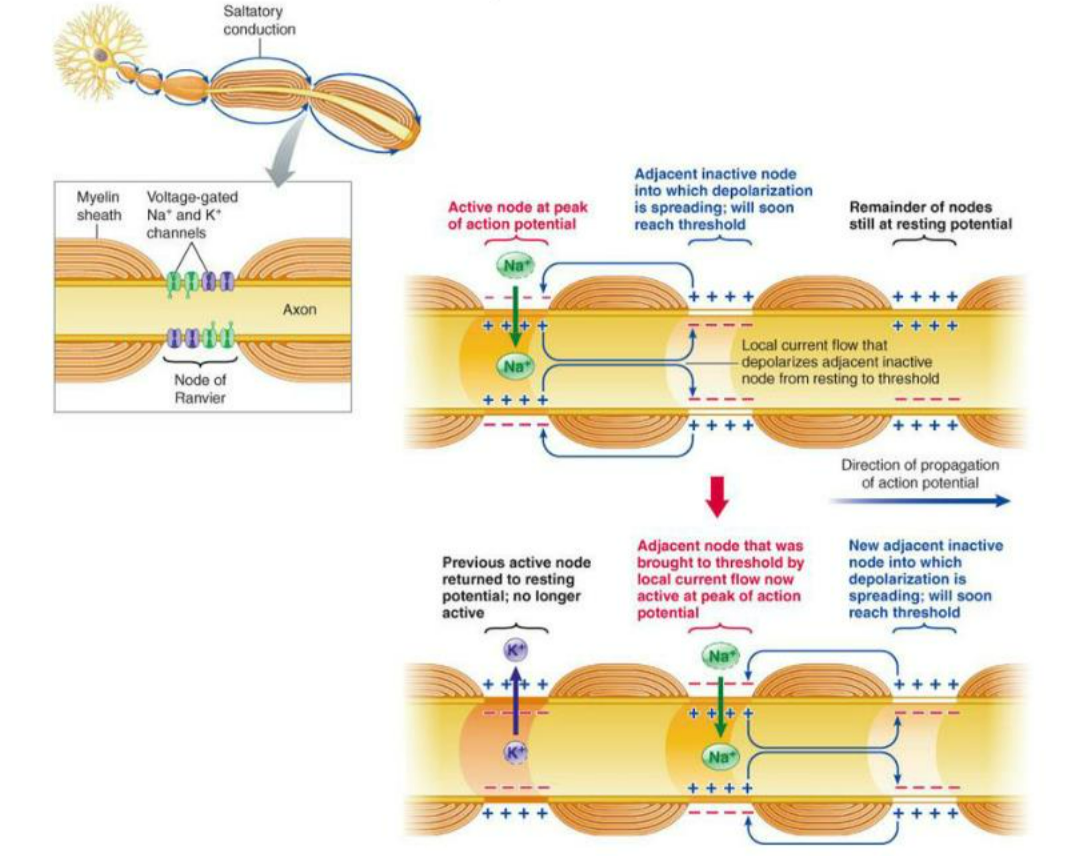 It insulates the axon and allows impulses to travel faster and more efficiently.
🔍 Key Features
1. Structure
- Axon is wrapped in layers of myelin.
- Nodes of Ranvier: small gaps between myelin segments.
- Axon membrane exposed only at nodes.
2. How Saltatory Conduction Works
- Action potential occurs only at the nodes.
- Depolarisation jumps from one node to the next instead of moving continuously.
- Reduces the number of times ions cross the membrane → faster impulse.
3. Advantages of Myelination
- Speeds up conduction: impulses travel much faster than in unmyelinated axons.
- Energy efficient: fewer ions moved → less ATP used by sodium-potassium pumps.
- Prevents signal loss: insulation keeps the impulse strong over long distances.
📌 Summary Table
| Feature | Myelinated Axon | Unmyelinated Axon |
|---|---|---|
| Conduction type | Saltatory | Continuous |
| Speed | Fast (100 m/s approx.) | Slow (1–10 m/s) |
| Energy use | Low | High |
| Signal strength | Maintained | Can weaken over distance |
📦 Quick Recap
Myelin = fatty insulation around axon.
Nodes of Ranvier = gaps where depolarisation occurs.
Saltatory conduction = impulse jumps node to node → faster + energy-efficient.
Myelination allows rapid, strong, and efficient nerve signalling.
Myelin = fatty insulation around axon.
Nodes of Ranvier = gaps where depolarisation occurs.
Saltatory conduction = impulse jumps node to node → faster + energy-efficient.
Myelination allows rapid, strong, and efficient nerve signalling.