Home / Edexcel A Level / A Level (IAL) Biology(YBI11) / 8.9 Habituation- Study Notes

Edexcel A Level (IAL) Biology -8.9 Habituation- Study Notes- New Syllabus

Edexcel A Level (IAL) Biology -8.9 Habituation- Study Notes- New syllabus

Edexcel A Level (IAL) Biology -8.9 Habituation- Study Notes -Edexcel A level Biology – per latest Syllabus.

Key Concepts:

  • 8.9 understand what is meant by the term habituation

Edexcel A level Biology-Study Notes- All Topics

Habituation

🌱 Introduction

Habituation is a basic form of non-associative learning. It occurs when an organism reduces or stops its response to a repeated, harmless stimulus over time.

  • Helps organisms ignore irrelevant stimuli.
  • Prevents wasting energy on unimportant events.
  • Observed in both simple (invertebrates) and complex (vertebrates) animals.

🔍 Key Features of Habituation

  • Stimulus-specific: Response decreases only to the repeated stimulus; other new stimuli still produce a reaction.
  • Reversible: Response can return if stimulus stops for a while (spontaneous recovery).
  • Not fatigue: Habituation is a learning process, not due to tired muscles or neurons.
  • Energy-saving mechanism: Allows focus on important stimuli indicating danger or opportunity.

🔹 Examples

OrganismExample of Habituation
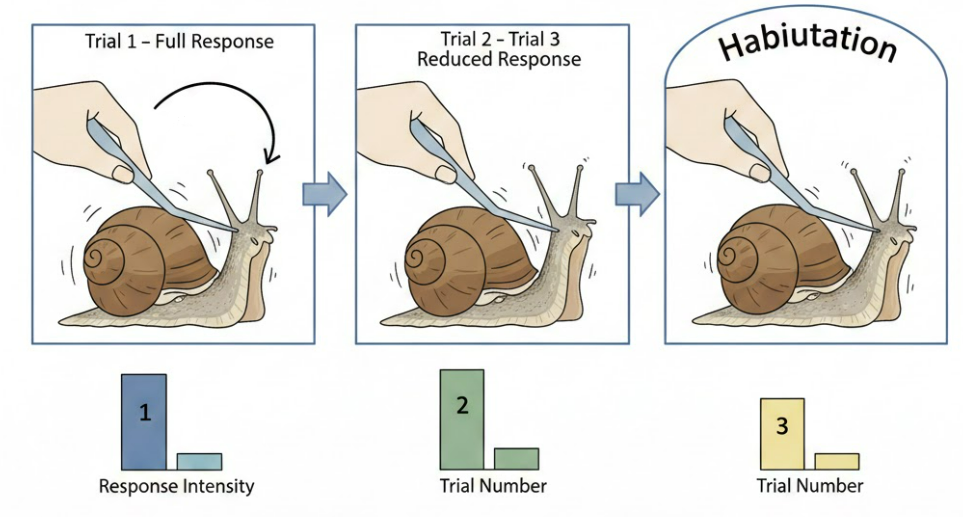
SnailStops retracting into shell after repeated harmless touches
HumansIgnore constant background noises (e.g., ticking clock)
FishStops fleeing from a harmless repeated stimulus in a tank
Sea slug (Aplysia)Reduced gill withdrawal after repeated harmless touch

🔹 Mechanism

Repeated harmless stimulus → less neurotransmitter released at the synapse → smaller response in post-synaptic neurone → reduced action potential → weaker or no response.

📦 Quick Recap
Habituation = learning to ignore repeated harmless stimuli.
Key points: stimulus-specific, reversible, not due to fatigue.
Purpose: conserve energy and focus on important events.
Example: snail stops retracting after repeated harmless touches; humans ignore constant background noise.

Investigating Habituation to a Stimulus

🌱 Introduction

Habituation is a simple form of learning where an organism reduces its response to a repeated harmless stimulus. This practical demonstrates how organisms learn to ignore repeated stimuli.

🔍 Aim

To investigate habituation in response to a repeated stimulus.

⚙️ Materials Needed
  • Small animal (e.g., snail, fish, or earthworm)
  • Tweezers or soft brush (for tactile stimulus)
  • Timer or stopwatch
  • Observation sheet

🔹 Method (Step-by-Step)

  1. Place the organism in a quiet environment and allow it to acclimatise.
  2. Apply a harmless stimulus (e.g., touch the snail’s shell or fish’s tail) at regular intervals.
  3. Observe and record the organism’s response (e.g., retraction, movement, or escape behaviour).
  4. Repeat the stimulus several times at fixed intervals (e.g., every 30 seconds).
  5. Note if the response becomes weaker or stops over repeated trials.
  6. Record time taken for the response to disappear or reduce significantly.

🔹 Observations

Trial NumberStimulus AppliedResponse ObservedNotes
1TouchFull retractionInitial response
2TouchSlight retractionResponse reduced
3TouchMinimal retractionHabituation begins

🔹 Conclusion

A reduction in response with repeated harmless stimuli indicates habituation. This confirms the organism can learn to ignore irrelevant stimuli, conserving energy.

📌 Key Points

Stimulus-specific: other stimuli still cause response
Reversible: response can return after some time without stimulus (spontaneous recovery)
Not due to fatigue: organism can still respond to a new stimulus

Scroll to Top