
1.2 The Mole and the Avogadro Constant
In chemistry, we often need to count extremely large numbers of atoms, molecules, or ions. Because these particles are extremely small, chemists use a special unit called the mole to measure the amount of a substance.
Mole
The mole (mol) is the SI unit used to measure the amount of substance.
One mole of any substance contains a fixed number of particles (atoms, molecules, ions, or electrons).
Avogadro Constant
The Avogadro constant \( L \) is the number of particles in one mole of a substance.
\( L = 6.02 \times 10^{23} \; \mathrm{mol^{-1}} \)
This means that one mole of any substance contains \( 6.02 \times 10^{23} \) particles.
Examples
- 1 mol of carbon atoms contains \( 6.02 \times 10^{23} \) carbon atoms.
- 1 mol of water molecules contains \( 6.02 \times 10^{23} \) molecules.
- 1 mol of sodium ions contains \( 6.02 \times 10^{23} \) ions.
Relationship Between Moles and Number of Particles
The number of particles in a substance can be calculated using the Avogadro constant.
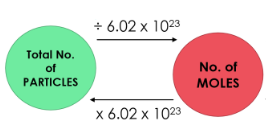
Number of particles = number of moles \( \times \) Avogadro constant
\( N = nL \)
Where:
- \( N \) = number of particles
- \( n \) = number of moles
- \( L = 6.02 \times 10^{23} \mathrm{mol^{-1}} \)
Example 1
How many atoms are present in \( 2.0 \) mol of helium?
▶️ Answer/Explanation
Use the relationship
\( N = nL \)
Substitute the values:
\( N = 2.0 \times 6.02 \times 10^{23} \)
\( N = 1.204 \times 10^{24} \)
Therefore, there are \( 1.204 \times 10^{24} \) helium atoms.
Example 2
A sample contains \( 3.01 \times 10^{23} \) molecules of oxygen. Calculate the number of moles present.
▶️ Answer/Explanation
Use the relationship
\( n = \dfrac{N}{L} \)
Substitute the values:
\( n = \dfrac{3.01 \times 10^{23}}{6.02 \times 10^{23}} \)
\( n = 0.50 \; \mathrm{mol} \)
Therefore, the sample contains \( 0.50 \) mol of oxygen molecules.