
1.6 Empirical and Molecular Formulae from Experimental Data
Experimental data such as masses or percentages of elements can be used to determine the empirical formula and molecular formula of a compound.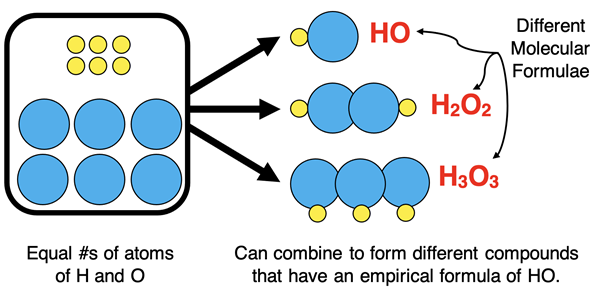
Empirical Formula
The empirical formula shows the simplest whole-number ratio of atoms of each element in a compound.
It is determined using experimental data such as the masses of elements in a compound.
Steps for Calculating an Empirical Formula
- Convert masses of each element to moles.
- Divide each value by the smallest number of moles.
- Simplify the ratio to the smallest whole numbers.
Molecular Formula
The molecular formula shows the actual number of atoms of each element present in a molecule.
It can be determined from the empirical formula if the molar mass of the compound is known.
The relationship between empirical and molecular formulae is:
\( \text{Molecular formula} = (\text{Empirical formula}) \times n \)
\( n = \dfrac{\text{molar mass}}{\text{empirical formula mass}} \)
Example 1
A compound contains \( 2.4\ \mathrm{g} \) of carbon and \( 0.4\ \mathrm{g} \) of hydrogen. Determine the empirical formula of the compound.
▶️ Answer/Explanation
Step 1: Convert masses to moles
\( n(C) = \dfrac{2.4}{12} = 0.20 \)
\( n(H) = \dfrac{0.4}{1} = 0.40 \)
Step 2: Divide by the smallest value
C : H = \( 0.20 : 0.40 \)
C : H = \( 1 : 2 \)
Therefore the empirical formula is
\( \mathrm{CH_2} \)
Example 2
A compound has an empirical formula \( \mathrm{CH_2O} \) and a molar mass of \( 180\ \mathrm{g\ mol^{-1}} \). Determine the molecular formula.
▶️ Answer/Explanation
Step 1: Calculate empirical formula mass
\( M_r = 12 + 2(1) + 16 = 30 \)
Step 2: Calculate multiplier
\( n = \dfrac{180}{30} = 6 \)
Step 3: Multiply empirical formula
\( (\mathrm{CH_2O}) \times 6 \)
\( \mathrm{C_6H_{12}O_6} \)
Therefore the molecular formula is \( \mathrm{C_6H_{12}O_6} \).