
2.12 Shapes of s and p Orbitals
Orbitals are regions of space around the nucleus where there is a high probability of finding an electron. These are not fixed paths, but probability distributions that describe where an electron is most likely to be located.
The shape of an orbital is important because it determines how atoms interact, overlap, and form chemical bonds. The two most important types of orbitals at this level are s orbitals and p orbitals.
s Orbitals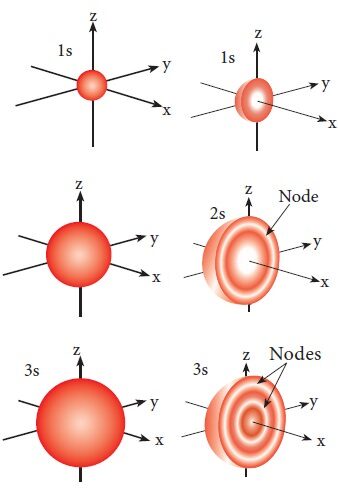
s orbitals are spherical in shape, meaning the electron density is distributed equally in all directions around the nucleus.
This spherical symmetry means that the probability of finding an electron depends only on the distance from the nucleus, not the direction.
There is only one s orbital per energy level (shell), for example:
1s, 2s, 3s, etc.
Each s orbital can hold a maximum of two electrons, which must have opposite spins.
As the principal energy level increases, the s orbital becomes larger and more diffuse:
Electrons in higher s orbitals (e.g. 3s) are, on average, further from the nucleus than those in lower orbitals (e.g. 1s).
In addition, higher s orbitals may contain regions called nodes, where the probability of finding an electron is zero.
p Orbitals
p orbitals have a dumbbell shape, consisting of two regions (lobes) of electron density on opposite sides of the nucleus.
The nucleus lies at the centre between the two lobes, and there is a region of zero electron density at the nucleus called a nodal plane.
There are three p orbitals in each p sub-shell, each oriented in a different direction in space:
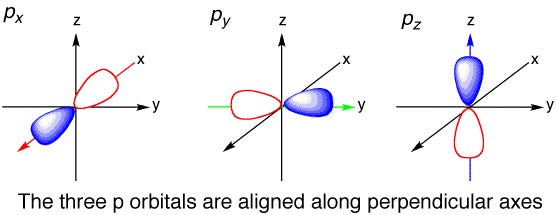
\( p_x \), \( p_y \), and \( p_z \)
These orbitals are arranged at right angles (90°) to each other along the three axes.
Each p orbital can hold a maximum of two electrons, so the entire p sub-shell can hold up to six electrons.
Unlike s orbitals, p orbitals are directional, meaning their orientation in space is important in determining how atoms bond.
Comparison of s and p Orbitals
The differences between s and p orbitals arise from their shapes, orientations, and energies.
- s orbitals are spherical and non-directional, while p orbitals are dumbbell-shaped and directional.
- There is only one s orbital per shell, but three p orbitals per sub-shell.
- s orbitals are lower in energy than p orbitals in the same shell, meaning electrons in s orbitals are more strongly attracted to the nucleus.
- p orbitals contain a nodal plane through the nucleus, whereas s orbitals have spherical symmetry (though higher s orbitals may have radial nodes).
Example 1:
Explain why p orbitals are described as directional whereas s orbitals are not.
▶️ Answer/Explanation
p orbitals have two distinct lobes aligned along specific axes (x, y, or z), meaning the electron density is concentrated in particular directions in space.
This gives p orbitals a defined orientation, making them directional.
In contrast, s orbitals are spherical, with electron density evenly distributed in all directions.
Therefore, s orbitals have no specific direction and are non-directional.
Example 2:
An atom has electrons in both 2s and 2p orbitals.
Explain how the shapes and energies of these orbitals affect:
(a) the distance of electrons from the nucleus (b) the ease of removing an electron
▶️ Answer/Explanation
(a)
The 2s orbital is spherical and has electron density closer to the nucleus, while the 2p orbitals extend further out in space.
Therefore, electrons in 2p orbitals are, on average, further from the nucleus than those in 2s orbitals.
(b)
Because 2p electrons are further from the nucleus and slightly more shielded, they experience weaker attraction.
As a result, electrons in 2p orbitals are easier to remove than electrons in 2s orbitals.