
4.17 (i) Reaction of Alkanes with Oxygen (Combustion)
Alkanes react with oxygen in the air in a process called combustion. This is an important reaction because it releases energy, making alkanes useful as fuels.
Complete Combustion 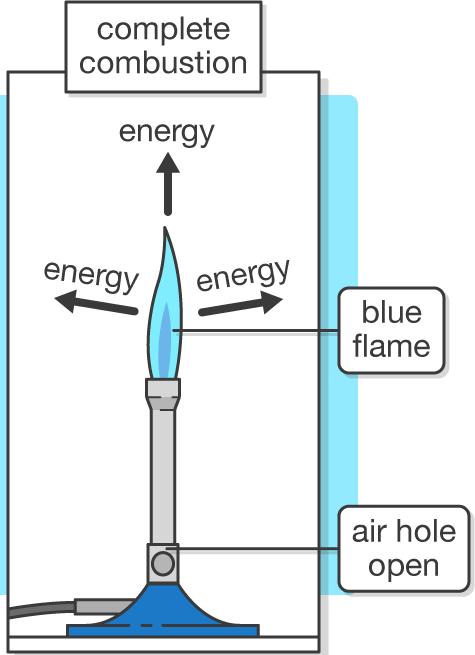
Complete combustion occurs when there is an excess supply of oxygen.
General equation:
\( \mathrm{C_{n}H_{2n+2} + O_2 \rightarrow CO_2 + H_2O} \)
Example
- \( \mathrm{CH_4 + 2O_2 \rightarrow CO_2 + 2H_2O} \)
- Produces carbon dioxide and water only.
- Releases a large amount of energy (exothermic).
- Blue flame is usually observed.
Therefore, complete combustion is efficient and produces minimal pollution.
Incomplete Combustion
Incomplete combustion occurs when there is a limited supply of oxygen.
Products Formed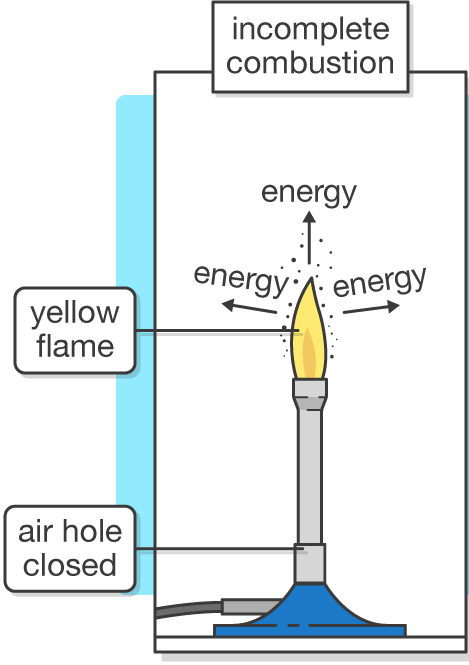
- Carbon monoxide (\( \mathrm{CO} \))
- Carbon (soot)
- Water (\( \mathrm{H_2O} \))
Examples
- \( \mathrm{2CH_4 + 3O_2 \rightarrow 2CO + 4H_2O} \)
- \( \mathrm{CH_4 + O_2 \rightarrow C + 2H_2O} \)
- Produces less energy than complete combustion.
- Yellow/orange smoky flame observed.
- Produces harmful pollutants (CO and soot).
Therefore, incomplete combustion is inefficient and environmentally harmful.
Energy Changes
Combustion reactions are exothermic, meaning they release heat energy.
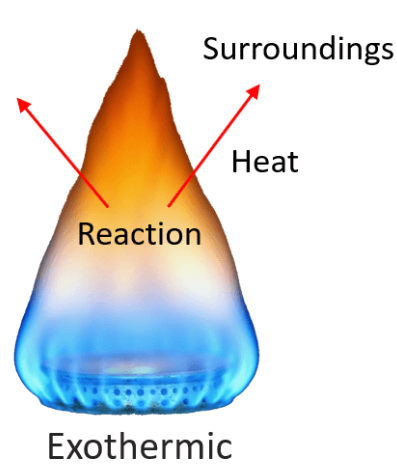
- Energy is released when new bonds (C=O and O–H) form.
- More energy is released than is required to break bonds in reactants.
Key Exam Points
- Excess oxygen → complete combustion → \( \mathrm{CO_2 + H_2O} \).
- Limited oxygen → incomplete combustion → \( \mathrm{CO} \), \( \mathrm{C} \), \( \mathrm{H_2O} \).
- Combustion is always exothermic.
- Incomplete combustion produces pollutants.
Summary
- Alkanes react with oxygen to release energy.
- Complete combustion forms \( \mathrm{CO_2} \) and \( \mathrm{H_2O} \).
- Incomplete combustion forms CO and soot.
- Reaction is exothermic and important for fuels.
Therefore, combustion of alkanes is a key reaction that provides energy but can also produce harmful pollutants if incomplete.
Example 1:
Write a balanced equation for the complete combustion of propane.
▶️ Answer/Explanation
\( \mathrm{C_3H_8 + 5O_2 \rightarrow 3CO_2 + 4H_2O} \)
Example 2:
Explain why incomplete combustion produces a yellow flame.
▶️ Answer/Explanation
Incomplete combustion produces carbon particles (soot).
These particles glow when heated.
This produces a yellow/orange flame.
4.17 (ii) Reaction of Alkanes with Halogens
Alkanes react with halogens (such as \( \mathrm{Cl_2} \) and \( \mathrm{Br_2} \)) in a reaction known as free radical substitution. This is an important reaction because it forms haloalkanes.
General Reaction
\( \mathrm{RH + X_2 \rightarrow RX + HX} \)
- \( \mathrm{R} \) = alkyl group
- \( \mathrm{X_2} \) = halogen (e.g. \( \mathrm{Cl_2} \), \( \mathrm{Br_2} \))
Example
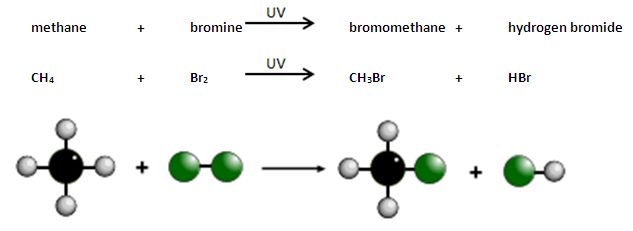
Conditions
- Requires UV light or sunlight.
- Provides energy for homolytic bond fission.
Mechanism: Free Radical Substitution
1. Initiation Step
Formation of free radicals by homolytic fission:
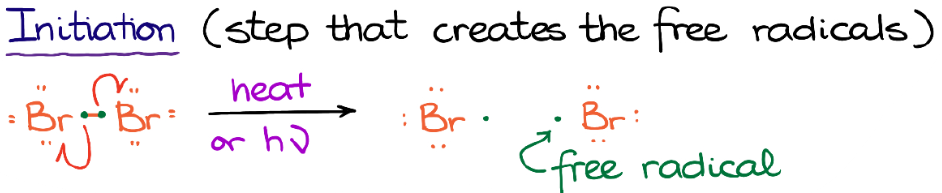
\( \mathrm{Cl_2 \rightarrow 2Cl\cdot} \)
- UV light breaks the \( \mathrm{Cl–Cl} \) bond.
- Two chlorine radicals are formed.
2. Propagation Steps
Radicals react to form products and new radicals:
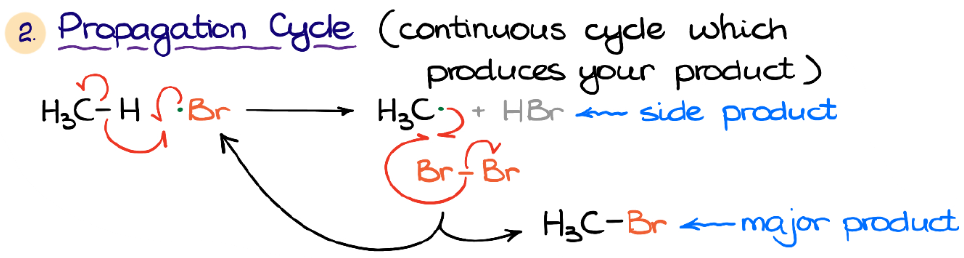
\( \mathrm{Cl\cdot + CH_4 \rightarrow HCl + CH_3\cdot} \)
\( \mathrm{CH_3\cdot + Cl_2 \rightarrow CH_3Cl + Cl\cdot} \)
- Radicals are continuously regenerated.
- This creates a chain reaction.
3. Termination Steps
Radicals combine to form stable molecules:

\( \mathrm{Cl\cdot + Cl\cdot \rightarrow Cl_2} \)
\( \mathrm{CH_3\cdot + Cl\cdot \rightarrow CH_3Cl} \)
\( \mathrm{CH_3\cdot + CH_3\cdot \rightarrow C_2H_6} \)
- Removes radicals from the system.
- Reaction eventually stops.
Further Substitution
- Reaction can continue beyond first substitution.
- Multiple hydrogen atoms can be replaced:
\( \mathrm{CH_3Cl \rightarrow CH_2Cl_2 \rightarrow CHCl_3 \rightarrow CCl_4} \)
Therefore, a mixture of products is often formed.
Key Exam Points
- Reaction type: free radical substitution.
- Requires UV light.
- Involves initiation, propagation, termination.
- Produces a mixture of substituted products.
Therefore, halogenation of alkanes is an important reaction but gives mixtures due to multiple substitutions.
Example 1:
Write the propagation steps for the chlorination of methane.
▶️ Answer/Explanation
\( \mathrm{Cl\cdot + CH_4 \rightarrow HCl + CH_3\cdot} \)
\( \mathrm{CH_3\cdot + Cl_2 \rightarrow CH_3Cl + Cl\cdot} \)
Example 2:
Explain why a mixture of products is formed during halogenation of alkanes.
▶️ Answer/Explanation
After one substitution, the product can undergo further substitution.
Different hydrogen atoms can be replaced.
Therefore, multiple products are formed.