
8.27 (i) Reaction of Solid Group 1 Halides with Concentrated Sulfuric Acid
These reactions show the trend in reducing ability of hydrogen halides (\( \mathrm{HX} \)) down Group 7.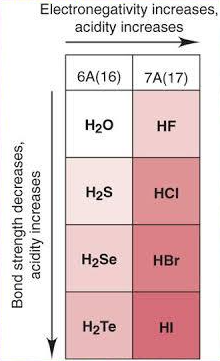
Key Trend
- Reducing ability increases down the group:
\( \mathrm{HF < HCl < HBr < HI} \)
- Due to weaker H–X bond → easier to lose electrons.
(A) Chloride (e.g. NaCl)
Reaction (Acid–Base Only)
\( \mathrm{NaCl + H_2SO_4 \rightarrow NaHSO_4 + HCl} \)
Observation
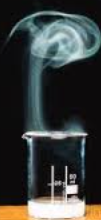
- Steamy white fumes of \( \mathrm{HCl} \)
Key Point
- No redox reaction (Cl⁻ is a weak reducing agent)
(B) Bromide (e.g. NaBr)
Step 1 (Acid–Base)
\( \mathrm{NaBr + H_2SO_4 \rightarrow NaHSO_4 + HBr} \)
Step 2 (Redox)
\( \mathrm{2HBr + H_2SO_4 \rightarrow Br_2 + SO_2 + 2H_2O} \)
Observations
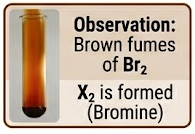
- Brown fumes of \( \mathrm{Br_2} \)
- Colourless \( \mathrm{SO_2} \) gas
Key Point
- Bromide is a stronger reducing agent → reduces \( \mathrm{H_2SO_4} \)
(C) Iodide (e.g. NaI)
Step 1 (Acid–Base)
\( \mathrm{NaI + H_2SO_4 \rightarrow NaHSO_4 + HI} \)
Further Redox Reactions
- \( \mathrm{2HI + H_2SO_4 \rightarrow I_2 + SO_2 + 2H_2O} \)
- \( \mathrm{6HI + H_2SO_4 \rightarrow 3I_2 + S + 4H_2O} \)
- \( \mathrm{8HI + H_2SO_4 \rightarrow 4I_2 + H_2S + 4H_2O} \)
Observations
- Purple iodine vapour (\( \mathrm{I_2} \))
- Yellow sulfur solid (\( \mathrm{S} \))
- Rotten egg smell (\( \mathrm{H_2S} \))
Key Point
- Iodide is the strongest reducing agent
- Reduces sulfur from +6 to +4, 0, and −2
Summary Table
| Halide | Reaction Type | Products |
|---|---|---|
| \( \mathrm{Cl^-} \) | Acid–base only | \( \mathrm{HCl} \) |
| \( \mathrm{Br^-} \) | Some redox | \( \mathrm{Br_2, SO_2} \) |
| \( \mathrm{I^-} \) | Extensive redox | \( \mathrm{I_2, SO_2, S, H_2S} \) |
Summary
- Reducing ability increases down Group 7.
- Chloride → no redox, bromide → partial, iodide → extensive redox.
- Shows increasing ease of electron donation.
Therefore, reactions with sulfuric acid clearly demonstrate the trend in reducing power of halides.
Example :
Explain why iodide ions produce more products than bromide ions when reacting with concentrated sulfuric acid.
▶️ Answer/Explanation
Iodide ions are stronger reducing agents than bromide ions.
They donate electrons more readily.
Therefore, they reduce sulfuric acid further.
This produces a wider range of products (SO\(_2\), S, H\(_2\)S).
8.27 (ii) Test for Halide Ions using Silver Nitrate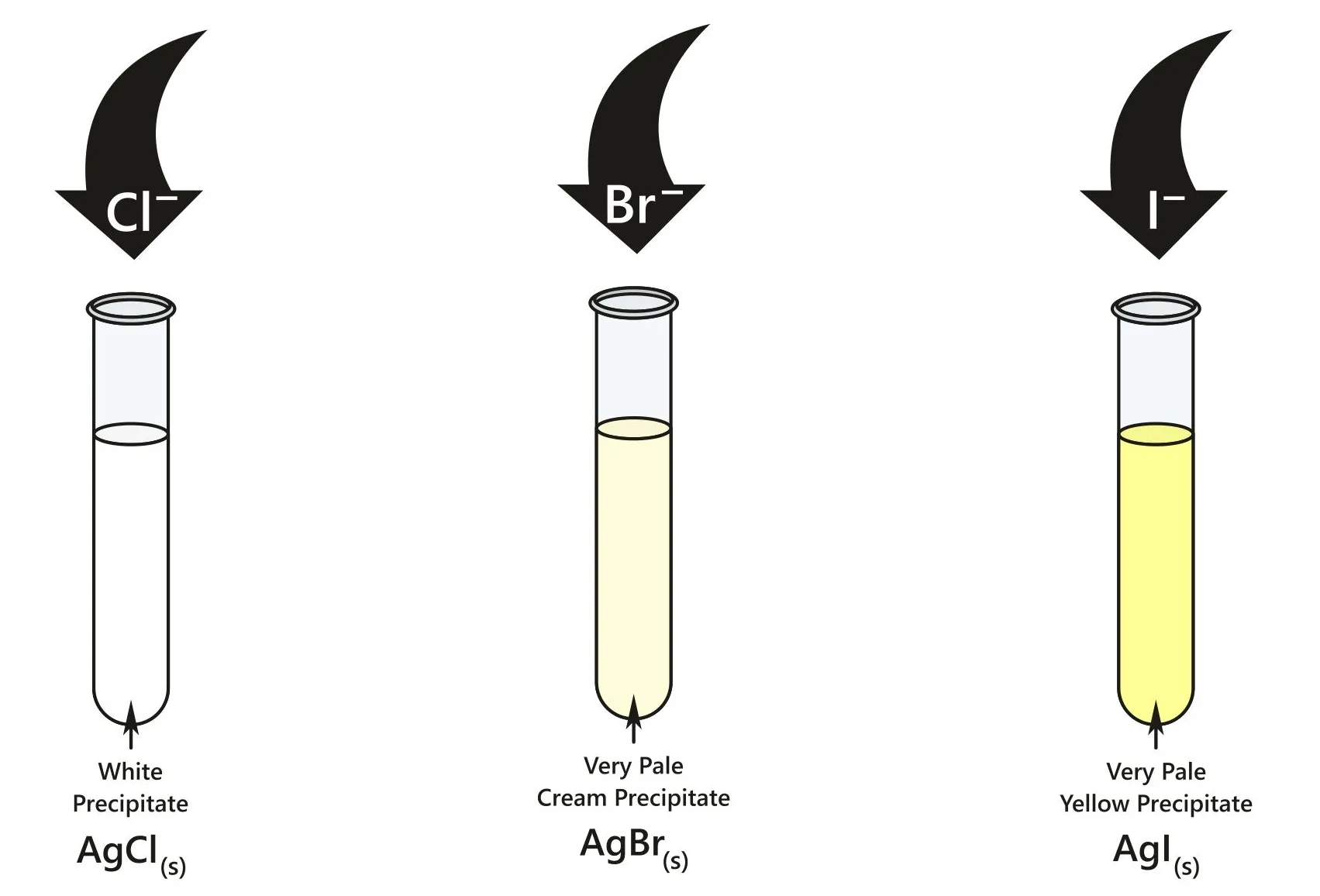
Halide ions (\( \mathrm{Cl^- , Br^- , I^-} \)) are identified using aqueous silver nitrate after acidifying with nitric acid.
(A) Why Nitric Acid is Used
- Removes interfering ions such as \( \mathrm{CO_3^{2-}} \)
- Prevents formation of other precipitates (e.g. \( \mathrm{Ag_2CO_3} \))
- Ensures test is specific for halides
(B) Precipitation Reactions
General Equation
\( \mathrm{Ag^+ + X^- \rightarrow AgX(s)} \)
Observations
| Ion | Precipitate | Colour |
|---|---|---|
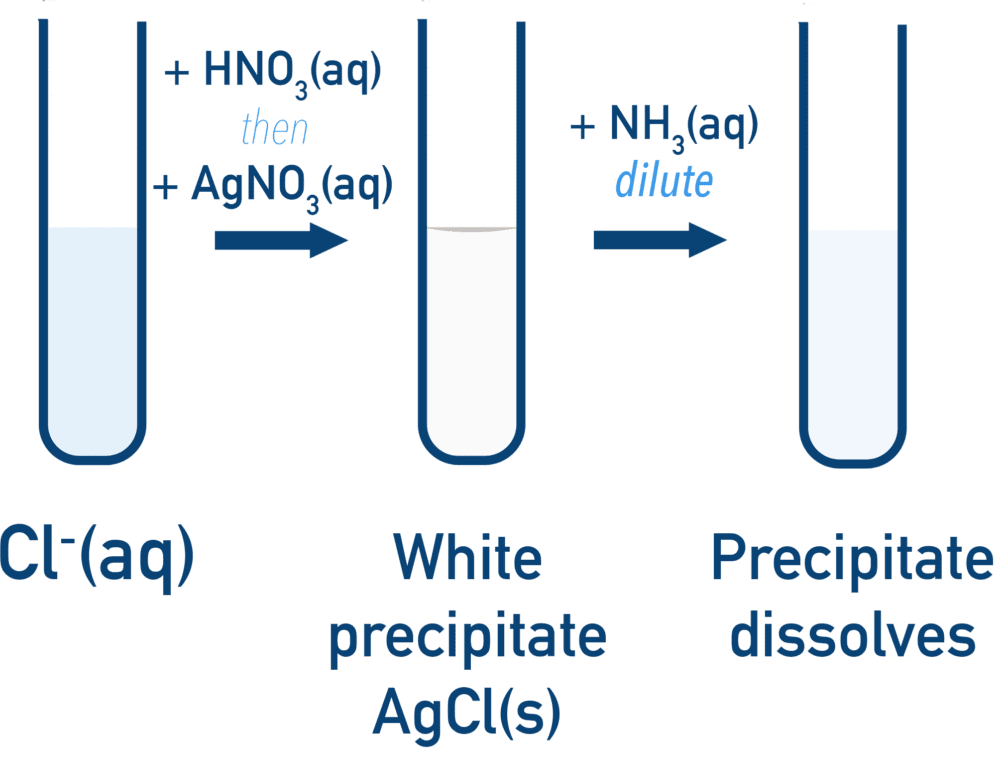
| \( \mathrm{Cl^-} \) | \( \mathrm{AgCl} \) | White |
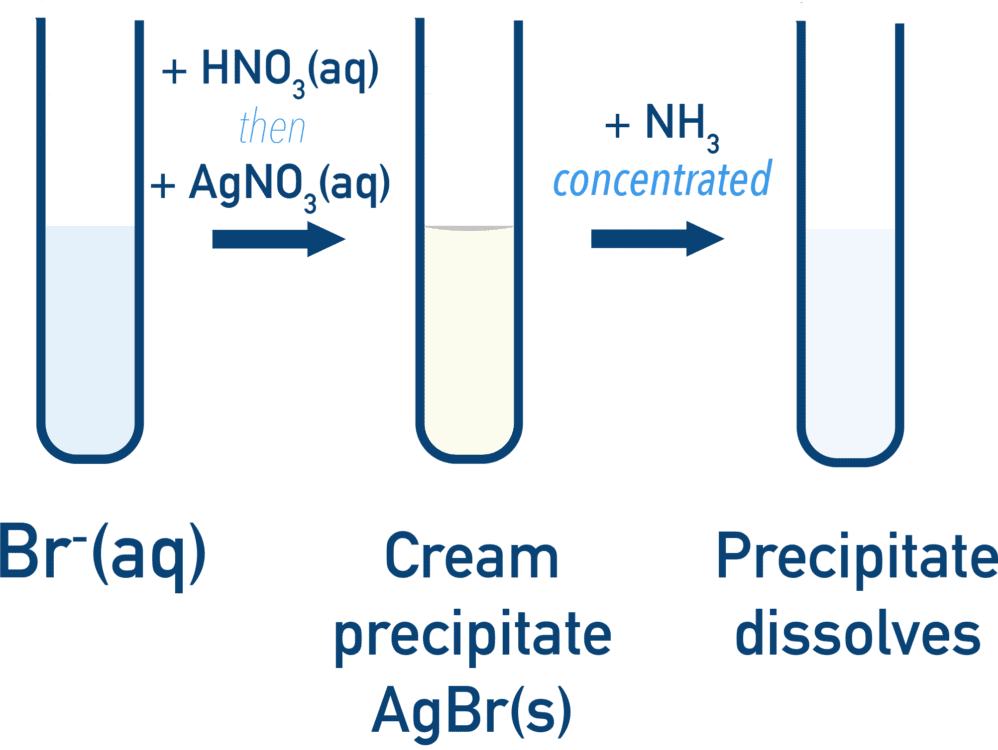
| \( \mathrm{Br^-} \) | \( \mathrm{AgBr} \) | Cream |
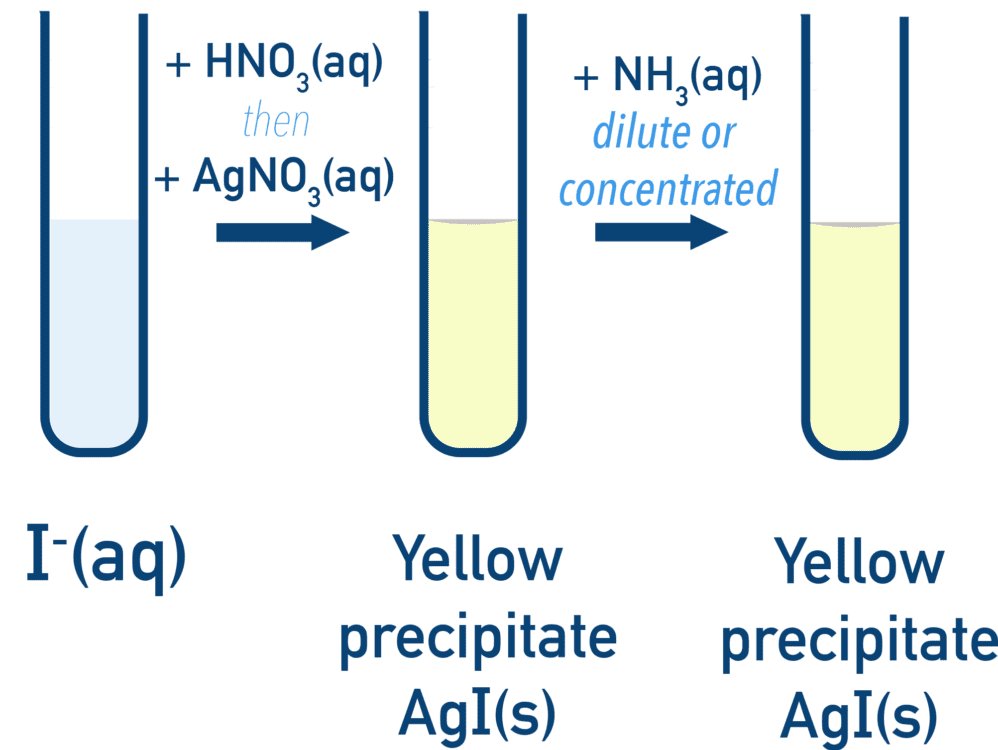
| \( \mathrm{I^-} \) | \( \mathrm{AgI} \) | Yellow |
(C) Solubility in Ammonia
- Used to confirm identity of halide
| Precipitate | Dilute NH\(_3\) | Concentrated NH\(_3\) |
|---|---|---|
| \( \mathrm{AgCl} \) | Dissolves | — |
| \( \mathrm{AgBr} \) | Partially dissolves | Dissolves |
| \( \mathrm{AgI} \) | Insoluble | Insoluble |
Explanation
- Ammonia forms a complex ion:
\( \mathrm{Ag^+ + 2NH_3 \rightarrow [Ag(NH_3)_2]^+} \)
- Strength of Ag–X bond increases from Cl → I
- Therefore solubility decreases down the group
Summary
- Silver nitrate forms characteristic precipitates.
- Colours distinguish halides.
- Ammonia confirms identity via solubility.
Therefore, this test is a key qualitative method for identifying halide ions.
Example :
A white precipitate forms with silver nitrate and dissolves in dilute ammonia. Identify the ion and explain.
▶️ Answer/Explanation
Ion = \( \mathrm{Cl^-} \).
Forms white precipitate \( \mathrm{AgCl} \).
Dissolves in dilute ammonia due to complex formation.
Therefore, chloride ion is present.
8.27 (iii) Reactions of Hydrogen Halides with Ammonia and Water
Hydrogen halides (\( \mathrm{HX} \), where X = Cl, Br, I) show important reactions with ammonia gas and water.
(A) Reaction with Ammonia Gas
General Equation
\( \mathrm{NH_3 + HX \rightarrow NH_4X} \)
Examples
- \( \mathrm{NH_3 + HCl \rightarrow NH_4Cl} \)
- \( \mathrm{NH_3 + HBr \rightarrow NH_4Br} \)
Observation
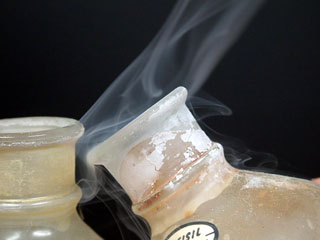
- White fumes of ammonium halide (e.g. \( \mathrm{NH_4Cl} \))
Explanation
- Ammonia acts as a base (accepts \( \mathrm{H^+} \))
- Hydrogen halide acts as an acid
- Forms ammonium salt via proton transfer
(B) Reaction with Water (Formation of Acids)
General Equation
\( \mathrm{HX + H_2O \rightarrow H_3O^+ + X^-} \)
Examples
- \( \mathrm{HCl + H_2O \rightarrow H_3O^+ + Cl^-} \)
- \( \mathrm{HBr + H_2O \rightarrow H_3O^+ + Br^-} \)
Observation
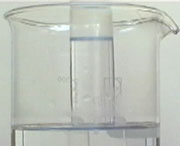
- Solution becomes acidic (low pH)
Explanation
- Hydrogen halide donates a proton to water
- Forms hydronium ions (\( \mathrm{H_3O^+} \))
- Therefore behaves as a strong acid (HCl, HBr, HI)
Key Comparison
| Reaction | Type | Product |
|---|---|---|
| With NH\(_3\) | Acid–base | Ammonium salt |
| With H\(_2\)O | Acid dissociation | \( \mathrm{H_3O^+} \) |
Summary
- Hydrogen halides react with ammonia to form ammonium salts.
- They dissolve in water to form acidic solutions.
- Both reactions involve proton transfer.
Therefore, hydrogen halides behave as acids in both gaseous and aqueous systems.
Example :
Describe the observations and explain the reaction when ammonia gas reacts with hydrogen chloride gas.
▶️ Answer/Explanation
White fumes of \( \mathrm{NH_4Cl} \) are formed.
\( \mathrm{NH_3 + HCl \rightarrow NH_4Cl} \)
Ammonia accepts a proton (base).
Hydrogen chloride donates a proton (acid).
Therefore, an ammonium salt is formed.