
8.9 Formation of Ions and Changes in Oxidation Number
The behaviour of elements in forming ions can be understood using the concept of oxidation number and electron transfer.
Metals: Formation of Positive Ions (Cations)
Metals tend to lose electrons to form positive ions (cations).
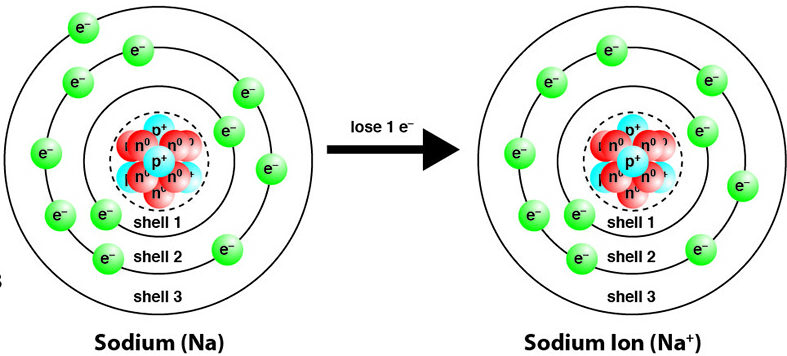
- Loss of electrons = oxidation.
- Oxidation number increases.
Example
\( \mathrm{Na \rightarrow Na^+ + e^-} \)
- Na: \( 0 \rightarrow +1 \)
- Oxidation number increases.
Therefore, metals are electron donors and are oxidised.
Non-metals: Formation of Negative Ions (Anions)
Non-metals tend to gain electrons to form negative ions (anions).
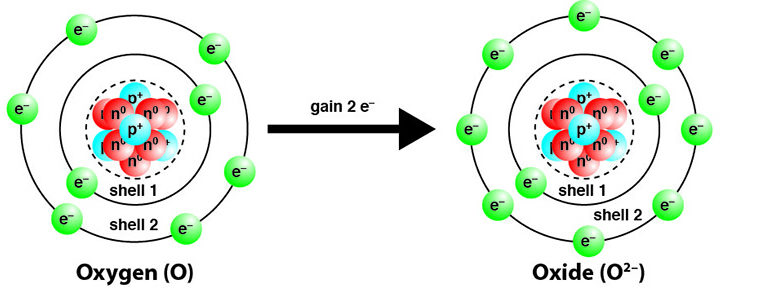
- Gain of electrons = reduction.
- Oxidation number decreases.
Example
\( \mathrm{Cl + e^- \rightarrow Cl^-} \)
- Cl: \( 0 \rightarrow -1 \)
- Oxidation number decreases.
Therefore, non-metals are electron acceptors and are reduced.
Summary of Trends
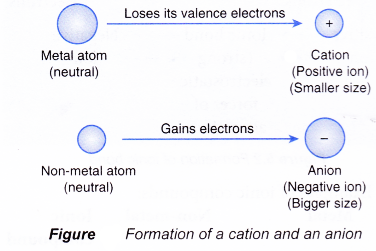
- Metals → lose electrons → form cations → oxidation number increases.
- Non-metals → gain electrons → form anions → oxidation number decreases.
Link to Redox Reactions
- Metals are usually oxidised (reducing agents).
- Non-metals are usually reduced (oxidising agents).
Example Reaction
\( \mathrm{2Na + Cl_2 \rightarrow 2NaCl} \)
- Na: \( 0 \rightarrow +1 \) (oxidation)
- Cl: \( 0 \rightarrow -1 \) (reduction)
Exam Points
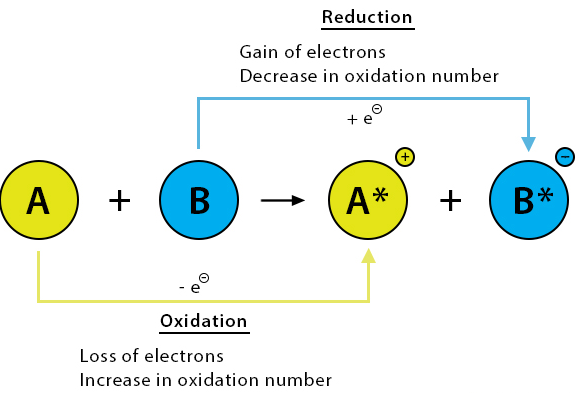
- Loss of electrons → oxidation → increase in oxidation number.
- Gain of electrons → reduction → decrease in oxidation number.
- Metals form positive ions; non-metals form negative ions.
Therefore, oxidation number provides a clear way to understand how metals and non-metals behave in reactions.
Example 1 :
In the reaction:
\( \mathrm{2Al + 3Cl_2 \rightarrow 2AlCl_3} \)
(a) Determine the oxidation number changes for aluminium and chlorine.
(b) Explain, in terms of electron transfer, why aluminium acts as a reducing agent.
▶️ Answer/Explanation
(a)
Al: \( 0 \rightarrow +3 \)
Cl: \( 0 \rightarrow -1 \)
(b)
Aluminium loses three electrons per atom.
This increases its oxidation number → oxidation.
It supplies electrons to chlorine, causing chlorine to be reduced.
Therefore, aluminium acts as a reducing agent.
Example 2 :
A student states: “All non-metals act as oxidising agents.”
Using oxidation numbers and a suitable reaction, evaluate this statement.
▶️ Answer/Explanation
The statement is not always true.
Example:
\( \mathrm{Cl_2 + H_2O \rightarrow HCl + HClO} \)
Cl: \( 0 \rightarrow -1 \) (reduction)
Cl: \( 0 \rightarrow +1 \) (oxidation)
Chlorine is both reduced and oxidised → disproportionation.
Therefore, non-metals can act as both oxidising and reducing agents depending on the reaction.