
9.8 Catalysts and the Maxwell–Boltzmann Distribution
The effect of a catalyst on the rate of reaction can be explained using the Maxwell–Boltzmann distribution of molecular energies and the concept of activation energy.
Maxwell–Boltzmann Distribution
The Maxwell–Boltzmann distribution shows how the energies of particles are distributed at a given temperature.
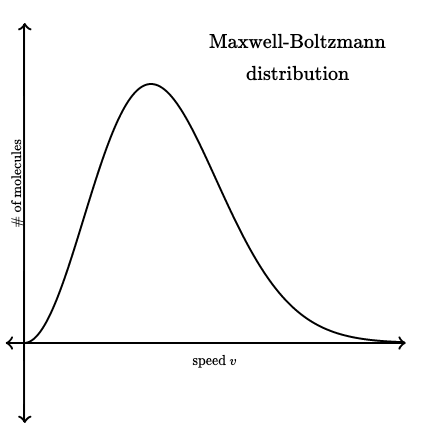
- Particles in a system have a range of different energies.
- Most particles have intermediate energies, while fewer have very high energies.
- The total area under the curve represents the total number of particles.
Activation Energy on the Distribution
The activation energy is the minimum energy required for a reaction to occur.
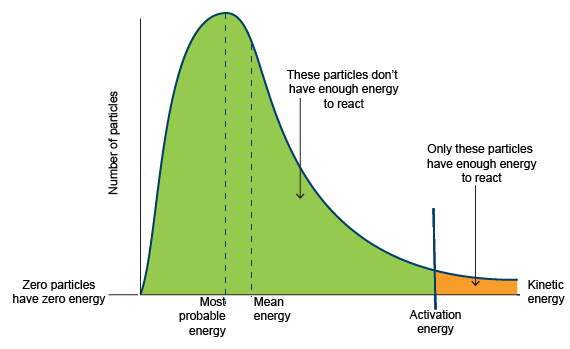
- On the graph, this is shown as a vertical line.
- The area under the curve to the right of this line represents particles with sufficient energy to react.
These particles are capable of undergoing successful collisions.
Effect of a Catalyst
A catalyst provides an alternative reaction pathway with lower activation energy.
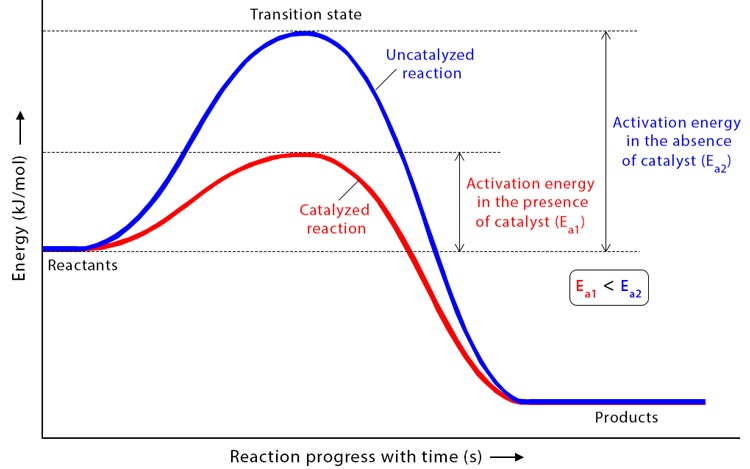
- The activation energy line shifts to the left on the distribution graph.
- The shape of the Maxwell–Boltzmann curve remains unchanged.
- This is because the temperature and overall energy distribution of particles do not change.
Effect on Successful Collisions
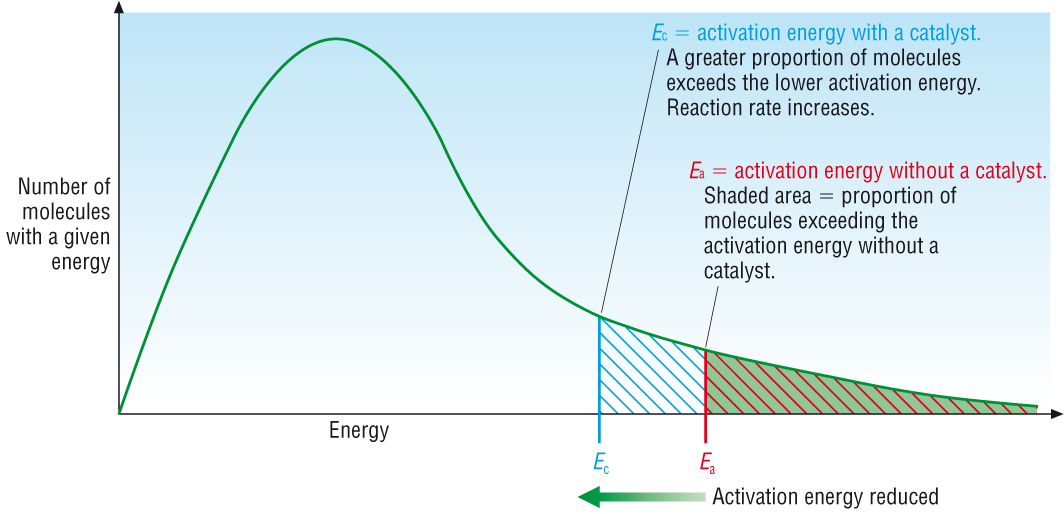
- Lowering the activation energy increases the area under the curve beyond the activation energy.
- This means a greater proportion of particles now have sufficient energy to react.
- Therefore, the number of successful collisions per unit time increases.
As a result, the rate of reaction increases significantly.
Comparison with Temperature
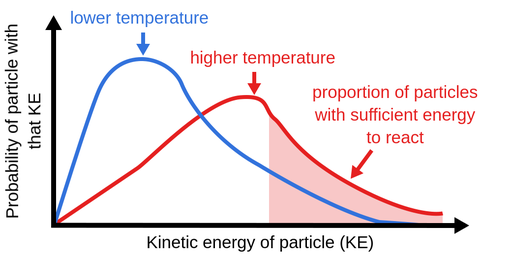
- Increasing temperature changes the shape of the distribution and increases particle energy.
- A catalyst does not change particle energies or the distribution shape.
- Instead, it lowers the activation energy, making it easier for particles to react.
Key Exam Statement
- A catalyst increases the rate of reaction by lowering activation energy, thereby increasing the proportion of particles with sufficient energy for successful collisions, without changing the energy distribution.
Therefore, catalysts increase the rate by increasing the number of successful collisions, not by increasing particle energy.
Example 1:
Explain, using the Maxwell–Boltzmann distribution, how a catalyst increases the rate of a reaction.
▶️ Answer/Explanation
A catalyst provides an alternative pathway with lower activation energy.
The activation energy line shifts to the left on the Maxwell–Boltzmann distribution.
A greater proportion of particles have energy greater than the activation energy.
Therefore, more successful collisions occur, increasing the rate of reaction.
Example 2:
Explain why a catalyst does not change the Maxwell–Boltzmann distribution curve.
▶️ Answer/Explanation
A catalyst does not change the temperature of the system.
Therefore, the distribution of particle energies remains unchanged.
Only the activation energy is lowered.
Hence, the shape of the Maxwell–Boltzmann curve remains the same.