
Gravitational Field Strength \( g = \dfrac{F}{m} \) and Weight \( W = mg \)
Gravitational Field Strength
Definition: Gravitational field strength at a point is the force per unit mass experienced by a small test mass placed at that point.

\( g = \dfrac{F}{m} \)
- \( g \) = gravitational field strength (N kg⁻¹)
- \( F \) = gravitational force acting on the mass (N)
- \( m \) = mass of the object (kg)
Meaning:
- \( g \) tells you how strong gravity is at a location.
- On Earth’s surface, \( g \approx 9.8\, \mathrm{N\,kg^{-1}} \).
- Further from Earth, \( g \) decreases.
Mass
Definition: Mass is the amount of matter in an object. It is a scalar quantity and does not change with location. The SI unit of mass is the kilogram (kg).
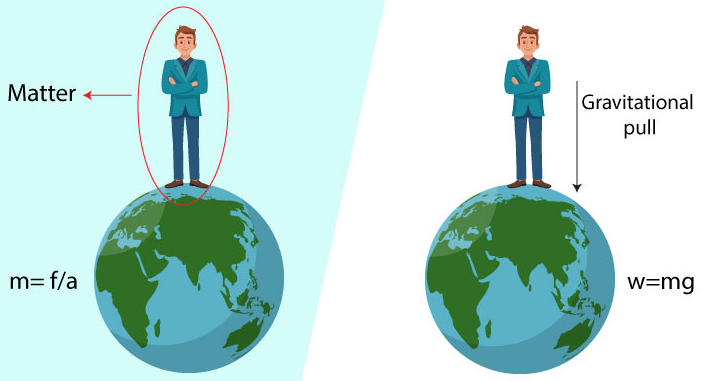
- Mass remains the same everywhere in the Universe.
- Mass is a measure of inertia — the resistance an object has to changes in motion.
- Mass does not depend on gravitational field strength.
- Weight changes with gravity, but mass stays constant.
Gravitational fields cause masses to experience a force. The strength of this field and the weight of an object are described by two key equations.
Weight of an Object
Definition of Weight: Weight is the gravitational force acting on a mass in a gravitational field.

\( W = mg \)
- \( W \) = weight (N)
- \( m \) = mass (kg)
- \( g \) = gravitational field strength (N kg⁻¹)
Key idea: Mass is constant everywhere, but weight changes with gravitational field strength.
Understanding the Relationship Between \( g \) and \( W \)
- Weight depends directly on gravitational field strength.
- If \( g \) increases → weight increases.
- If \( g \) decreases → weight decreases.
- On the Moon, \( g \approx 1.6\, \mathrm{N\,kg^{-1}} \) → weight is much smaller.
- Mass does not change because it is the amount of matter.
Typical Uses in Mechanics
- Finding weight using mass: \( W = mg \)
- Finding acceleration due to gravity using measured force and mass: \( g = \dfrac{F}{m} \)
- Used in free-body diagrams and Newton’s laws problems.
- Used in projectile motion (vertical acceleration = \( -g \)).
Example (Easy)
Find the weight of a \( 2.5\, \mathrm{kg} \) mass on Earth.
▶️ Answer / Explanation
Use \( W = mg \):
\( W = 2.5 \times 9.8 = 24.5\, \mathrm{N} \)
Example (Medium)
A mass experiences a gravitational force of \( 15\, \mathrm{N} \) in some region of space. If its mass is \( 3.0\, \mathrm{kg} \), find the gravitational field strength there.
▶️ Answer / Explanation
Use \( g = \dfrac{F}{m} \):
\( g = \dfrac{15}{3.0} = 5\, \mathrm{N\,kg^{-1}} \)
Example (Hard)
An astronaut with mass \( 72\, \mathrm{kg} \) weighs \( 120\, \mathrm{N} \) on a planet. Find the gravitational field strength on that planet, and compare it with Earth’s.
▶️ Answer / Explanation
Use \( g = \dfrac{F}{m} \):
\( g = \dfrac{120}{72} \approx 1.67\, \mathrm{N\,kg^{-1}} \)
Comparison:
- Earth: \( 9.8\, \mathrm{N\,kg^{-1}} \)
- This planet: \( 1.67\, \mathrm{N\,kg^{-1}} \)
Gravity is much weaker on this planet → weight is smaller though mass is unchanged.