
CORE PRACTICAL 1: Determine the Acceleration of a Freely-Falling Object
This core practical aims to measure the acceleration due to gravity \( g \) by analysing the motion of an object falling freely under gravity.
Aim of the Experiment
To determine the value of gravitational acceleration \( g \) using the equation of motion:
\( s = ut + \dfrac{1}{2}gt^2 \)
For a freely falling object: \( u = 0 \) → initial velocity is zero.
Apparatus
- Light gate(s)
- Electronic timer
- Data logger (optional)
- Clamp stand
- Ball bearing (or similar small dense object)
- Metre ruler
Method (Using One Light Gate)
- Set up a light gate connected to an electronic timer.
- Measure the height \( h \) from the bottom of the ball to the top of the light gate.
- Hold the ball at the measured height and release it so it falls freely.
- The light gate measures the time \( t \) it takes for the ball to fall through the gate.
- Repeat several times for the same height, then for different heights.
Using the equation:
\( h = \dfrac{1}{2}gt^2 \)
Rearrange to find \( g \):
\( g = \dfrac{2h}{t^2} \)
Alternative Method (Using Two Light Gates)
- Place two light gates a known distance \( s \) apart.
- As the object falls, each gate records its velocity at that point.
- The average acceleration is calculated using:
\( g = \dfrac{v_2 – v_1}{t} \)
Where:
- \( v_1 \) = velocity at first gate
- \( v_2 \) = velocity at second gate
- \( t \) = time between passing the two gates
Data Processing
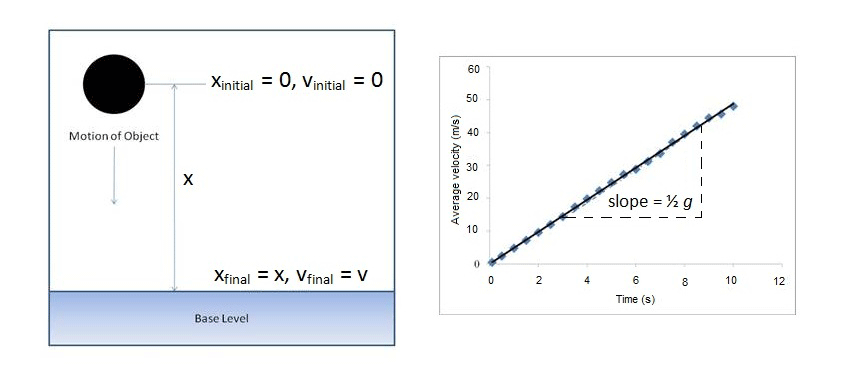
- Record several values of height and corresponding time.
- Plot a graph of \( h \) against \( t^2 \).
- The gradient of the straight line is \( \dfrac{1}{2}g \).
- Multiply the gradient by 2 to obtain \( g \).
Sources of Error
- Reaction time error if using manual timing (avoid by using light gates).
- Air resistance slowing the object slightly.
- Height measurement inaccuracies.
- The ball may not fall straight if released inconsistently.
Improvements
- Use light gates instead of a stopwatch.
- Use a dense object (reduces air resistance effect).
- Ensure the ball is released without any initial push.
- Take multiple readings for each height and average them.
Example (Easy)
A ball is dropped from a height of \( 0.80\, \mathrm{m} \). The measured fall time is \( 0.40\, \mathrm{s} \). Calculate \( g \).
▶️ Answer / Explanation
\( g = \dfrac{2h}{t^2} = \dfrac{2(0.80)}{0.40^2} = \dfrac{1.6}{0.16} = 10\, \mathrm{m\,s^{-2}} \)
Close to accepted value \( 9.8\, \mathrm{m\,s^{-2}} \).
Example (Medium)
Two light gates measure velocities \( v_1 = 1.2\, \mathrm{m\,s^{-1}} \) and \( v_2 = 3.4\, \mathrm{m\,s^{-1}} \). The time between gates is \( 0.25\, \mathrm{s} \). Find \( g \).
▶️ Answer / Explanation
\( g = \dfrac{v_2 – v_1}{t} = \dfrac{3.4 – 1.2}{0.25} = \dfrac{2.2}{0.25} = 8.8\, \mathrm{m\,s^{-2}} \)
Example (Hard)
A student collects height–time data and plots a graph of \( h \) vs \( t^2 \). The gradient of the line is \( 4.92\, \mathrm{m\,s^{-2}} \). Find the value of \( g \).
▶️ Answer / Explanation
The gradient of the graph = \( \dfrac{1}{2}g \).
\( g = 2 \times 4.92 = 9.84\, \mathrm{m\,s^{-2}} \)
This is very close to the accepted value.