
Newton’s Third Law of Motion and Properties of Interaction Pairs
Newton’s Third Law of Motion
Newton’s third law states that:
“For every action, there is an equal and opposite reaction.”
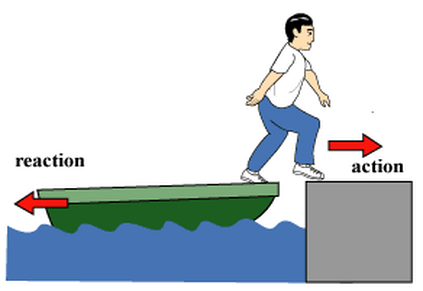
This law describes the forces that two bodies exert on each other during an interaction.
Key Statement in Physics Form:
If body A exerts a force on body B, then body B exerts an equal and opposite force on body A.
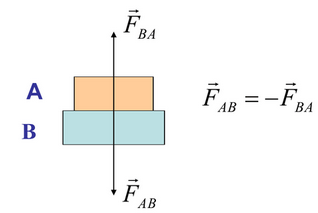
Symbolically:
\( \vec{F}_{AB} = -\vec{F}_{BA} \)
- \( \vec{F}_{AB} \) = force exerted by A on B
- \( \vec{F}_{BA} \) = force exerted by B on A
Properties of Newton’s Third Law Force Pairs
- The forces are equal in magnitude.
- The forces are opposite in direction.
- The forces act on two different bodies (never on the same body).
- The forces are of the same type (e.g., both gravitational, both normal, both magnetic).
- Both forces occur simultaneously, not one after the other.
Examples of Action–Reaction Pairs

- A book on a table:
- Book pushes the table down.
- Table pushes the book up (equal and opposite).
- A rocket launching:
- Rocket pushes gas downwards.
- Gas pushes rocket upwards.
- Walking:
- Foot pushes ground backwards.
- Ground pushes foot forward.
Common Misconceptions
- Action–reaction forces do NOT cancel out because they act on different bodies.
- They are not cause–effect; they occur simultaneously.
- Normal reaction is NOT the third-law pair of weight.
- Weight is Earth pulling object downward.
- Reaction pair: object pulls Earth upward.
Example (Easy)
A ball pushes down on the ground with a force of 50 N. What is the force exerted by the ground on the ball?
▶️ Answer / Explanation
By Newton’s third law, the ground pushes upward on the ball with a force of 50 N (equal in magnitude, opposite in direction).
Example (Medium)
A car’s wheels push backwards on the road with a force of \( 2500\, \mathrm{N} \). Identify the reaction force.
▶️ Answer / Explanation
The road pushes the wheels forward with a force of \( 2500\, \mathrm{N} \).
These two forces form a Newton’s third law pair.
Example (Hard)
A person of mass 70 kg stands on the floor. The Earth pulls the person downward with a force of \( 686\, \mathrm{N} \). Identify the third-law pair and explain why the normal reaction from the floor is not the third-law pair of weight.
▶️ Answer / Explanation
Weight pair:
Earth pulls person downward with \( 686\, \mathrm{N} \). Person pulls Earth upward with \( 686\, \mathrm{N} \).
Why normal reaction is NOT the third-law pair:
- Normal reaction acts on the person (from the floor).
- Weight acts on the person (from Earth).
- Therefore, they act on the same body → not a third-law pair.
- Third-law forces must act on different bodies.