
Momentum Defined as \( p = mv \)
Momentum is a fundamental quantity in mechanics that describes the motion of an object in terms of both its mass and its velocity.
Definition: Momentum is the product of an object’s mass and its velocity.

\( p = mv \)
- \( p \) = momentum (kg m s⁻¹)
- \( m \) = mass (kg)
- \( v \) = velocity (m s⁻¹)
Key Points:
- Momentum is a vector quantity (direction is important).
- Momentum increases with either higher mass or higher velocity.
- Objects moving faster or with greater mass have more “impact” when they collide.
- If the velocity changes direction, the momentum direction also changes.
Understanding the Concept
- An object with zero velocity has zero momentum.
- Doubling the mass doubles the momentum.
- Doubling the velocity also doubles the momentum.
- Momentum helps describe motion in collisions and explosions.
How to Calculate Change in Momentum
The change in momentum is defined as the difference between final and initial momentum:
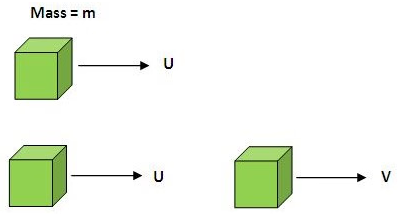
\( \Delta p = p_f – p_i \)
- \( p_i = m u \) = initial momentum
- \( p_f = m v \) = final momentum
- The sign of velocity matters (use negative for opposite direction).
- If an object reverses direction, the change in momentum becomes large because signs differ.
Example (Easy)
A 2 kg object moves with a velocity of \( 3\, \mathrm{m\,s^{-1}} \). Find its momentum.
▶️ Answer / Explanation
\( p = mv = 2 \times 3 = 6\, \mathrm{kg\,m\,s^{-1}} \)
Example (Medium)
A car of mass \( 1200\, \mathrm{kg} \) travels at \( 20\, \mathrm{m\,s^{-1}} \). Calculate its momentum.
▶️ Answer / Explanation
\( p = mv = 1200 \times 20 = 24000\, \mathrm{kg\,m\,s^{-1}} \)
Example (Hard)
A tennis ball of mass \( 0.060\, \mathrm{kg} \) is moving at \( 25\, \mathrm{m\,s^{-1}} \). After hitting a wall, it rebounds in the opposite direction at \( 18\, \mathrm{m\,s^{-1}} \). Find the change in momentum (take rebound direction as negative).
▶️ Answer / Explanation
Initial momentum:
\( p_i = 0.060 \times 25 = 1.5\, \mathrm{kg\,m\,s^{-1}} \)
Final momentum (opposite direction):
\( p_f = 0.060 \times (-18) = -1.08\, \mathrm{kg\,m\,s^{-1}} \)
Change in momentum:
\( \Delta p = p_f – p_i = -1.08 – 1.5 = -2.58\, \mathrm{kg\,m\,s^{-1}} \)
Principle of Conservation of Linear Momentum
Definition: The total linear momentum of a system remains constant provided no external forces act on the system.
\( \text{Total momentum before} = \text{Total momentum after} \)
\( m_1 u_1 + m_2 u_2 = m_1 v_1 + m_2 v_2 \)

- Momentum is conserved in all interactions (collisions and explosions).
- Applies only when the net external force on the system is zero.
- Works in one dimension and can be extended to two dimensions.
Connection to Newton’s Laws of Motion
Link to Newton’s Third Law:
- In a collision, the force body A exerts on B is equal and opposite to the force body B exerts on A.
- These forces act for the same time interval.
- Therefore, the impulses are equal and opposite.
- This leads directly to conservation of momentum.
\( F_{AB} \Delta t = -F_{BA} \Delta t \)
This shows that the total momentum change of the two-body system is zero.
Link to Newton’s Second Law:
- Newton’s second law in terms of momentum is \( F = \dfrac{\Delta p}{\Delta t} \).
- If no external force acts, then \( F = 0 \Rightarrow \Delta p = 0 \).
- This means momentum is constant.
Applying Conservation of Momentum in One Dimension
Use the equation:
\( m_1 u_1 + m_2 u_2 = m_1 v_1 + m_2 v_2 \)

Sign convention: Choose one direction as positive (usually right). Negative sign indicates motion in the opposite direction.
- Collisions (objects come together).
- Explosions (objects move apart).
- Recoil motion (e.g., gun and bullet).
- Elastic or inelastic collisions (momentum always conserved).
Example (Easy)
A 2 kg trolley moving at \( 3\, \mathrm{m\,s^{-1}} \) collides and sticks to a stationary 1 kg trolley. Find their common velocity.
▶️ Answer / Explanation
Total momentum before:
\( p = (2 \times 3) + (1 \times 0) = 6 \)
Total mass after collision = \( 3\, \mathrm{kg} \).
Common velocity:
\( v = \dfrac{6}{3} = 2\, \mathrm{m\,s^{-1}} \)
Example (Medium)
A 1500 kg car moving at \( 18\, \mathrm{m\,s^{-1}} \) hits a 900 kg car moving in the same direction at \( 10\, \mathrm{m\,s^{-1}} \). After collision, they move together. Find their joint velocity.
▶️ Answer / Explanation
Momentum before:
\( p = (1500 \times 18) + (900 \times 10) = 27000 + 9000 = 36000 \)
Total mass = \( 2400\, \mathrm{kg} \).
Velocity after:
\( v = \dfrac{36000}{2400} = 15\, \mathrm{m\,s^{-1}} \)
Example (Hard)
A 0.5 kg ball moving at \( 12\, \mathrm{m\,s^{-1}} \) strikes a 1.2 kg ball moving toward it at \( 4\, \mathrm{m\,s^{-1}} \). After collision, the 0.5 kg ball rebounds at \( -6\, \mathrm{m\,s^{-1}} \). Find the final velocity of the 1.2 kg ball.
▶️ Answer / Explanation
Take the 0.5 kg ball’s initial direction as positive.
Momentum before:
\( p = (0.5 \times 12) + (1.2 \times -4) = 6 – 4.8 = 1.2 \)
Momentum after:
\( 1.2 = (0.5 \times -6) + (1.2 \, v) \)
Solve:
\( 1.2 = -3 + 1.2v \)
\( 1.2v = 4.2 \Rightarrow v = 3.5\, \mathrm{m\,s^{-1}} \)