
Principle of Conservation of Energy
Principle of Conservation of Energy
Energy cannot be created or destroyed — it can only be transferred from one form to another. In a closed system, the total energy remains constant.
\(\text{Total Energy Initially} = \text{Total Energy Finally}\)
In mechanics, the main forms of energy we use are:
- Kinetic energy \( E_k = \tfrac{1}{2}mv^2 \)
- Gravitational potential energy \( E_{\text{grav}} = mg\Delta h \)
- Work done by forces \( W = F\Delta s \)
Energy Transfers Involving Work, GPE, and KE
- Work done on an object increases its energy.
- Work done by an object decreases its energy.
- Falling objects lose GPE and gain KE.
- Raising objects increases GPE and requires work to be done.
- If no energy is lost to friction,
- \(\Delta E_k = -\Delta E_{\text{grav}}\)
- \(\Delta E_{\text{grav}} + \Delta E_k + W_{\text{external}} = 0\)
- In real situations, some energy becomes thermal energy (not recoverable as mechanical energy).
Using Conservation of Energy in Calculations
For a system where only GPE and KE are involved (no friction):
\( mg\Delta h + \tfrac{1}{2}mu^2 = \tfrac{1}{2}mv^2 \)
With external work:
\( W_{\text{external}} + \text{Initial Energy} = \text{Final Energy} \)
With friction:
\( \text{Useful Energy Output} = \text{Energy Input} – \text{Work Against Friction} \)
Energy Diagrams

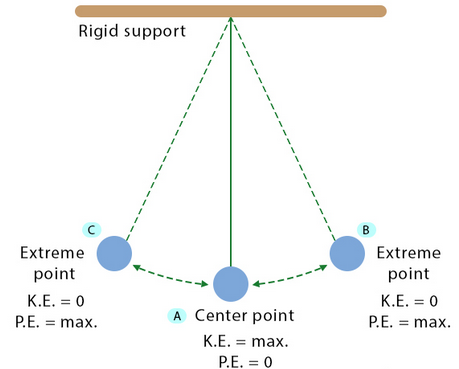
- At top of a fall: maximum GPE, minimum KE.
- At bottom of a fall: maximum KE, minimum GPE.
- Total mechanical energy remains (approximately) constant.
Example (Easy)
A \( 2.0\, \mathrm{kg} \) object is raised by \( 3.0\, \mathrm{m} \). Find the increase in GPE.
▶️ Answer / Explanation
\( \Delta E_{\text{grav}} = mg\Delta h = 2.0 \times 9.8 \times 3.0 = 58.8\, \mathrm{J} \)
Energy input = gain in GPE.
Example (Medium)
A \( 5.0\, \mathrm{kg} \) object is dropped from a height of \( 10\, \mathrm{m} \). Find its speed just before it hits the ground (ignore air resistance).
▶️ Answer / Explanation
GPE lost = KE gained.
\( mg\Delta h = \tfrac{1}{2}mv^2 \)
Mass cancels:
\( 9.8 \times 10 = \tfrac{1}{2}v^2 \Rightarrow v^2 = 196 \)
\( v = 14\, \mathrm{m\,s^{-1}} \)
Example (Hard)
A block of mass \( 4.0\, \mathrm{kg} \) slides down a rough slope. It starts from rest at a height of \( 6.0\, \mathrm{m} \). The work done against friction is \( 50\, \mathrm{J} \). Find the speed of the block at the bottom.
▶️ Answer / Explanation
Initial GPE:
\( mg\Delta h = 4.0 \times 9.8 \times 6.0 = 235.2\, \mathrm{J} \)
Energy lost to friction = \( 50\, \mathrm{J} \).
KE at bottom:
\( E_k = 235.2 – 50 = 185.2\, \mathrm{J} \)
Use KE formula:
\( \tfrac{1}{2}mv^2 = 185.2 \Rightarrow v^2 = \dfrac{185.2 \times 2}{4} = 92.6 \)
\( v = 9.62\, \mathrm{m\,s^{-1}} \)