
Upthrust = Weight of Fluid Displaced
Archimedes’ Principle
When an object is fully or partially submerged in a fluid, it experiences an upward force called upthrust.
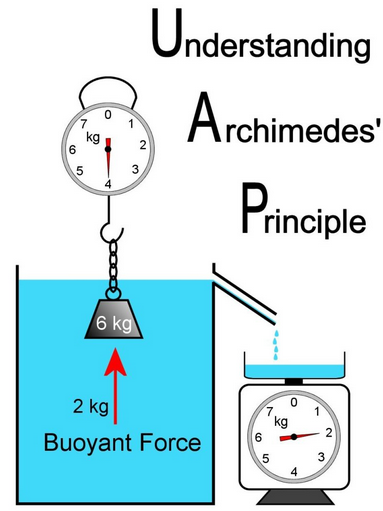
Definition: The upthrust on an object is equal to the weight of the fluid displaced by the object.
\(\text{Upthrust} = \text{Weight of Fluid Displaced} \)
Understanding the Concept

- The deeper an object goes, the greater the pressure on its bottom surface.
- This pressure difference produces a net upward force → upthrust.
- If an object displaces a large weight of fluid, it will float more easily.
- The weight of fluid displaced is:
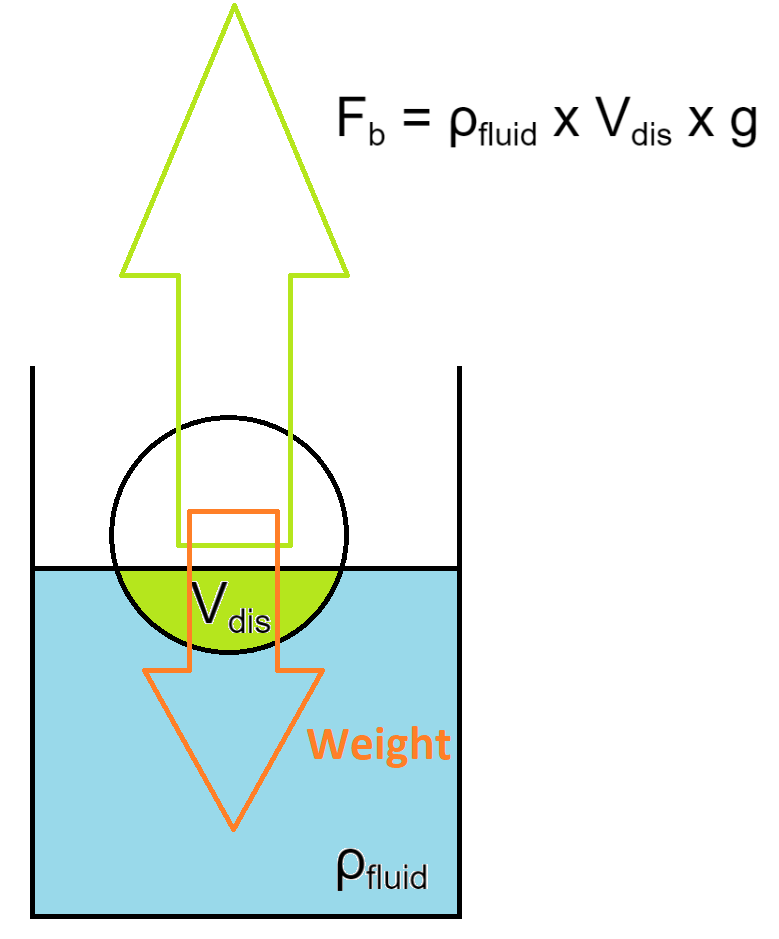
\( W_{\text{fluid}} = \rho_{\text{fluid}} V g \)
- Objects float when:
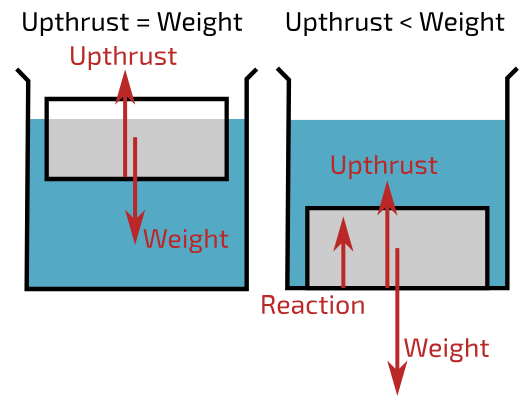
\( \text{Upthrust} = \text{Weight of Object} \)
- Objects sink when their weight is greater than upthrust.
Key Points
- Upthrust acts vertically upward.
- Weight acts vertically downward.
- The difference between weight and upthrust determines if an object sinks, floats, or remains suspended.
- Floating objects displace a weight of fluid equal to their own weight.
- Sinking objects displace a volume equal to their own volume BUT the weight of fluid displaced is less than their weight.
Example (Easy)
A cube of volume \( 0.002\, \mathrm{m^3} \) is fully submerged in water. Find the upthrust. (Take water density \( \rho = 1000\, \mathrm{kg\,m^{-3}} \))
▶️ Answer / Explanation
Weight of fluid displaced:
\( W = \rho V g = 1000 \times 0.002 \times 9.8 = 19.6\, \mathrm{N} \)
Upthrust = 19.6 N
Example (Medium)
A metal block weighs \( 40\, \mathrm{N} \) in air and \( 28\, \mathrm{N} \) when fully submerged in oil. Find the upthrust exerted by the oil on the block.
▶️ Answer / Explanation
Apparent weight loss = upthrust.
\( U = 40 – 28 = 12\, \mathrm{N} \)
Upthrust = 12 N
Example (Hard)
A wooden block of mass \( 3.0\, \mathrm{kg} \) floats in water with \( 75\% \) of its volume submerged. Find the total volume of the block. (Take \( \rho_{\text{water}} = 1000\, \mathrm{kg\,m^{-3}} \))
▶️ Answer / Explanation
For floating:
Upthrust = Weight of block
Weight of block:
\( W = mg = 3.0 \times 9.8 = 29.4\, \mathrm{N} \)
Upthrust = weight of fluid displaced:
\( U = \rho V_{\text{sub}} g = 1000 \times (0.75V) \times 9.8 \)
Equating:
\( 1000 \times 0.75V \times 9.8 = 29.4 \)
Simplify:
\( 7350V = 29.4 \Rightarrow V = 0.004\, \mathrm{m^3} \)
Total volume of block = \( 0.004\, \mathrm{m^3} \)