
CORE PRACTICAL 2: Determine the Viscosity of a Liquid Using the Falling-Ball Method
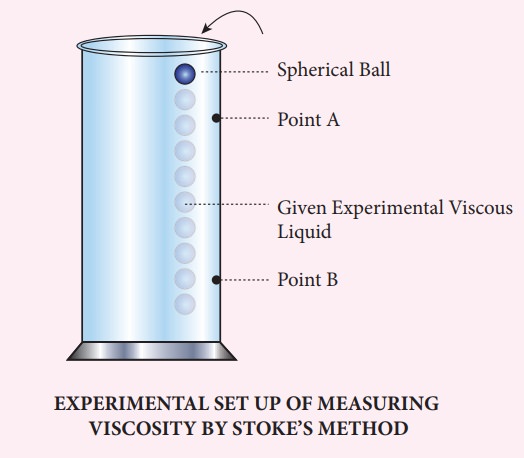
This practical uses Stokes’ Law to determine the viscosity of a liquid by measuring the terminal velocity of a small sphere (ball bearing) falling through it.
Aim
To determine the viscosity \( \eta \) of a liquid (e.g., glycerine) using Stokes’ Law:
\( F = 6\pi \eta r v \)
Apparatus

- Long transparent cylinder filled with test liquid (e.g., glycerine)
- Ball bearings of known radius \( r \)
- Meter ruler or marked scale on cylinder
- Stopwatch (or video timer for accuracy)
- Micrometer screw gauge (to measure radius)
- Tongs or tweezers
- Thermometer (viscosity depends on temperature)
Theory
When a sphere falls through a viscous liquid:
- Weight acts downward
- Upthrust acts upward
- Viscous drag acts upward
At terminal velocity, forces balance:
Weight − Upthrust = Drag
Using Stokes’ Law:
\( 6\pi \eta r v = \dfrac{4}{3}\pi r^3 g (\rho_s – \rho_f) \)
Rearranged to find viscosity:
\( \eta = \dfrac{2 r^2 g (\rho_s – \rho_f)}{9 v} \)
Procedure
- Measure the radius \( r \) of the ball bearing using a micrometer.
- Measure density of sphere \( \rho_s \) (or look up material density).
- Measure density of fluid \( \rho_f \) (or use known value).
- Fill the tube with liquid and mark two points vertically (e.g., 0.10 m apart).
- Use tongs to release the ball gently so it does not touch the sides.
- Allow the ball to accelerate and reach terminal velocity before it reaches the first mark.
- Start the timer when the ball passes the upper mark.
- Stop the timer when it passes the lower mark.
- Repeat at least 5 times for reliability.
- Repeat with different-sized spheres for improved accuracy.
Data Processing
1. Calculate terminal velocity:
\( v = \dfrac{\Delta s}{\Delta t} \)
2. Substitute \( r \), \( \rho_s \), \( \rho_f \), \( v \) into:
\( \eta = \dfrac{2 r^2 g (\rho_s – \rho_f)}{9 v} \)
3. Take an average viscosity from multiple trials.
Assumptions (Why Stokes’ Law Works Here)
- The sphere is small and smooth.
- The motion is slow (laminar flow).
- The fluid is Newtonian (constant viscosity).
- No turbulence occurs around the sphere.
- The falling ball is far from the tube walls (minimising wall effects).
- The temperature is constant (viscosity depends strongly on temperature).
Sources of Error
- Timing errors (ball passes quickly through marks).
- Difficulty identifying exact terminal velocity point.
- Ball touching tube walls increases drag.
- Temperature variation changes viscosity.
- Inaccurate measurement of radius \( r \).
- Density values may not be precise.
How to Improve Accuracy
- Use video tracking to measure time more accurately.
- Use a taller tube so the ball reaches terminal velocity more clearly.
- Perform the experiment in a temperature-controlled environment.
- Use multiple ball sizes and plot \( v \) vs. \( r^2 \).
- Ensure the sphere is released centrally and gently.
- Repeat measurements and average results.
Example
A ball bearing of radius \( 1.0\times10^{-3}\, \mathrm{m} \) falls through oil and takes \( 4.0\, \mathrm{s} \) to travel \( 0.12\, \mathrm{m} \). Density of sphere = \( 7800\, \mathrm{kg\,m^{-3}} \) Density of oil = \( 900\, \mathrm{kg\,m^{-3}} \)
▶️ Answer / Explanation
Terminal velocity:
\( v = \dfrac{0.12}{4.0} = 0.03\, \mathrm{m\,s^{-1}} \)
Use Stokes’ viscosity formula:
\( \eta = \dfrac{2 r^2 g (\rho_s – \rho_f)}{9 v} \)
Substitute values:
\( \eta = \dfrac{2 (1\times10^{-3})^2 (9.8)(7800 – 900)}{9(0.03)} \)
\( \eta \approx 0.21\, \mathrm{Pa\,s} \)