
Elastic Strain Energy \( \Delta E_{\text{el}} = \tfrac{1}{2}F\,\Delta x \) and Area Under Force–Extension Graph
Elastic strain energy is the work done on a material to deform it elastically (i.e., it returns to its original shape when the force is removed).
Elastic Strain Energy Formula
For materials obeying Hooke’s Law:
$ \Delta E_{\text{el}} = \frac{1}{2} F\,\Delta x $
- \( \Delta E_{\text{el}} \) = elastic strain energy (J)
- \( F \) = applied force (N)
- \( \Delta x \) = extension (m)
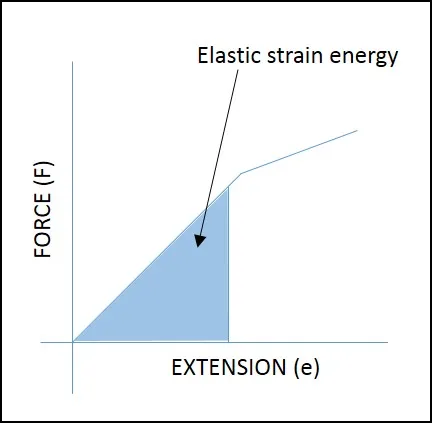
This equation is valid only in the linear region where Hooke’s Law holds.
Energy from Spring Constant
If the spring constant \( k \) is known:

$ \Delta E_{\text{el}} = \frac{1}{2}k(\Delta x)^2 $
- More useful when a force-extension graph is not provided.
Energy from the Area Under the Force–Extension Graph
The work done in stretching a material is:

$ \Delta E_{\text{el}} = \text{Area under the } F\text{–}x \text{ graph} $
- This works for linear and non-linear materials.
- Linear graph → area is a triangle → use \( \frac{1}{2}F\Delta x \).
- Non-linear graph → area must be estimated (trapeziums, counting squares, integration).
Linear (Hookean) Materials
- Graph is a straight line.
- Energy stored is triangular area under the line.
- Accurate and simple to calculate.
$ \Delta E_{\text{el}} = \frac{1}{2}F\Delta x $
Non-Linear Materials (Rubber, Polymers, Plastics)
- Curve is not straight → no simple formula.
- Estimate area using:
- small trapeziums beneath the curve
- counting squares on graph paper
- digital integration (A-level: trapezium rule)
- The area still equals the energy stored.
Important Notes
- Elastic strain energy is only recoverable if deformation is elastic.
- In the plastic region, work done is not fully recovered → some becomes internal energy.
- Energy stored in real materials often shows hysteresis (energy loss during unloading).
Example (Easy)
A spring is stretched by \( 0.10\, \mathrm{m} \) under a force of \( 6\, \mathrm{N} \). Find the elastic strain energy stored.
▶️ Answer / Explanation
\( \Delta E_{\text{el}} = \frac{1}{2}F\Delta x = \frac{1}{2}(6)(0.10) = 0.3\, \mathrm{J} \)
Example (Medium)
A material obeys Hooke’s Law with a spring constant \( k = 200\, \mathrm{N\,m^{-1}} \). Find the elastic energy stored when it is stretched by \( 0.08\, \mathrm{m} \).
▶️ Answer / Explanation
\( \Delta E_{\text{el}} = \frac{1}{2}k(\Delta x)^2 = \frac{1}{2}(200)(0.08)^2 = 0.64\, \mathrm{J} \)
Example (Hard)
The force–extension graph for a rubber band is non-linear. The force increases from 0 to \( 12\, \mathrm{N} \) over an extension of \( 0.20\, \mathrm{m} \). Estimate the elastic energy stored using the trapezium rule (take four strips).
▶️ Answer / Explanation
Divide extension range into 4 equal strips of width \( h = 0.05\,\mathrm{m} \).
Suppose measured forces at intervals are:
- 0.00 m → 0 N
- 0.05 m → 4 N
- 0.10 m → 7 N
- 0.15 m → 10 N
- 0.20 m → 12 N
Use trapezium rule:
$ E \approx \frac{h}{2}\left(F_0 + 2(F_1 + F_2 + F_3) + F_4\right) $
$ E = \frac{0.05}{2}\left[0 + 2(4 + 7 + 10) + 12\right] = 0.025(2 \times 21 + 12) $
\( E = 0.025(54) = 1.35\, \mathrm{J} \)
Estimated elastic energy stored ≈ \( 1.35\, \mathrm{J} \)