
Independence of Vertical and Horizontal Motion in Projectiles
A projectile is any object moving through the air under the influence of gravity only (assuming no air resistance). A key idea in projectile motion is that the horizontal and vertical motions are independent of each other.
Independence of Motion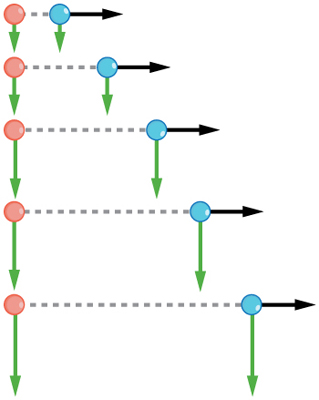
Horizontal motion:
- No horizontal forces → no horizontal acceleration.
- Horizontal velocity is constant.
- \( \mathrm{a_x = 0} \)
- \( \mathrm{v_x = u_x} \)
- \( \mathrm{x = u_x t} \)
Vertical motion:
- Only gravity acts vertically.
- Vertical acceleration is constant and downward.
- \( \mathrm{a_y = -g} \)
- Vertical motion follows SUVAT equations.
The two motions do not affect each other.
Why Independence Occurs
- Gravity acts only vertically → cannot change horizontal velocity.
- No horizontal forces → cannot change vertical velocity.
- Mathematically, horizontal and vertical equations are separate and unrelated.
- The path of the projectile is the result of combining both independent motions.
Result: Projectile follows a parabolic path because horizontal motion is uniform while vertical motion is accelerated.
Projectile Motion
Projectile motion describes the path of an object moving under the influence of gravity only, with no air resistance. The object follows a curved (parabolic) path due to the independence of horizontal and vertical motion.
1. Key Principles of Projectile Motion

- Horizontal and vertical motions are independent.
- Gravity acts only vertically → causes vertical acceleration.
- No horizontal forces → horizontal velocity is constant.
- Path of projectile = parabola.
- SUVAT equations apply to the vertical direction only.
2. Horizontal Motion
No acceleration horizontally:
\( \mathrm{a_x = 0} \)
Horizontal velocity remains constant:
\( \mathrm{v_x = u_x} \)
Horizontal displacement:
\( \mathrm{x = u_x t} \)
3. Vertical Motion
Vertical motion behaves like motion under constant acceleration:
Acceleration due to gravity:
\( \mathrm{a_y = -g} \)
Vertical velocity:
\( \mathrm{v_y = u_y – gt} \)
Vertical displacement:
\( \mathrm{y = u_y t – \dfrac{1}{2}gt^2} \)
Time to reach maximum height:
\( \mathrm{t_{max} = \dfrac{u_y}{g}} \)
4. Angle of Projection
If a projectile is launched with speed u at angle θ:
- Horizontal component: \( \mathrm{u_x = u\cos\theta} \)
- Vertical component: \( \mathrm{u_y = u\sin\theta} \)
All projectile equations come from combining these components.
5. Range, Time of Flight and Maximum Height
Time of flight: (projectile lands at same vertical level)
\( \mathrm{T = \dfrac{2u\sin\theta}{g}} \)
Maximum height:
\( \mathrm{H = \dfrac{u^2\sin^2\theta}{2g}} \)
Horizontal range:
\( \mathrm{R = \dfrac{u^2\sin2\theta}{g}} \)
These apply only when landing height = launch height.
6. Projectile Motion from a Height (Horizontal Launch)
- Initial vertical velocity = 0
- Vertical displacement: \( \mathrm{y = -\dfrac{1}{2}gt^2} \)
- Time to hit ground: \( \mathrm{t = \sqrt{\dfrac{2h}{g}}} \)
- Range: \( \mathrm{R = u_x t} \)
7. Why Projectile Motion Is Parabolic
- Horizontal motion = constant velocity
- Vertical motion = constant acceleration
- Combining the two gives a quadratic curve → parabola
Example (Easy)
A ball is thrown horizontally at \( \mathrm{8\ m\,s^{-1}} \). How does gravity affect its horizontal motion?
▶️ Answer / Explanation
Gravity acts only vertically. Therefore:
- Horizontal acceleration = 0
- Horizontal velocity stays constant at \( \mathrm{8\ m\,s^{-1}} \)
Example (Medium)
A ball is projected at \( \mathrm{20\ m\,s^{-1}} \) at an angle of \( \mathrm{30^\circ} \). Find its initial horizontal and vertical velocity components.
▶️ Answer / Explanation
Horizontal:
\( \mathrm{u_x = 20\cos30^\circ = 20\left(\dfrac{\sqrt{3}}{2}\right)} \)
\( \mathrm{u_x = 10\sqrt{3}\ m\,s^{-1}} \)
Vertical:
\( \mathrm{u_y = 20\sin30^\circ = 20\left(\dfrac{1}{2}\right)} \)
\( \mathrm{u_y = 10\ m\,s^{-1}} \)
Example (Hard)
A projectile is launched at \( \mathrm{25\ m\,s^{-1}} \) at an angle of \( \mathrm{40^\circ} \). How long does it take to reach maximum height?
▶️ Answer / Explanation
Vertical component of velocity:
\( \mathrm{u_y = 25\sin40^\circ} \)
At maximum height, \( \mathrm{v_y = 0} \).
Use: \( \mathrm{v_y = u_y – gt} \)
So:
\( \mathrm{0 = u_y – 9.8t} \)
\( \mathrm{t = \dfrac{u_y}{9.8}} \)
Since vertical motion is independent of horizontal motion, only the vertical component matters.
Example (Easy)
A ball is thrown horizontally at \( \mathrm{12\,m\,s^{-1}} \). If it takes 0.5 s to hit the ground, find the horizontal distance travelled.
▶️ Answer / Explanation
Horizontal velocity is constant:
\( \mathrm{x = u_x t = 12 \times 0.5 = 6\ m} \)
Example (Medium)
A projectile is launched at \( \mathrm{u = 18\ m\,s^{-1}} \) at an angle of \( \mathrm{40^\circ} \). Find its initial vertical velocity component.
▶️ Answer / Explanation
\( \mathrm{u_y = u\sin\theta = 18\sin40^\circ} \)
\( \mathrm{u_y \approx 11.6\ m\,s^{-1}} \)
Example (Hard)
A projectile is fired from ground level at \( \mathrm{u = 30\ m\,s^{-1}} \) at \( \mathrm{35^\circ} \). Find the time of flight.
▶️ Answer / Explanation
Use:
\( \mathrm{T = \dfrac{2u\sin\theta}{g}} \)
\( \mathrm{T = \dfrac{2(30)\sin35^\circ}{9.8}} \)
\( \mathrm{T \approx 3.5\ s} \)