
Speed of a Transverse Wave on a String \( v = \sqrt{\dfrac{T}{\mu}} \)
This formula gives the speed of a transverse wave travelling along a stretched string or wire. It depends on how tight the string is and how much mass it has per unit length.
The Wave Speed Formula
The speed of a transverse wave on a string is: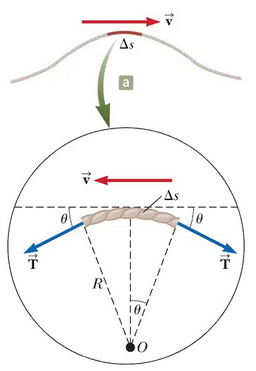
$ v = \sqrt{\frac{T}{\mu}} $
- \( v \) = wave speed (m s⁻¹)
- \( T \) = tension in the string (N)
- \( \mu \) = mass per unit length of the string (kg m⁻¹)
Meaning:
- Increasing tension → increases wave speed.
- Increasing mass per unit length → decreases wave speed.
- Speed does NOT depend on the amplitude or frequency of the oscillations.
Understanding Mass per Unit Length \( \mu \)
\( \mu \) tells us how “heavy” a string is for each metre of length. It is calculated by:
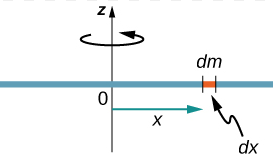
$ \mu = \frac{m}{L} $
- \( m \) = mass of the string (kg)
- \( L \) = length of the string (m)
Thicker or denser strings have larger \( \mu \) → waves travel more slowly.
Physical Interpretation
- A tighter string pulls the wave forward faster → larger \( T \).
- A heavier string resists acceleration → larger \( \mu \).
- The formula resembles Newton’s second law: higher tension provides more force; higher mass per metre resists motion.
Applications
- Vibrating strings on musical instruments.
- Laboratory experiments for measuring tension & string density.
- Understanding harmonics and standing waves on strings.
- Stringed resonance tubes in physics experiments.
Using the Formula Correctly
- Always convert mass of string to kilograms.
- Ensure \( \mu \) is in kg/m.
- Tension must be measured in newtons.
- Wave speed depends only on string properties — not on the driving frequency.
Example (Easy)
A string has tension \( 20\,\mathrm{N} \) and mass per unit length \( 0.010\,\mathrm{kg\,m^{-1}} \). Find the wave speed.
▶️ Answer / Explanation
$ v = \sqrt{\frac{T}{\mu}} = \sqrt{\frac{20}{0.010}} = \sqrt{2000} \approx 44.7\,\mathrm{m\,s^{-1}} $
Example (Medium)
A 3.0 m long string has a mass of 0.12 kg and is under 30 N tension. Find the speed of a wave on the string.
▶️ Answer / Explanation
Step 1: Find mass per unit length
$ \mu = \frac{m}{L} = \frac{0.12}{3.0} = 0.040\,\mathrm{kg\,m^{-1}} $
Step 2: Use wave speed formula
$ v = \sqrt{\frac{30}{0.040}} = \sqrt{750} \approx 27.4\,\mathrm{m\,s^{-1}} $
Example (Hard)
A string vibrates with a wave speed of \( 65\,\mathrm{m\,s^{-1}} \) when the tension is \( 50\,\mathrm{N} \). Calculate the mass per unit length of the string.
▶️ Answer / Explanation
Use the formula rearranged:
$ v = \sqrt{\frac{T}{\mu}} \quad\Rightarrow\quad \mu = \frac{T}{v^2} $
$ \mu = \frac{50}{65^2} = \frac{50}{4225} \approx 0.0118\,\mathrm{kg\,m^{-1}} $
Mass per unit length = \( 1.18\times10^{-2}\,\mathrm{kg\,m^{-1}} \)