
CORE PRACTICAL 5: Investigate How Length, Tension and Mass per Unit Length Affect the Frequency of a Vibrating String
This practical investigates how the frequency of a vibrating string depends on: (1) its length, (2) its tension, and (3) its mass per unit length. A signal generator and vibration transducer are used to excite the string.
Aim
To measure how the frequency of the fundamental mode (first harmonic) of a vibrating string changes with:
- string length \( L \)
- tension \( T \)
- mass per unit length \( \mu \)
The theoretical relationship is:
$ f = \frac{1}{2L}\sqrt{\frac{T}{\mu}}$
Apparatus
- String or wire
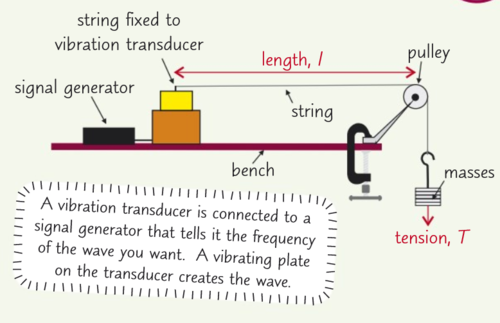
- Signal generator
- Vibration transducer / mechanical oscillator
- Pulley, masses and hanger (to apply tension)
- Metre ruler
- Micrometer (to find mass per unit length if required)
- Digital balance
- Fixed bridge/clamps
Theory
The fundamental frequency of a stretched string is:
$ f = \frac{1}{2L}\sqrt{\frac{T}{\mu}} $
- Increasing tension → higher frequency.
- Increasing length → lower frequency.
- Increasing mass per unit length → lower frequency.
This relationship is derived from wave speed:
$ v = \sqrt{\frac{T}{\mu}}, \qquad f = \frac{v}{2L} $
Procedure (General)
- Fix one end of the string and pass the other end over a pulley with masses attached (to control tension).
- Attach a vibration transducer near the fixed end and connect it to the signal generator.
- Set the string into vibration using the signal generator.
- Adjust the frequency until the first harmonic is observed (one antinode in the middle).
- Record the frequency.
- Repeat the experiment while varying:
- Length \( L \)
- Tension \( T \)
- Mass per unit length \( \mu \)

- Take several readings and calculate averages.
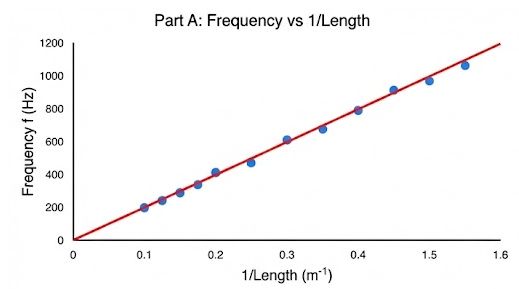
Part A: Effect of Length
- Keep tension \( T \) and mass per unit length \( \mu \) constant.
- Change the vibrating length by moving bridges along the string.
- Find the fundamental frequency for each length.
- Plot:
\( f \) on y-axis vs \( \frac{1}{L} \) on x-axis.
- A straight line should be obtained.
Part B: Effect of Tension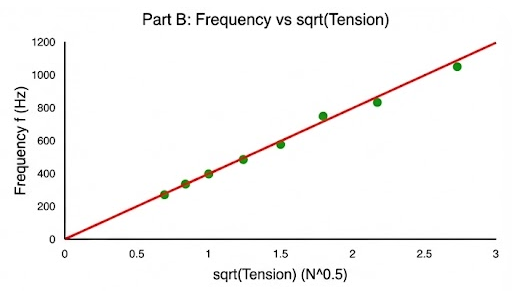
- Keep length \( L \) and mass per unit length \( \mu \) constant.
- Change tension by adding masses to hanger.
- Record frequency for each tension.
- Plot:
\( f \) vs \( \sqrt{T} \)
- A straight line should be obtained.
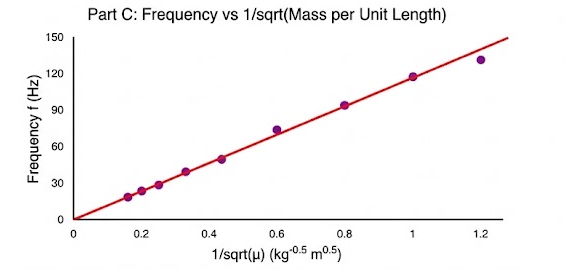
Part C: Effect of Mass per Unit Length
- Use strings or wires of different mass per unit length \( \mu \).
- Keep tension and length constant.
- Find frequency for each string.
- Plot:
\( f \) vs \( \frac{1}{\sqrt{\mu}} \)
- A straight line should be obtained.
Sources of Error
- Difficulty identifying exact resonance frequency.
- Vibrations not in the fundamental mode.
- Air resistance or damping.
- String not perfectly horizontal.
- Mass hanger friction in pulley.
- String stiffness (real strings aren’t perfectly flexible).
Improvements
- Use a well-calibrated digital signal generator.
- Take readings several times and average.
- Ensure string is straight and parallel to bench.
- Use heavier masses to reduce percentage uncertainty in tension.
- Use a low-mass, low-friction pulley.
Example Calculation
A string of length \( L = 0.80\,\mathrm{m} \), tension \( T = 16\,\mathrm{N} \), and mass per unit length \( \mu = 0.004\,\mathrm{kg\,m^{-1}} \) vibrates in its fundamental mode. Calculate the frequency.
▶️ Answer / Explanation
Step 1: Use the formula
$ f = \frac{1}{2L}\sqrt{\frac{T}{\mu}} $
Step 2: Substitute values
$ f = \frac{1}{2(0.80)}\sqrt{\frac{16}{0.004}} $
$ = \frac{1}{1.6}\sqrt{4000} = 0.625 \times 63.25 \approx 39.5\,\mathrm{Hz} $
Frequency ≈ \( 40\,\mathrm{Hz} \)