
Measuring the Refractive Index of a Solid Material
To measure the refractive index of a solid, we normally use one of the following: (1) Snell’s Law method using a rectangular or semicircular block, or (2) Critical angle method using a prism.
Both methods rely on the definition of refractive index:
$ n = \frac{\sin\theta_1}{\sin\theta_2} = \frac{c}{v} $
Method 1: Using Snell’s Law (Rectangular Glass Block)
This is the most common laboratory method.
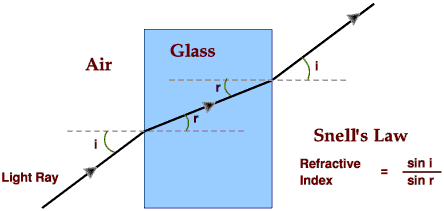
Apparatus:
- Rectangular glass block
- Ray box or laser
- Protractor
- Paper and pencil
- Pins (for ray tracing)
Procedure:
- Place the rectangular block on paper and trace around it.
- Shine a ray into the block at different angles of incidence.
- Trace the incident and emergent rays.
- Measure:
- angle of incidence \( \theta_1 \)
- angle of refraction \( \theta_2 \)
- Repeat for a range of angles.
- Plot:
\( \sin\theta_1 \) (y-axis) vs \( \sin\theta_2 \) (x-axis)
- The gradient = refractive index \( n \).
Using Snell’s law:
$ n = \frac{\sin\theta_1}{\sin\theta_2} $
Method 2: Using the Critical Angle (Prism or Block)
Useful when the material has a critical angle that can be measured directly.
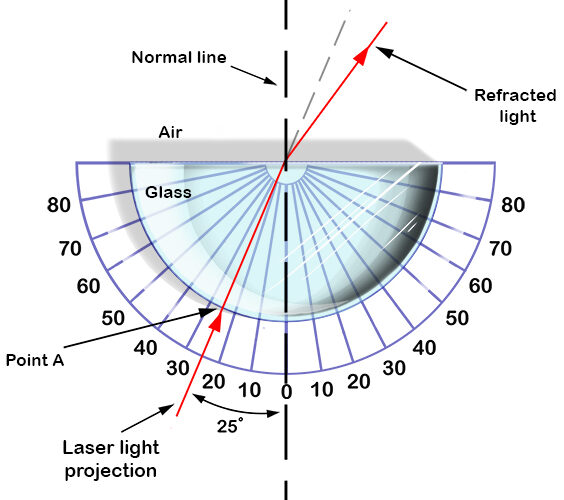
Apparatus:
- Glass or Perspex prism
- Laser or ray box
- Protractor
Procedure:
- Shine a ray inside the prism so it meets the boundary with air.
- Increase the angle of incidence until the refracted ray just disappears — the ray emerges along the boundary.
- Measure this angle → the critical angle \( C \).
- Use:
$ \sin C = \frac{1}{n} $
- Rearrange:
$ n = \frac{1}{\sin C} $
Notes and Tips
- Ensure boundaries are clean and dry.
- Use a fine, narrow laser beam for accuracy.
- Measure angles carefully with a protractor.
- Take multiple measurements and average them.
- Use a semicircular block to avoid refraction on entry.
Why semicircular blocks are helpful?
- The entry surface is curved → ray enters normal to the surface → no refraction on entry.
- This isolates refraction only at the flat face.
Example (Easy)
A ray enters a glass block with \( \theta_1 = 40^\circ \) and refracts with \( \theta_2 = 25^\circ \). Find the refractive index.
▶️ Answer / Explanation
$ n = \frac{\sin 40^\circ}{\sin 25^\circ} = \frac{0.643}{0.423} \approx 1.52 $
Refractive index ≈ 1.52
Example (Medium)
The critical angle of a solid is measured to be \( 42^\circ \). Calculate its refractive index.
▶️ Answer / Explanation
$ n = \frac{1}{\sin C} = \frac{1}{\sin 42^\circ} = \frac{1}{0.669} \approx 1.49 $
Refractive index ≈ 1.49
Example (Hard)
A beam enters a semicircular glass block of refractive index \( n \). When the ray reaches the flat surface at \( 60^\circ \), it refracts into air at \( 35^\circ \). Find \( n \).
▶️ Answer / Explanation
Using Snell’s law: $ n \sin 60^\circ = 1.00 \sin 35^\circ $ $ n = \frac{\sin 35^\circ}{\sin 60^\circ} = \frac{0.574}{0.866} \approx 0.663 $
But this is impossible because \( n < 1 \) for a solid.
This means the student measured the wrong angle — entry was not normal, or the ray did not hit the centre of the curved face.