
Plane Polarisation
Polarisation is a wave property that describes the orientation of the oscillations of a transverse wave. Only transverse waves (e.g., light, radio waves, microwaves, water waves, seismic S-waves) can be polarised. Longitudinal waves (e.g., sound) cannot be polarised because their oscillations occur along the direction of travel.
What Is Plane Polarisation?
Plane polarisation occurs when the oscillations of a transverse wave are restricted to one plane only.
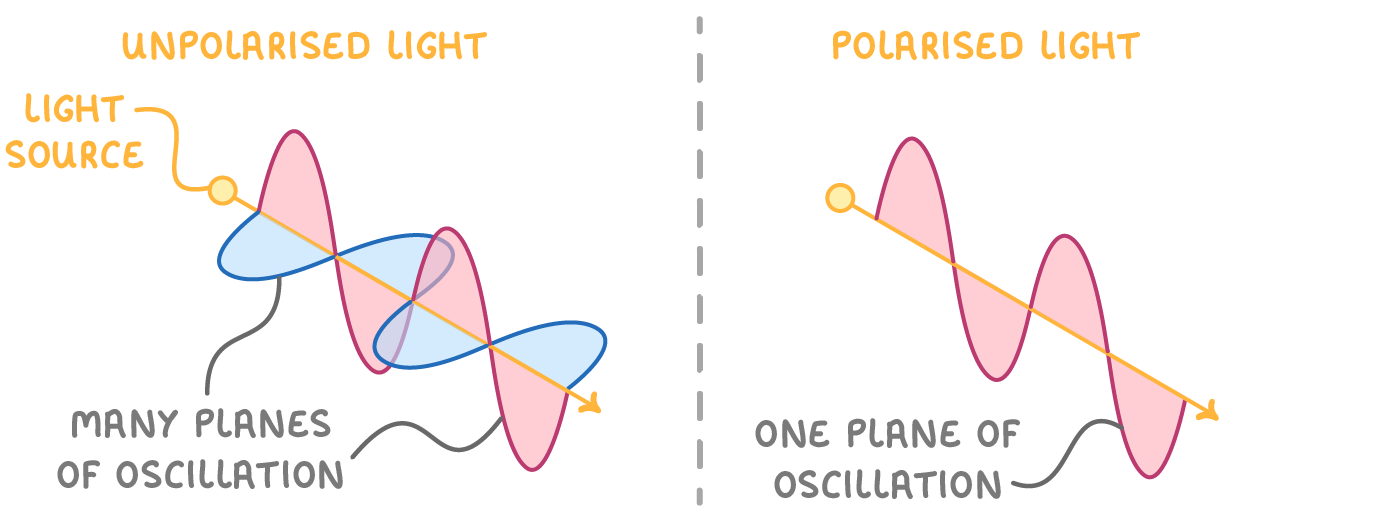
- Unpolarised waves vibrate in many random planes perpendicular to the direction of propagation.
- A plane-polarised wave vibrates in only one plane.
- The direction of propagation remains the same; only the oscillation direction changes.
Example: Light from the Sun or a bulb is unpolarised (vibrates in all planes). Passing it through a polarising filter produces plane-polarised light.
How Polarisation Occurs
There are several methods:

Characteristics of Plane-Polarised Waves
- Oscillations occur in only a single plane.
- If a polarised wave passes through another polariser:
- If axes are aligned → wave passes through.
- If axes are perpendicular → no wave passes (intensity = 0).
- Polarisation changes wave intensity:
\( I_{\text{transmitted}} = I_{\text{incident}} \cos^2\theta \)

(Malus’ law — not required here, but useful conceptually.)
Uses and Applications
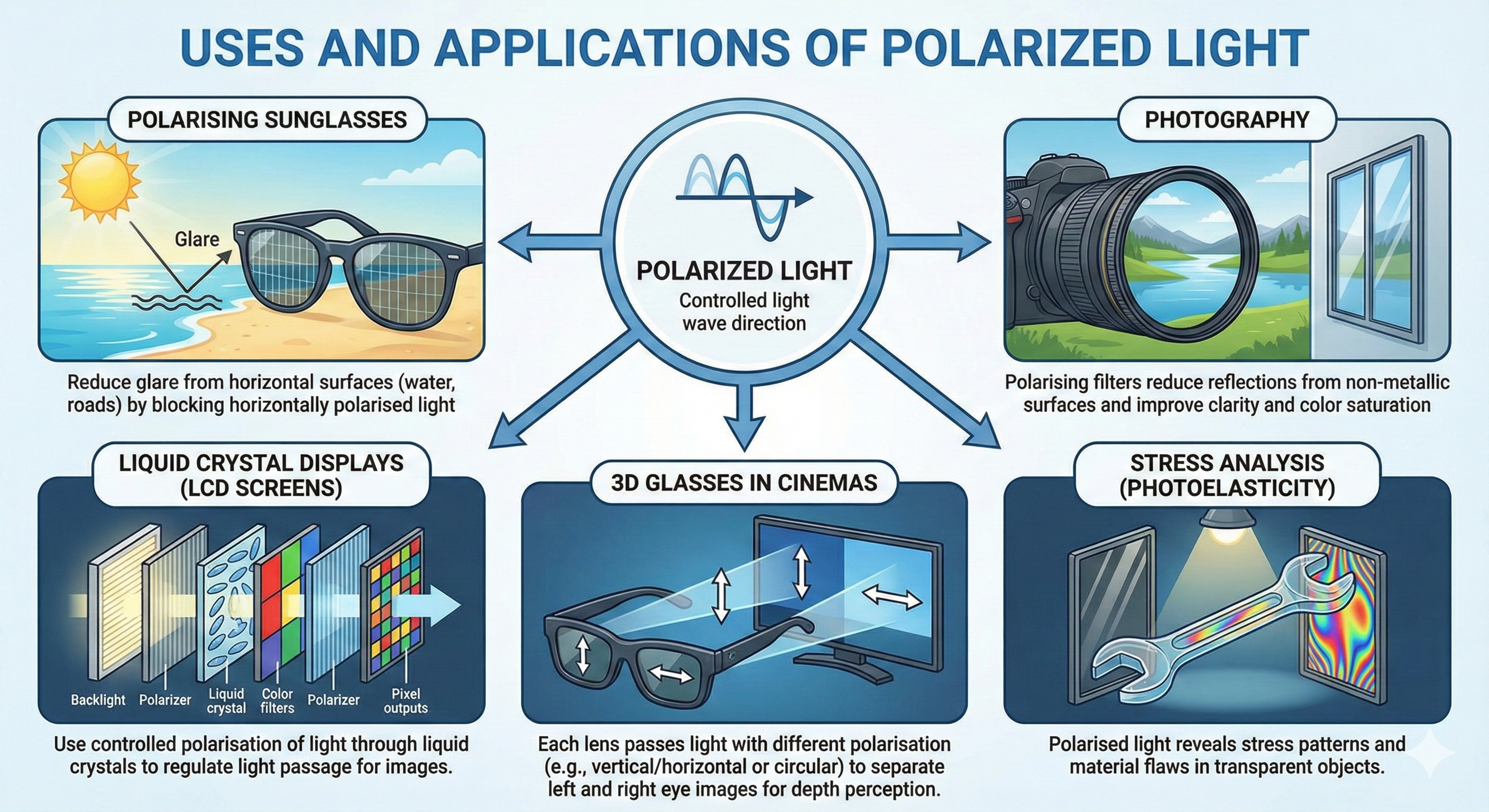
- Polarising sunglasses
- Reduce glare from horizontal surfaces by blocking horizontally polarised light.

- Reduce glare from horizontal surfaces by blocking horizontally polarised light.
- Photography
- Polarising filters reduce reflections and improve clarity.
- Liquid crystal displays (LCD screens)
- Use controlled polarisation of light through liquid crystals.
- Stress analysis in materials (photoelasticity)
- Polarised light shows stress patterns in transparent materials.
- 3D glasses in cinemas
- Each lens passes light with different polarisation → separate left and right eye images.
Identifying Polarisation in Experiments
- Rotate a polarising filter in front of a light source:
- Unpolarised light → intensity varies continuously as filter rotates.
- Plane-polarised light → intensity falls to zero at 90° rotation.
- Using microwaves: A metal grille acts as a polariser by blocking oscillations parallel to its wires.
Example (Easy)
What type of wave can be plane-polarised?
▶️ Answer / Explanation
- Only transverse waves can be polarised.
- Examples: light, microwaves, radio waves.
Example (Medium)
If plane-polarised light passes through a second polariser rotated by 90°, what happens to the intensity?
▶️ Answer / Explanation
Intensity becomes zero because the oscillations cannot pass through a perpendicular axis.
Example (Hard)
A microwave transmitter produces plane-polarised radiation. When a metal grille is placed in the path, the intensity falls to zero. What does this tell you about the orientation of the electric field?
▶️ Answer / Explanation
- A metal grille absorbs electric field oscillations parallel to its wires.
- If intensity becomes zero, the electric field must be oscillating parallel to the wires.
- Thus, the grille acts as a polariser by removing that component.