
Transmission and Reflection of Waves at an Interface
When a wave meets the boundary between two different media, part of the wave is transmitted into the second medium and part is reflected back into the first medium. This behaviour occurs for all types of waves: light, sound, water waves, seismic waves, etc.
What Happens at an Interface?
A wave carries energy. When it reaches a boundary:

- Some energy is reflected (wave bounces back).
- Some energy is transmitted (wave passes into the next medium).
- The proportions depend on differences in properties of the two media (density, refractive index, impedance).
Reflection at an Interface
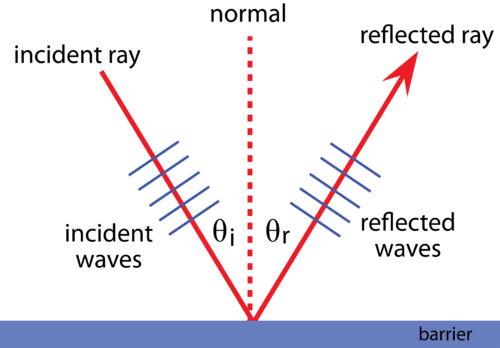
- The wave returns back into the original medium.
- The law of reflection applies:
\( \theta_i = \theta_r \)
- If the wave moves into a denser medium, more reflection occurs.
- Reflection may involve a phase change (e.g., for light or waves on a string).
Transmission at an Interface
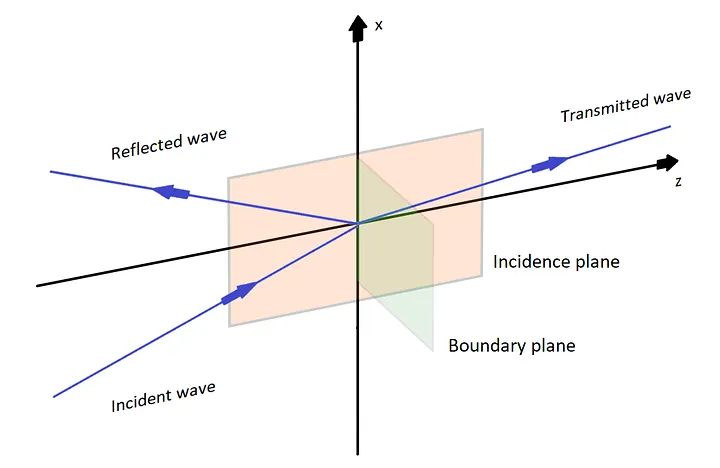
- The transmitted wave continues into the second medium.
- Its speed, wavelength, and sometimes direction change.
- Frequency remains constant because the source determines frequency.
For light, transmission involves refraction:
\( n_1\sin\theta_1 = n_2\sin\theta_2 \)
Energy Distribution
At a boundary, wave energy is split:

- High contrast between media → strong reflection, weak transmission.
- Low contrast → weak reflection, strong transmission.
Special case: At the critical angle, 100% transmission becomes impossible → total internal reflection may occur.
Examples of Reflection & Transmission
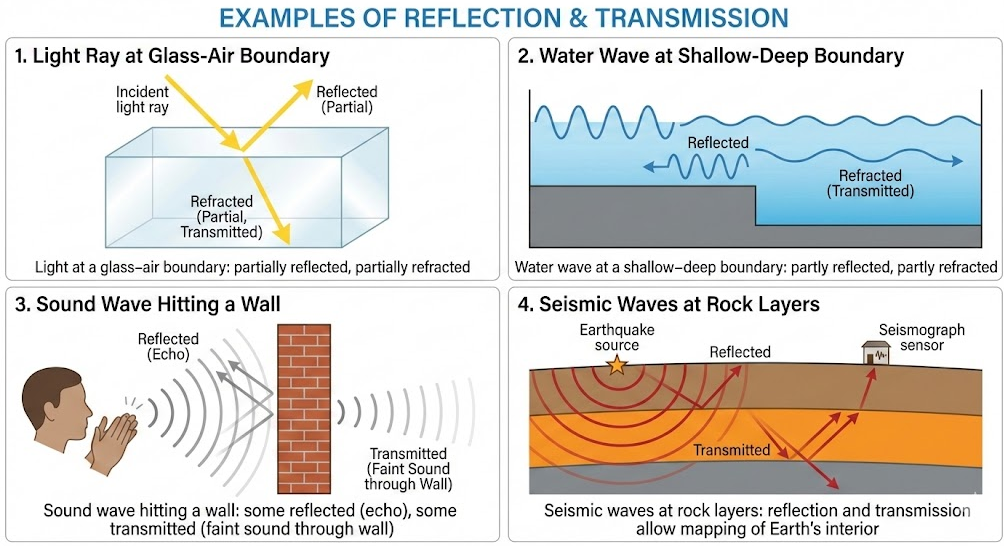
- Light ray at a glass–air boundary: partially reflected, partially refracted.
- Water wave at a shallow–deep boundary: partly reflected, partly refracted.
- Sound wave hitting a wall: some reflected (echo), some transmitted (faint sound through wall).
- Seismic waves at rock layers: reflection and transmission allow mapping of Earth’s interior.
Why Transmission and Reflection Occur
- Wave properties (speed, impedance, refractive index) differ between media.
- Boundary conditions require continuity of displacement and energy flow.
- As a result, energy splits between returning (reflected) and continuing (transmitted) waves.
Example (Easy)
What happens when a light wave hits a glass–air boundary?
▶️ Answer / Explanation
- Part of the wave is reflected (weak reflection).
- Most of the wave is transmitted and refracted away from the normal.
Example (Medium)
A sound wave hits a boundary between warm air and cold air. Explain what happens.
▶️ Answer / Explanation
- Some sound is reflected because the densities differ.
- Most sound is transmitted, but speed and wavelength change.
- Frequency stays the same.
Example (Hard)
A wave pulse travels along a light string attached to a heavy rope. Describe reflection and transmission at the boundary.
▶️ Answer / Explanation
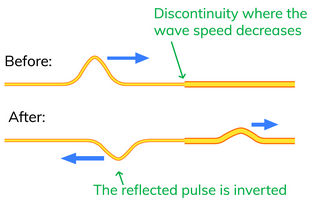
- Most energy is reflected because the second medium has much higher mass per unit length.
- The reflected pulse is inverted (phase change of \( \pi \)).
- A small transmitted pulse enters the heavier rope with reduced speed and wavelength.
- Frequency remains unchanged.