
Pulse–Echo Technique: Determining the Position of an Object
The pulse–echo technique is used in ultrasound, sonar, radar, and medical imaging. A short pulse of radiation (sound waves, radio waves, or ultrasound) is sent toward an object. The pulse reflects (echoes) back, and the time taken for its return is used to determine the object’s position.
How the Pulse–Echo Technique Works
- A transmitter emits a short pulse of waves.
- The waves travel to the object.
- The object reflects the pulse back toward the detector.
- The time taken for the echo to return is measured.
The distance to the object is found using:
\( \text{distance} = \dfrac{vt}{2} \)
- \( v \) = speed of the wave in the medium
- \( t \) = time for the echo to return
- The factor \( 2 \) is because the pulse travels to the object and back.
Uses of the Pulse–Echo Method
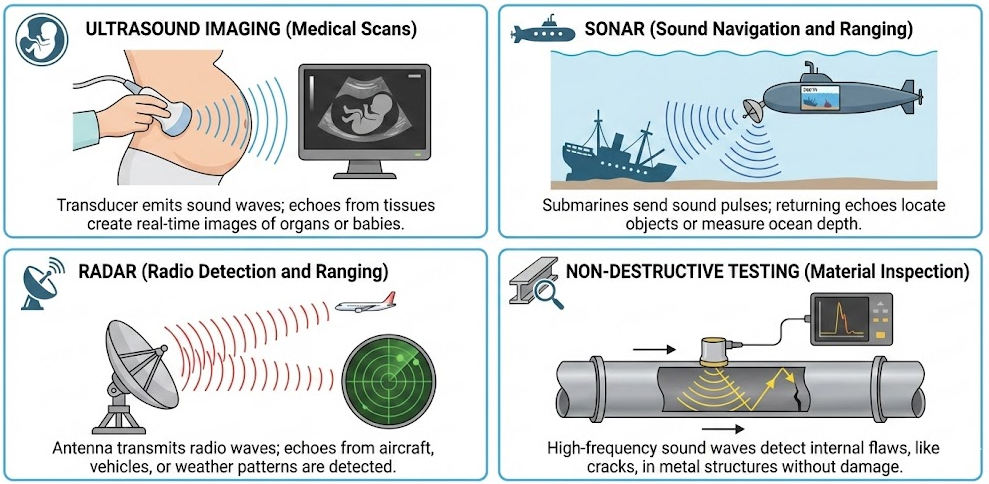
- Ultrasound imaging (medical scans of organs/babies)
- Sonar (submarines locating objects or ocean depth)
- Radar (detecting aircraft, vehicles, weather patterns)
- Non-destructive testing (cracks in metal structures)
Limitations of the Technique
Two major factors limit the resolution and accuracy:
A. Limitation Due to Wavelength
- To detect small objects, the wavelength must be smaller than the size of the object.
- If the wavelength is too large:
- the wave diffracts strongly
- the echo becomes weak or spread out
- small object details cannot be resolved

- Ultrasound uses high-frequency sound because it has a short wavelength.
- Radio waves (long wavelength) cannot detect very small objects.
B. Limitation Due to Pulse Duration
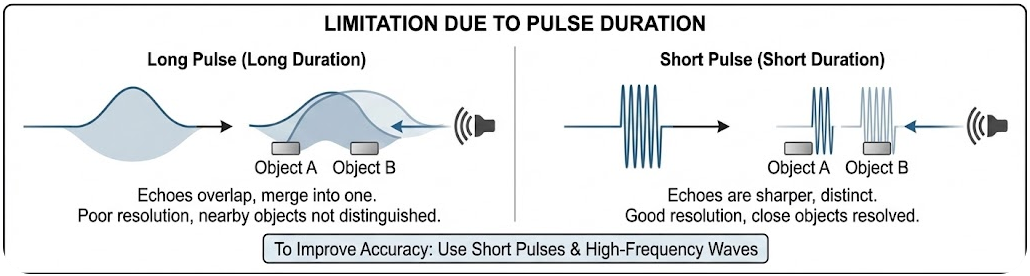
- If the pulse is long (time duration large):
- the beginning and end of the echo overlap
- reflections from closely spaced objects merge into one
- poor resolution → cannot distinguish nearby objects
- If the pulse is short (short duration):
- echoes are sharper
- close reflections can be resolved
- greater detail obtained
Why Wavelength and Pulse Duration Limit Information
- You cannot detect an object smaller than the wavelength → wave “waves around it.”
- You cannot distinguish two echoes closer in time than the pulse duration → they overlap.
- These limitations together set the resolution of imaging systems.
Example (Easy)
An ultrasound pulse takes \( 0.012\ \mathrm{s} \) to return. The speed of ultrasound in tissue is \( 1600\ \mathrm{m\,s^{-1}} \). How far away is the object?
▶️ Answer / Explanation
\( \text{distance} = \dfrac{vt}{2} = \dfrac{1600 \times 0.012}{2} = 9.6\ \mathrm{m} \)
Example (Medium)
Why does using a high-frequency ultrasound wave improve image resolution?
▶️ Answer / Explanation
- Higher frequency → shorter wavelength.
- Shorter wavelength → better ability to detect small objects.
- Less diffraction → sharper echoes and clearer boundaries.
Example (Hard)
A radar pulse lasts \( 5\times10^{-6}\ \mathrm{s} \). How close can two aircraft be before their echoes overlap? (The speed of radio waves = \( 3.0\times10^{8}\ \mathrm{m\,s^{-1}} \))
▶️ Answer / Explanation
Step 1: Find distance travelled during pulse duration.
\( d = vt = (3.0\times10^{8})(5\times10^{-6}) = 1500\ \mathrm{m} \)
The pulse travels out and back:
Minimum separation = \( \dfrac{1500}{2} = 750\ \mathrm{m} \)
Two aircraft closer than 750 m cannot be distinguished.