
Longitudinal Waves: Pressure Variation and Displacement of Molecules
Longitudinal waves are waves in which the particles of the medium oscillate parallel to the direction of wave travel. Examples include sound waves in air, ultrasound waves, and compression waves in springs.
Particle Displacement in Longitudinal Waves
As the wave travels, particles oscillate back and forth about their equilibrium position.
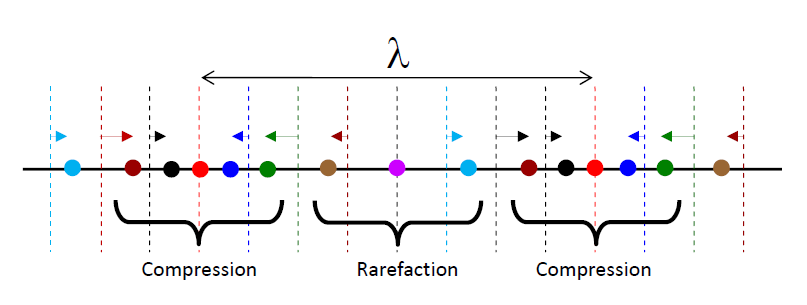
- The displacement of molecules is along the same line as the direction of energy transfer.
- Molecules move forward and backward, but the wave itself travels forward.
- Energy is transferred, but the molecules themselves do not travel with the wave.
Key idea: Particles oscillate; the wave propagates.
Pressure Variations in Longitudinal Waves
Longitudinal waves consist of alternating:
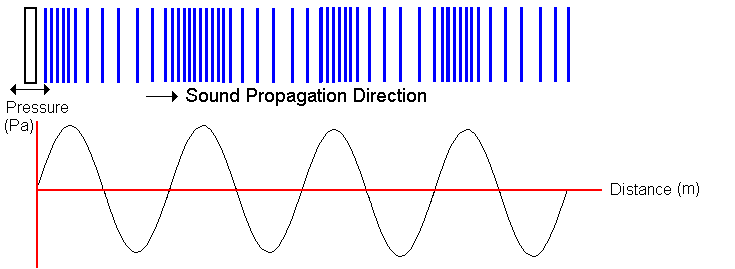
- Compressions: regions where particles are closer together → high pressure.
- Rarefactions: regions where particles are further apart → low pressure.
As the wave moves, pressure varies periodically at any point in the medium.
Pressure ↑ during compressions
Pressure ↓ during rarefactions
The Link Between Pressure and Displacement
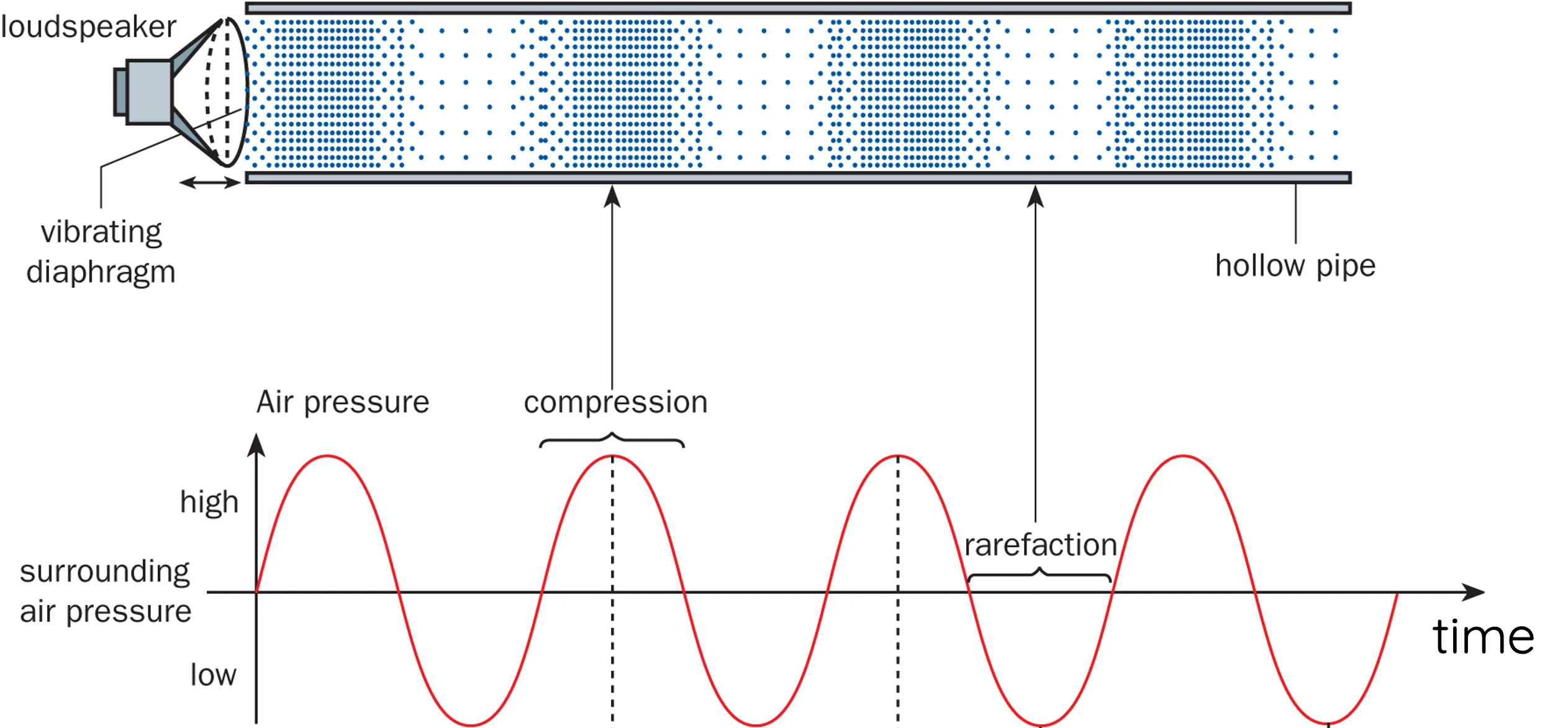
- Where particles are displaced closer together → region of high pressure.
- Where particles are displaced further apart → region of low pressure.
- Particle displacement and pressure variation are 90° out of phase:
- Maximum compression occurs when particle velocity is zero.
- Maximum displacement occurs midway between compressions.
Visual Description

- Imagine a slinky pushed and pulled along its length.
- When coils are pushed → compression.
- When coils are pulled apart → rarefaction.
- Each coil moves back and forth, not along the entire length of the slinky.
Properties of Longitudinal Waves
- Require a medium (cannot travel in vacuum).
- Wave speed depends on properties of medium:
- faster in solids
- slower in liquids
- slowest in gases
- Frequency and wavelength still follow \( v = f\lambda \).
Example (Easy)
In a longitudinal wave, which direction do the particles oscillate compared to the direction of wave travel?
▶️ Answer / Explanation
Particles oscillate parallel to the direction of wave travel.
Example (Medium)
Explain how pressure changes in a sound wave as it travels through air.
▶️ Answer / Explanation
- When air molecules are pushed closer → pressure increases (compression).
- When they spread out → pressure decreases (rarefaction).
- These alternating high/low pressure regions move along with the wave.
Example (Hard)
Describe the phase relationship between particle displacement and pressure variation in a longitudinal wave.
▶️ Answer / Explanation
- Maximum compression occurs when particle displacement = 0 (change of direction).
- Maximum displacement occurs midway between a compression and rarefaction.
- Thus, pressure and displacement are 90° out of phase.
Transverse Waves
Transverse waves are waves in which the particles of the medium oscillate perpendicular to the direction of wave travel. They occur in many physical systems, including water waves, electromagnetic waves, and waves on strings.
Particle Motion in a Transverse Wave
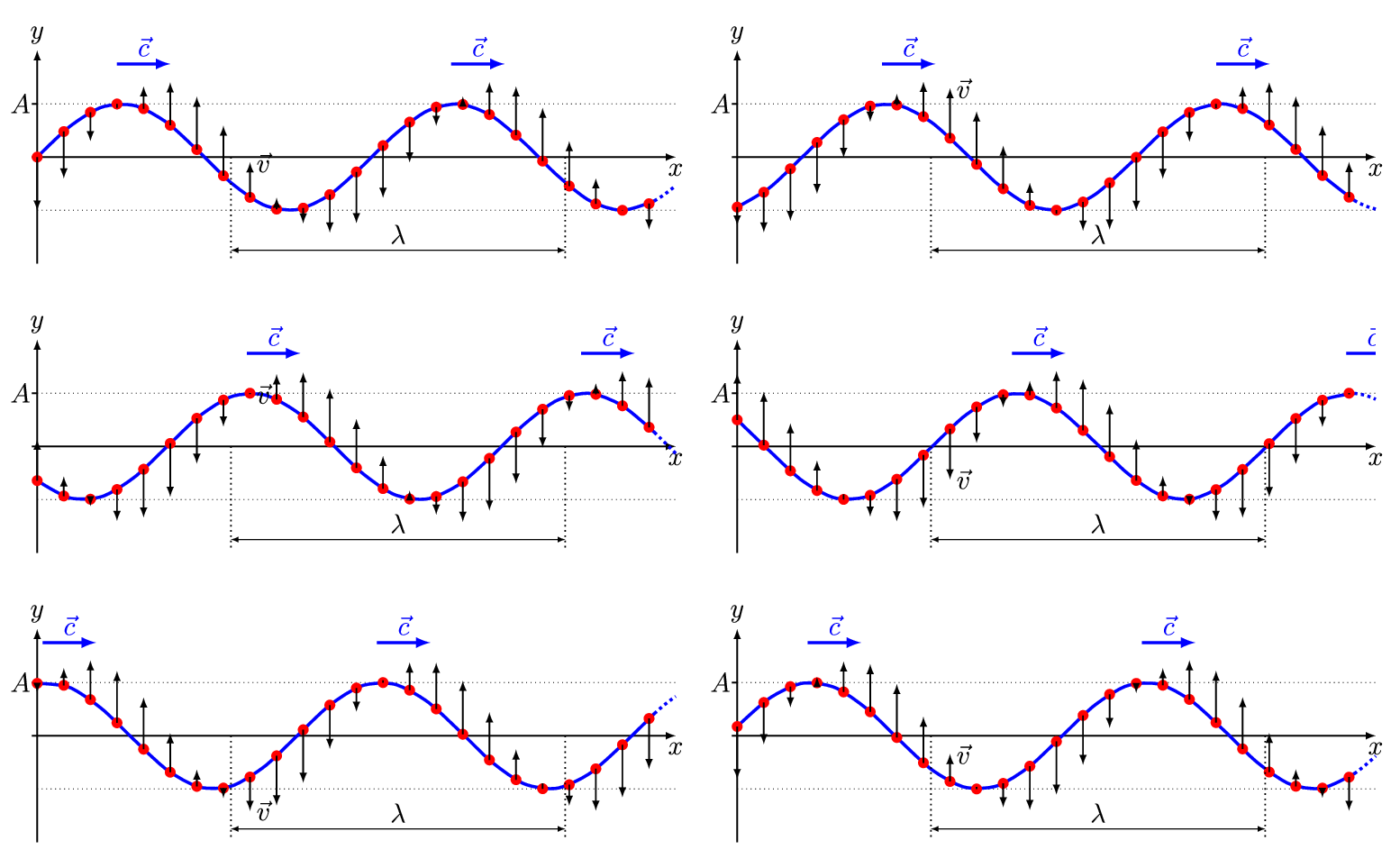
- Particles vibrate up and down or side to side.
- The direction of oscillation is at right angles to the direction of wave propagation.
- The particles do not travel with the wave; only energy is transferred.
Key idea: Oscillation ⟂ Direction of wave travel.
Features of a Transverse Wave

- Crest: highest point of the wave.
- Trough: lowest point of the wave.
- Wavelength (\( \lambda \)): distance between consecutive crests or troughs.
- Amplitude: maximum displacement from the equilibrium position.
Examples of Transverse Waves

- Waves on a stretched rope or string.
- Water ripples on pond surfaces.
- Electromagnetic waves (light, radio, X-rays).
- Seismic S-waves inside the Earth.
Important note: Electromagnetic waves are always transverse.
Comparison with Longitudinal Waves
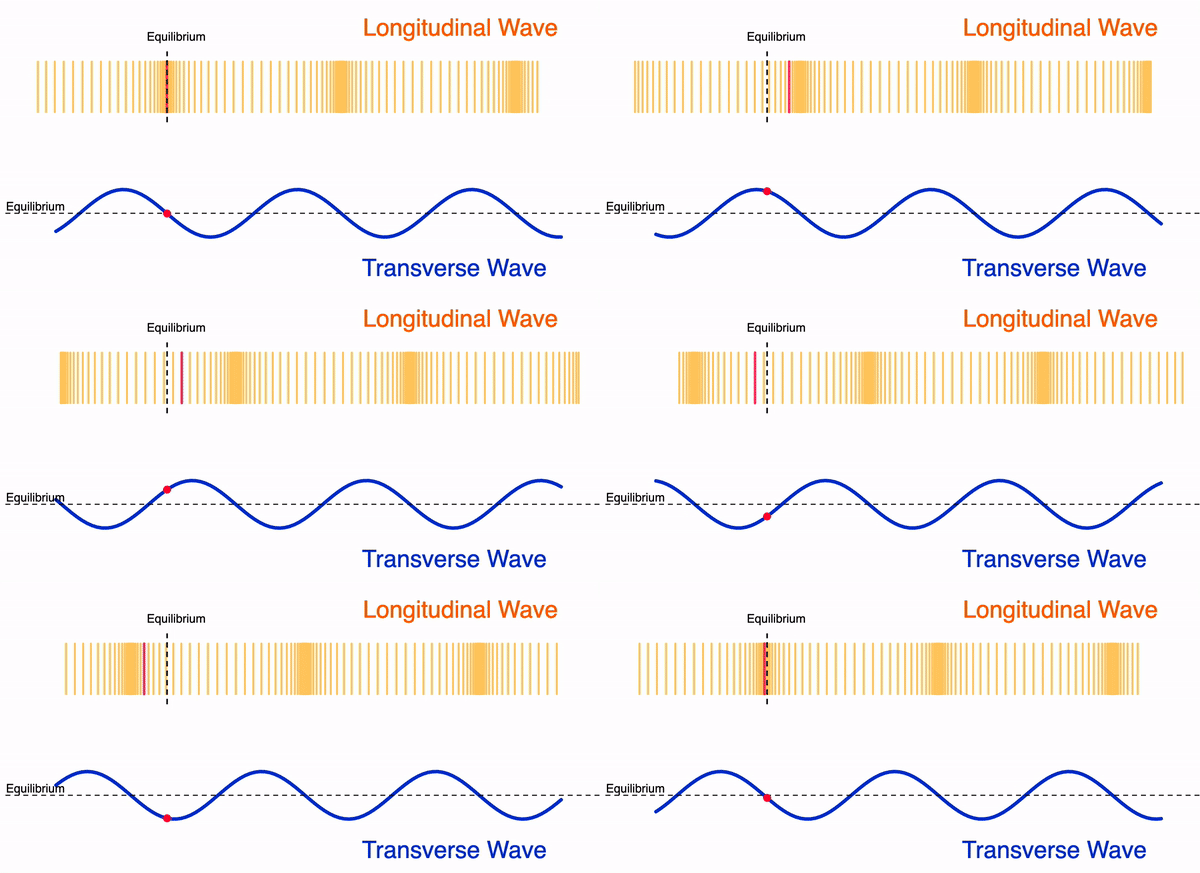
- In transverse waves → displacement ⟂ wave direction.
- In longitudinal waves → displacement ∥ wave direction.
- Pressure variation occurs in longitudinal waves, not in transverse waves.
Properties of Transverse Waves
- Can travel in solids and on surfaces of liquids.
- Cannot travel through fluids (liquids or gases) in bulk — particles cannot support shear motion.
- Still follow \( v = f\lambda \) for wave speed.
- Energy increases with amplitude.
Example (Easy)
In a transverse wave, which direction do particles oscillate relative to the direction of wave travel?
▶️ Answer / Explanation
Particles oscillate perpendicular to the direction of the wave.
Example (Medium)
A water wave has a frequency of \( 2.0\,\mathrm{Hz} \) and travels at \( 1.5\,\mathrm{m\,s^{-1}} \). Find its wavelength.
▶️ Answer / Explanation
\( \lambda = \frac{v}{f} = \frac{1.5}{2.0} = 0.75\, \mathrm{m} \)
Example (Hard)
An earthquake produces transverse S-waves travelling at \( 3500\,\mathrm{m\,s^{-1}} \) with a wavelength of \( 700\,\mathrm{m} \). Calculate the frequency of the wave.
▶️ Answer / Explanation
\( f = \frac{v}{\lambda} = \frac{3500}{700} = 5\,\mathrm{Hz} \)