
Resistance \( R = \dfrac{V}{I} \) and Ohm’s Law
Electrical resistance describes how much a component opposes the flow of electric current. It represents how difficult it is for charges to pass through a material or device.
Defining Resistance
The resistance \( R \) of a component is defined using the potential difference \( V \) across it and the current \( I \) flowing through it:

\( R = \dfrac{V}{I} \)
- \( R \) = resistance (ohms, \( \Omega \))
- \( V \) = potential difference (volts, V)
- \( I \) = current (amperes, A)
Meaning: A component with higher resistance allows less current to flow for the same applied voltage.
Understanding Resistance Physically
- Electrons collide with atoms inside the material.
- More collisions → more opposition → higher resistance.
- Thin, long, or hot wires usually have higher resistance.
- Good conductors (e.g., copper) have low resistance.
Ohm’s Law
Ohm’s law states:
\( I \propto V \quad \text{when temperature is constant} \)
Or equivalently:
\( V = IR \)
- Resistance remains constant as long as temperature does not change.
- This linear relationship applies only to ohmic conductors.
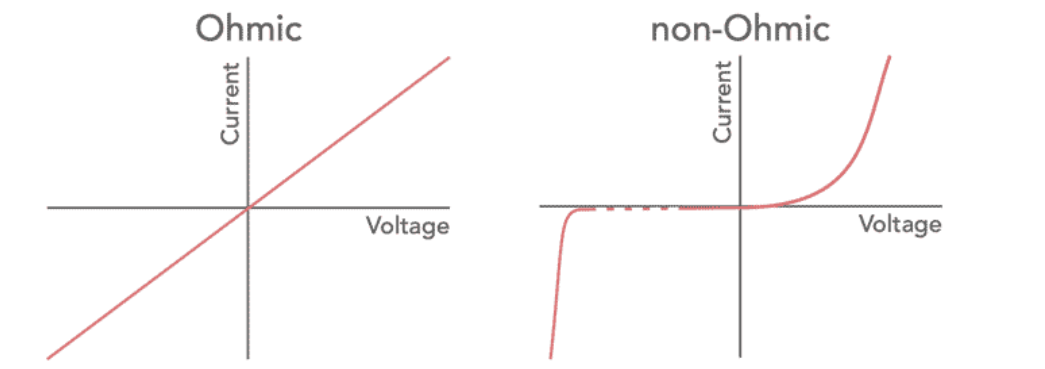
Ohmic devices: resistors, metal wires at constant temperature.
Non-ohmic devices: filament lamps, diodes, thermistors — they do not obey Ohm’s law.
Resistance from V–I Graphs
An ohmic conductor gives a straight-line V–I graph through the origin.

- Gradient of \( V \)–\( I \) graph:
\( \text{gradient} = R \)
- Gradient of \( I \)–\( V \) graph:
\( \text{gradient} = \dfrac{1}{R} \)
Temperature Effects
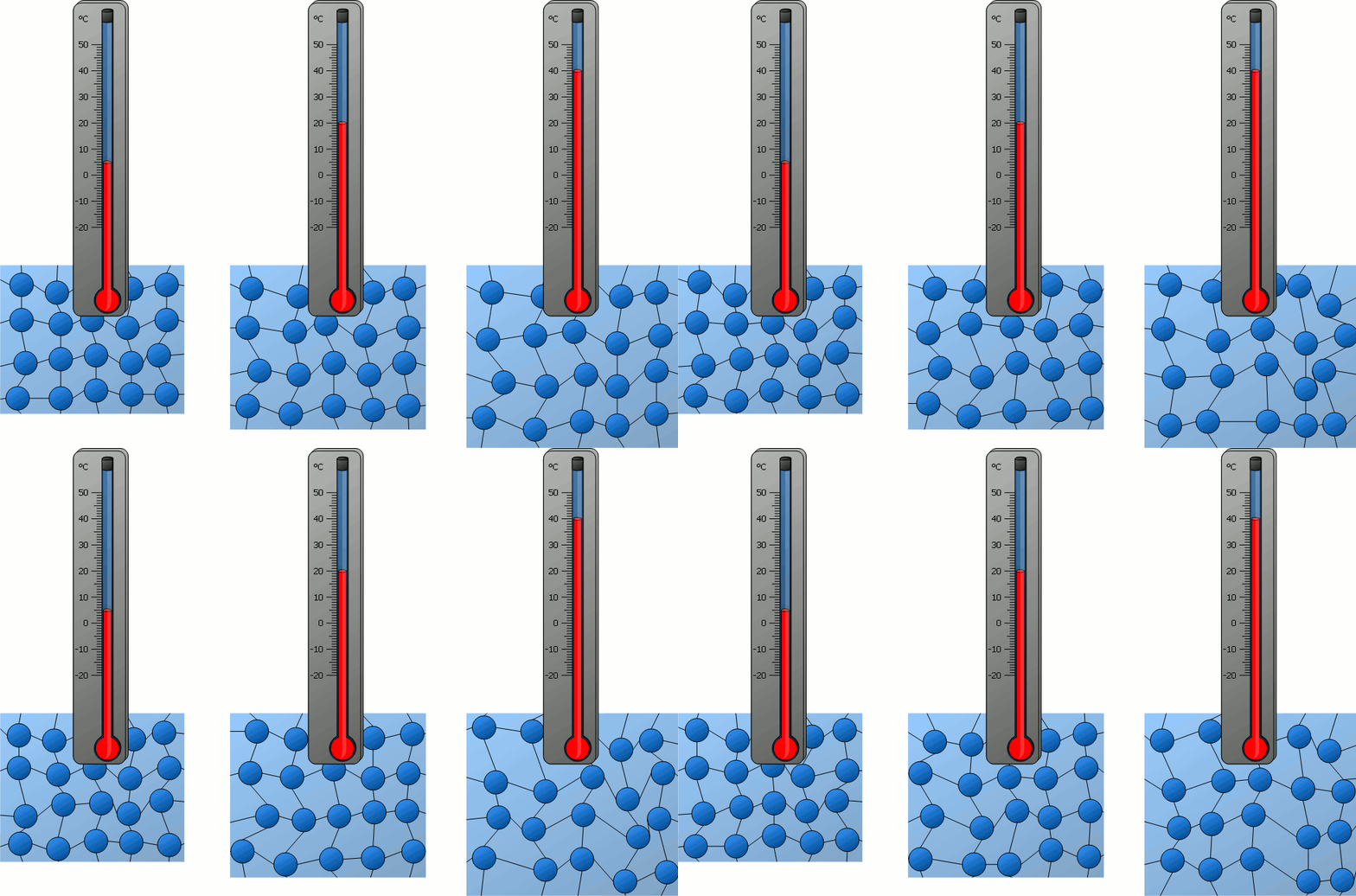
- Increasing temperature increases lattice vibrations.
- More collisions → higher resistance.
- Thus Ohm’s law may no longer hold if temperature changes.
Example (Easy)
A component has \( V = 10\ \mathrm{V} \) across it and a current of \( 2\ \mathrm{A} \). Find its resistance.
▶️ Answer / Explanation
\( R = \dfrac{V}{I} = \dfrac{10}{2} = 5\ \Omega \)
Example (Medium)
A resistor obeys Ohm’s law. If the current is \( 0.5\ \mathrm{A} \) when the voltage is \( 6\ \mathrm{V} \), what is the current when the voltage is increased to \( 12\ \mathrm{V} \)?
▶️ Answer / Explanation
Resistance is constant for an ohmic device:
\( R = \dfrac{6}{0.5} = 12\ \Omega \)
At 12 V:
\( I = \dfrac{V}{R} = \dfrac{12}{12} = 1\ \mathrm{A} \)
Example (Hard)
A component has a non-linear V–I graph. At \( 4\ \mathrm{V} \), the current is \( 0.8\ \mathrm{A} \); at \( 8\ \mathrm{V} \), the current is \( 1.0\ \mathrm{A} \). Is this component ohmic? Explain.
▶️ Answer / Explanation
Check resistance at both points:
At 4 V: \( R = \dfrac{4}{0.8} = 5\ \Omega \)
At 8 V: \( R = \dfrac{8}{1.0} = 8\ \Omega \)
- Resistance changes from \( 5\ \Omega \) to \( 8\ \Omega \).
- Since \( R \) is not constant → the component does not obey Ohm’s law.