
Current and Drift Velocity \( I = nqvA \)
The current in a conductor is carried by charged particles (usually electrons in metals). The equation \( I = nqvA \) links current to microscopic properties of the material and helps explain why different materials have vastly different resistivities.
The Drift Velocity Equation
The electric current is given by:
\( I = nqvA \)
- \( I \) = current (A)
- \( n \) = number of charge carriers per unit volume (m⁻³)
- \( q \) = charge of each carrier (C)
- \( v \) = drift velocity (m s⁻¹)
- \( A \) = cross-sectional area of conductor (m²)
Meaning: Current depends on how many charges are available to move and how quickly they drift through the material.
What Is Drift Velocity?
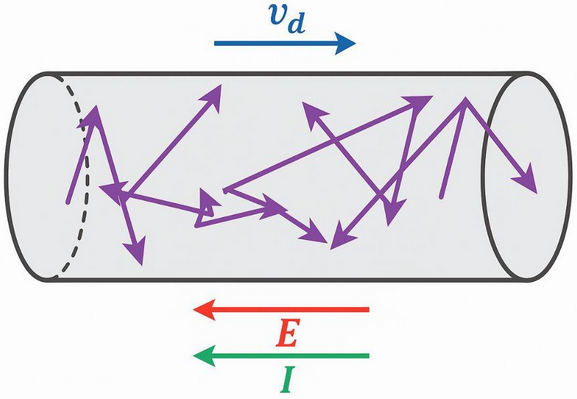
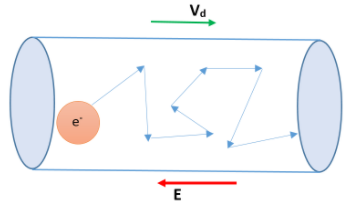
- Electrons move randomly, but when an electric field is applied, they drift slowly in one direction.
- This average slow movement is called the drift velocity.
- Typical drift velocity in a metal wire is extremely small (~0.1 mm/s).
- The reason current is large is because \( n \), the number of free electrons, is extremely high.
Explaining Resistivity Using \( I = nqvA \)
Ohm’s law (microscopic form) links drift velocity and resistivity. Different materials have very different resistivities because of differences in:
- Number of free charge carriers \( n \)
- Drift velocity \( v \) (affected by scattering/collisions)
- Charge carrier mobility
- Atomic structure and electron availability
High Conductivity (Low Resistivity):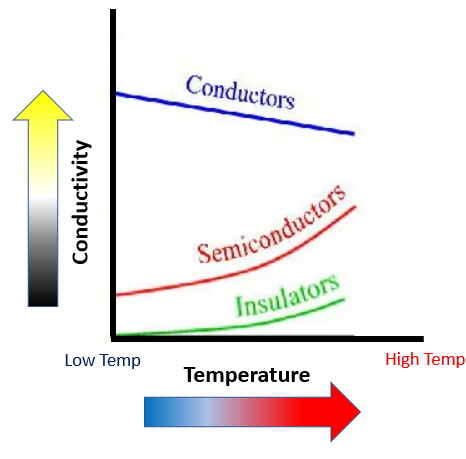
- Large \( n \) → many electrons free to move
- Large \( v \) → electrons drift easily with fewer collisions
- Metals like copper, silver have very high carrier density and low resistance
Low Conductivity (High Resistivity):
- Small \( n \) → few charge carriers
- Small \( v \) → many collisions, high opposition to flow
- Insulators (rubber, glass): almost no free electrons → very high resistivity
Semiconductors:
- Moderate \( n \)
- Resistivity decreases strongly with temperature (more charge carriers released)
- Explained well by \( I = nqvA \)
Microscopic Connection to Resistivity
Resistivity is given by:
\( \rho = \dfrac{1}{nq\mu} \)
where \( \mu \) is carrier mobility. Thus:
- Large \( n \) → small \( \rho \)
- Large mobility → small \( \rho \)
This links directly with the drift velocity model and explains the huge range of resistivities across materials.
Example (Easy)
A copper wire has cross-sectional area \( 1.0\times10^{-6}\ \mathrm{m^{2}} \). The number density of free electrons is \( 8.5\times10^{28}\ \mathrm{m^{-3}} \). The drift velocity is \( 2.0\times10^{-4}\ \mathrm{m/s} \). Find the current.
▶️ Answer / Explanation
\( I = nqvA \)
\( I = (8.5\times10^{28})(1.6\times10^{-19})(2.0\times10^{-4})(1.0\times10^{-6}) \)
\( I \approx 2.72\ \mathrm{A} \)
Example (Medium)
Why does copper have much lower resistivity than nichrome?
▶️ Answer / Explanation
- Copper has a much larger number density of free electrons \( n \).
- Electrons in copper experience fewer collisions → higher drift velocity \( v \).
- Thus \( I = nqvA \) is larger for the same electric field → lower resistivity.
Example (Hard)
Silicon has a free electron density of only \( 1\times10^{16}\ \mathrm{m^{-3}} \) at room temperature, whereas copper has \( 8.5\times10^{28}\ \mathrm{m^{-3}} \). Explain how this leads to their very different resistivities.
▶️ Answer / Explanation
- Silicon has \( 10^{12} \) times fewer charge carriers than copper.
- With such a small \( n \), the current \( I = nqvA \) is extremely small unless very large voltages are applied.
- This makes its resistivity extremely high (insulator-like).
- Copper has abundant free electrons → very large \( n \) → small resistivity.
Therefore, the huge range of resistivities among materials is largely due to differences in carrier number density \( n \) and mobility (affecting drift velocity).