
Electromotive Force (e.m.f.), Internal Resistance and Terminal Potential Difference
Cells and power supplies provide energy to a circuit, but real sources are not ideal. They have an internal resistance that affects the voltage delivered to the external load.
Electromotive Force (e.m.f.) — Definition
The e.m.f. \( \mathcal{E} \) of a source is the energy supplied per unit charge by the source when no current is flowing.

\( \mathcal{E} = \dfrac{W}{Q} \)
- Units: volts (V)
- It is the maximum possible voltage the cell can supply.
- Measured when the circuit is open (no current drawn).
Internal Resistance \( r \)
Every cell or power supply has some resistance inside it due to its construction. This is called internal resistance.
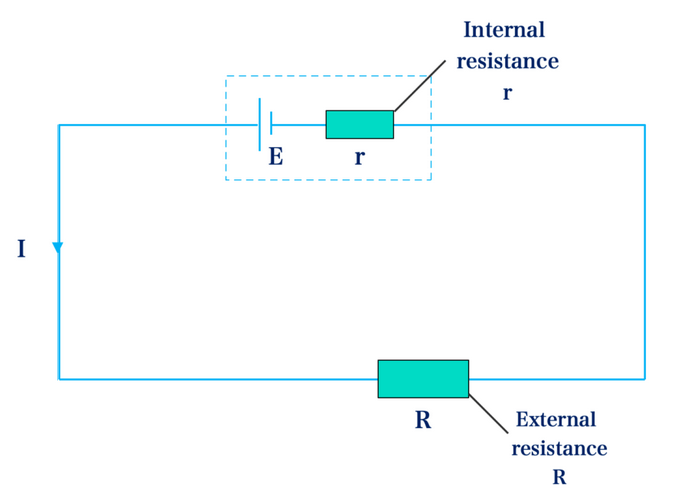
- Causes a voltage drop inside the cell.
- Energy is lost as heat inside the cell.
- Reduces the terminal voltage when current flows.
Voltage lost inside cell:
\( V_{\text{lost}} = Ir \)
Terminal Potential Difference (t.p.d.)
The terminal potential difference \( V \) is the voltage available across the external circuit when current is flowing.

\( V = \mathcal{E} – Ir \)
Thus:
- Terminal p.d. is always less than the e.m.f. when current flows.
- The greater the current, the larger the internal voltage loss \( Ir \), and the smaller the t.p.d.
- If no current flows (\( I = 0 \)) → \( V = \mathcal{E} \).
Distinguishing e.m.f. and Terminal p.d.

| Quantity | Definition | When measured |
|---|---|---|
| e.m.f. \( \mathcal{E} \) | Energy provided per unit charge by the source | When no current flows (open circuit) |
| Terminal p.d. \( V \) | Voltage across external load while current flows | When circuit delivers power to a load |
Circuit Equation Including Internal Resistance
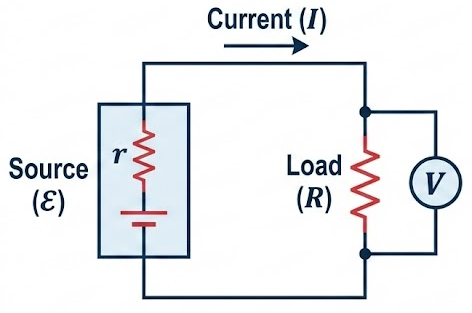
For a source with internal resistance \( r \) and external load \( R \):
\( \mathcal{E} = V + Ir \)
And since \( V = IR \):
\( \mathcal{E} = IR + Ir = I(R + r) \)
Using Graphs to Determine \( r \) and \( \mathcal{E} \)
Plot terminal voltage \( V \) against current \( I \):
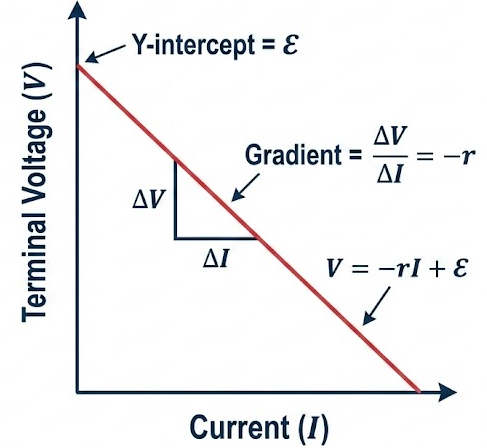
- Straight line of form \( V = -rI + \mathcal{E} \)
- Gradient = \( -r \)
- Y-intercept = \( \mathcal{E} \)
Example (Easy)
A cell has an e.m.f. of \( 6.0\ \mathrm{V} \) and no current is drawn from it. What is its terminal p.d.?
▶️ Answer / Explanation
No current → \( I = 0 \)
\( V = \mathcal{E} – Ir = 6.0 – 0 = 6.0\ \mathrm{V} \)
Example (Medium)
A 12 V battery has internal resistance \( 0.40\ \Omega \). If it supplies \( 3.0\ \mathrm{A} \), calculate the terminal p.d.
▶️ Answer / Explanation
\( V = \mathcal{E} – Ir = 12 – (3.0)(0.40) = 12 – 1.2 = 10.8\ \mathrm{V} \)
Example (Hard)
A cell has e.m.f. \( 9.0\ \mathrm{V} \) and internal resistance \( 0.50\ \Omega \). It is connected to an external resistor \( R \), and the terminal voltage is measured to be \( 6.0\ \mathrm{V} \). Find the current and the value of \( R \).
▶️ Answer / Explanation
Step 1: Find current.
\( V = \mathcal{E} – Ir \)
\( 6.0 = 9.0 – 0.50I \)
\( 0.50I = 3.0 \Rightarrow I = 6.0\ \mathrm{A} \)
Step 2: Find external resistance.
\( V = IR \Rightarrow R = \dfrac{6.0}{6.0} = 1.0\ \Omega \)