
Temperature Dependence of Resistance: Lattice Vibrations and Conduction Electrons
Electrical resistance depends strongly on temperature. This behaviour can be explained using a microscopic model involving lattice vibrations and the number of conduction electrons. Different materials behave differently — especially metals and NTC thermistors.
Metallic Conductors — Why Resistance Increases with Temperature
In metals, conduction is due to free electrons moving through a lattice of positive ions.
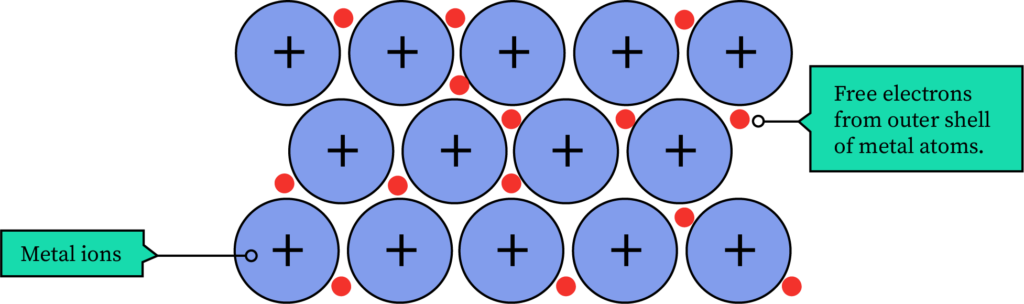
When temperature increases:
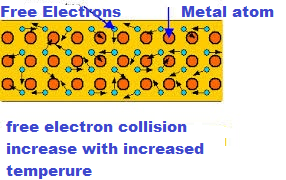
- The metal ions vibrate more vigorously (increased lattice vibrations).
- Electrons collide more frequently with the vibrating ions.
- More collisions → electrons lose momentum more often.
- Drift velocity decreases for the same applied voltage.
Result: Resistance increases with temperature.
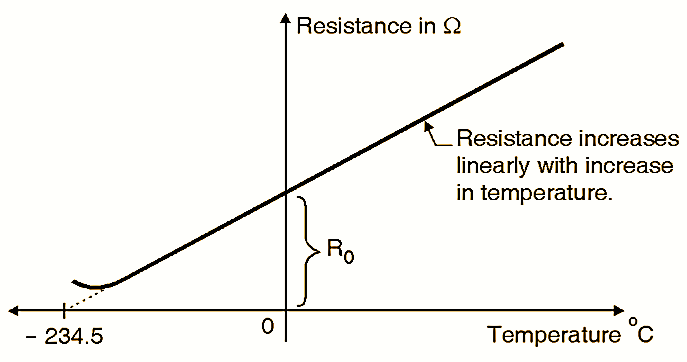
\( R \uparrow \quad \text{as} \quad T \uparrow \)
Reason (microscopic): increased electron–ion collisions.
NTC Thermistors — Why Resistance Decreases with Temperature
In semiconductors (including NTC thermistors), conduction works differently.
When temperature increases:
- More electrons gain enough energy to enter the conduction band.
- This increases the number of charge carriers \( n \).
- More carriers → higher current for the same voltage.
- Thus resistance decreases.
Result: Resistance decreases with temperature.
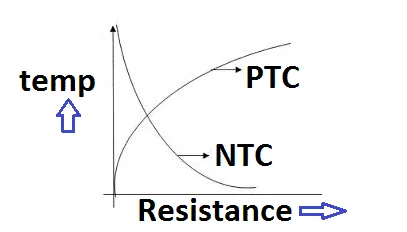
\( R \downarrow \quad \text{as} \quad T \uparrow \)
Reason (microscopic): increase in charge carriers dominates over increase in vibrations.
Comparing Metals and Thermistors
| Material | Effect of Temperature | Microscopic Reason |
|---|---|---|
| Metallic conductor | Resistance increases | More lattice vibrations → more electron collisions |
| NTC thermistor | Resistance decreases | More electrons released (increase in \( n \)) |
Using the Drift Velocity Model
The drift velocity equation:
\( I = nqvA \)
Helps us understand behaviour:
- Metals: \( n \) is constant (number of free electrons doesn’t change); temperature increases → lower \( v \) (more collisions) → resistance increases.
- Thermistors: \( n \) increases dramatically with temperature; this overwhelms effect of collisions → resistance decreases.
Applying the Model
A. Metallic Conductor
- Initial temperature rise → slight increase in \( n \) but negligible.
- Main effect: increased lattice vibrations.
- Thus \( R \propto T \) approximately linearly at moderate temperatures.
B. NTC Thermistor

- At low temperatures, few carriers are available → high resistance.
- With temperature rise, many electrons jump to conduction band.
- Thus resistance drops rapidly (non-linear behaviour).
Example (Easy)
Why does the resistance of a copper wire increase as it gets hotter?
▶️ Answer / Explanation
- More lattice vibrations at higher temperature.
- Electrons collide more often.
- More collisions → greater resistance.
Example (Medium)
Explain why the resistance of an NTC thermistor falls rapidly with temperature.
▶️ Answer / Explanation
- Temperature increases release many more charge carriers.
- Thus \( n \) rises dramatically.
- More electrons available to carry current → lower resistance.
- This effect is stronger than increased lattice vibrations.
Example (Hard)
Describe how the drift velocity model explains the opposite temperature behaviour of metals and thermistors.
▶️ Answer / Explanation
Metal:
- Number of charge carriers \( n \) is constant.
- Higher temperature → more ion vibrations → more collisions.
- More collisions → lower drift velocity \( v \).
- Lower \( v \) → resistance increases.
Thermistor:
- Heating releases more electrons → \( n \) increases greatly.
- Higher \( n \) increases current even if collisions increase.
- Thus drift velocity behaviour is dominated by the rise in electron number.
- Overall effect → resistance decreases.