
Resistance and Illumination: Conduction Electron Model for LDRs
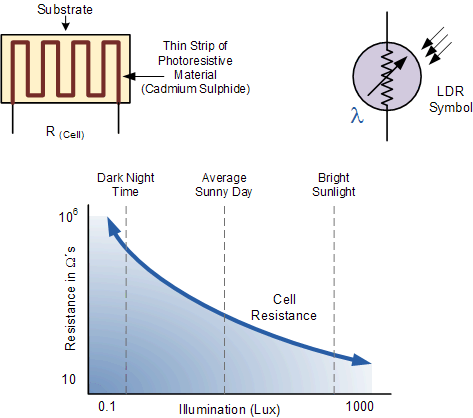
A Light-Dependent Resistor (LDR) is a semiconductor whose resistance decreases as light intensity increases. This behaviour can be modelled in terms of the number of conduction electrons.
Why Illumination Affects Resistance
In semiconductors, electrons are usually bound in the valence band. To conduct electricity, they must move into the conduction band.
When light shines on an LDR:
- Photons provide energy to electrons.
- Electrons gain enough energy to move to the conduction band.
- The number of conduction electrons \( n \) increases.
- More conduction electrons → higher current for the same voltage.
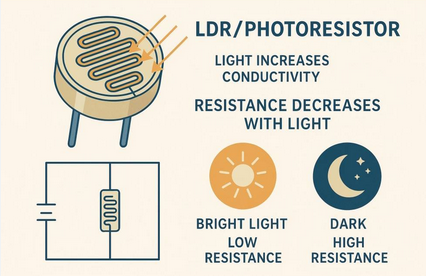
Thus, resistance decreases with illumination.
\( R \downarrow \quad \text{as light intensity} \uparrow \)
Drift Velocity Model: Using \( I = nqvA \)
The current in a conductor is:
\( I = nqvA \)
- \( n \): number of charge carriers per unit volume
- \( q \): charge of an electron
- \( v \): drift velocity
- \( A \): cross-sectional area
In an LDR: illumination increases \( n \) (the number of free electrons). If \( n \) increases and \( V \) is constant, current increases → resistance decreases.
Main point: The increase in conduction electrons is the dominant factor.
Applying the Model to LDR Behaviour
- Dark conditions: very few conduction electrons → high resistance (e.g., megaohms).
- Bright conditions: many electrons excited → low resistance (hundreds or tens of ohms).
- Change is non-linear: small increases in light can drastically reduce resistance.
This makes LDRs ideal for sensing light levels.
Where LDRs Are Used
- Automatic streetlights
- Light meters
- Security systems
- Brightness-controlled circuits
- Potential dividers to produce light-dependent voltages
Summary Table: Illumination vs Resistance
| Condition | Conduction Electrons \( n \) | Current | Resistance |
|---|---|---|---|
| Dark | Very small \( n \) | Very low | High |
| Bright light | Large increase in \( n \) | High | Low |
Example (Easy)
What happens to the resistance of an LDR as light intensity increases?
▶️ Answer / Explanation
- More photons hit the LDR.
- More electrons enter the conduction band.
- More charge carriers → lower resistance.
Example (Medium)
Explain the behaviour of an LDR in terms of the equation \( I = nqvA \).
▶️ Answer / Explanation
- Light increases \( n \), the number of free electrons.
- Since current \( I \) is proportional to \( n \), the current increases.
- At constant voltage: increase in current → decrease in resistance.
Example (Hard)
An LDR has resistance \( 50\ \mathrm{k\Omega} \) in darkness and \( 400\ \Omega \) in bright light. Explain why the resistance changes by such a large factor when illuminated.
▶️ Answer / Explanation
- Even a small increase in light releases many conduction electrons.
- Semiconductors are extremely sensitive to energy input from photons.
- This causes a huge increase in \( n \).
- Since current \( I = nqvA \), this dramatically increases current.
- Thus resistance drops by a very large factor.