
Wavefront, Coherence, Path Difference, Superposition, Interference and Phase
This section explains the fundamental concepts used in wave optics and interference phenomena.
Wavefront
A wavefront is a surface (or line, in 2D diagrams) that joins points on a wave that are in the same phase.
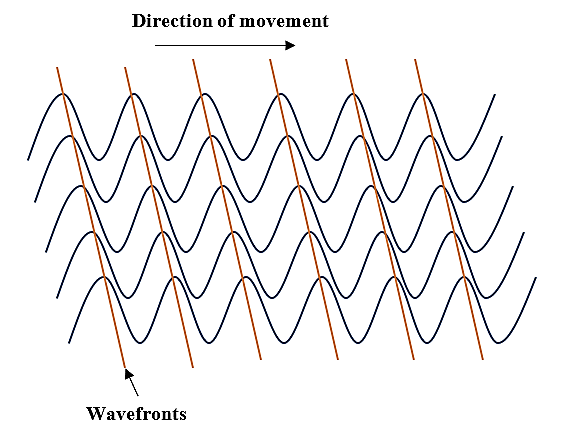
- All points on a wavefront reach crests/troughs at the same time.
- Wavefronts are always perpendicular to the direction of wave propagation.
- Examples:
- Circular wavefronts (from a point source)
- Plane wavefronts (waves far from the source)
Coherence
Two sources are coherent if they have:
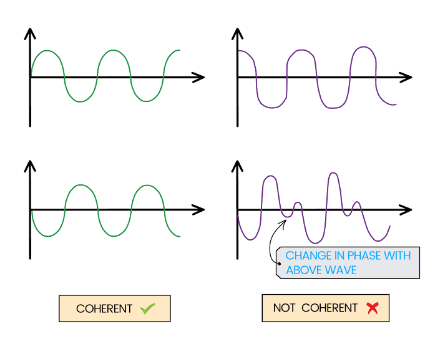
- the same frequency, and
- a constant phase difference
Coherence is essential for producing a stable interference pattern.
Path Difference
Path difference is the difference in the distances travelled by two waves from their respective sources before meeting at a point.
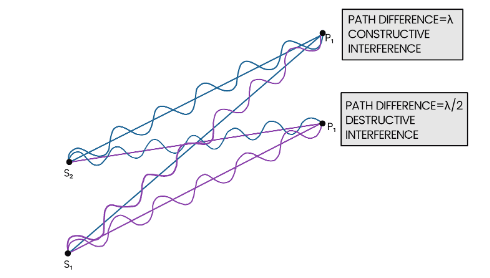
\( \Delta x = x_1 – x_2 \)
- Measured in metres (m).
- Determines whether waves interfere constructively or destructively.
Conditions:
- Constructive interference → \( \Delta x = n\lambda \)
- Destructive interference → \( \Delta x = (n+\tfrac{1}{2})\lambda \)
Superposition
Superposition is the principle that when two or more waves meet, the resultant displacement is the vector sum of the individual displacements.
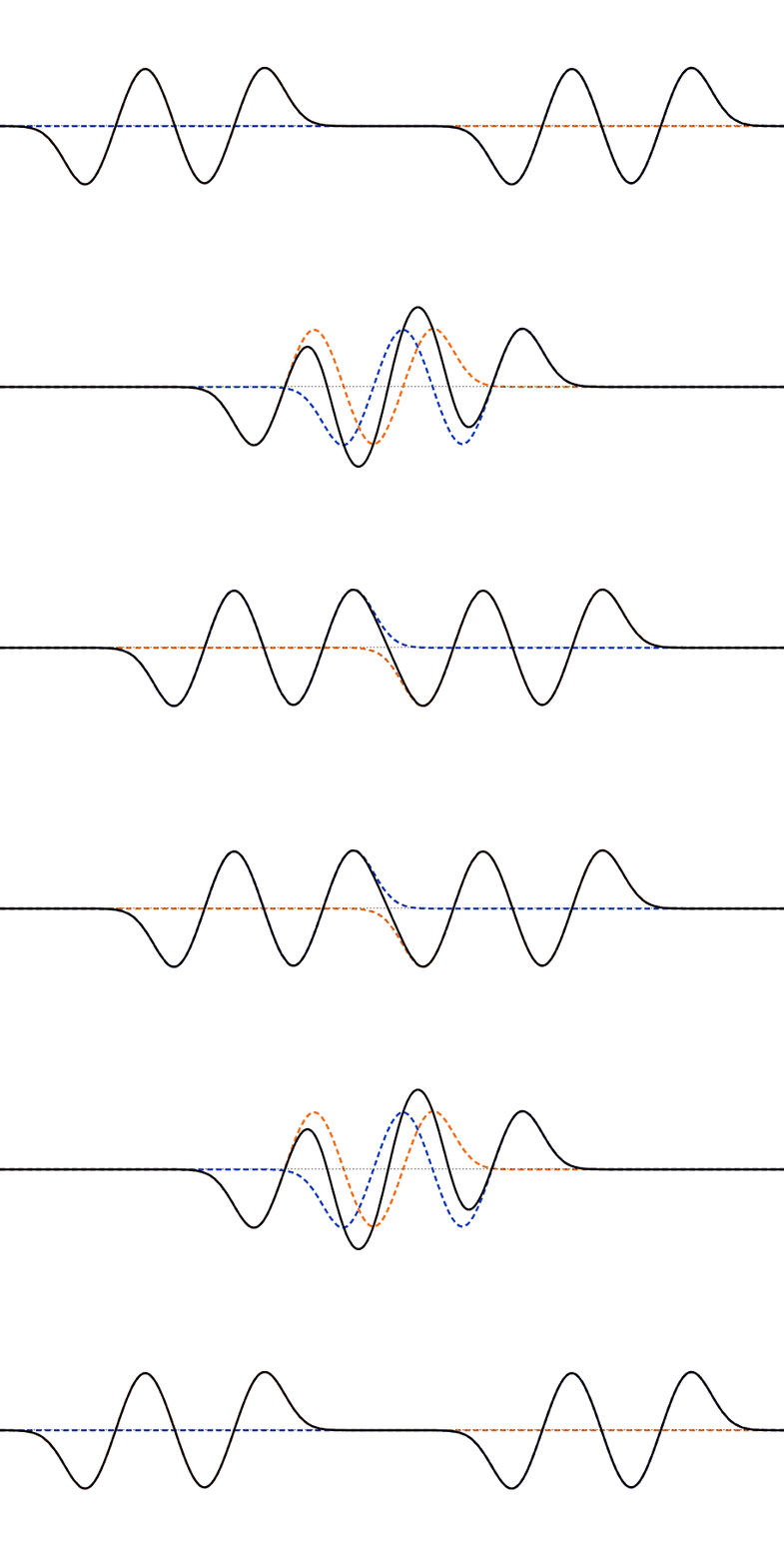
- Waves pass through each other without being permanently changed.
- Can produce constructive and destructive interference.
Interference
Interference is the observable effect of superposition.
When two coherent waves overlap, they can produce:
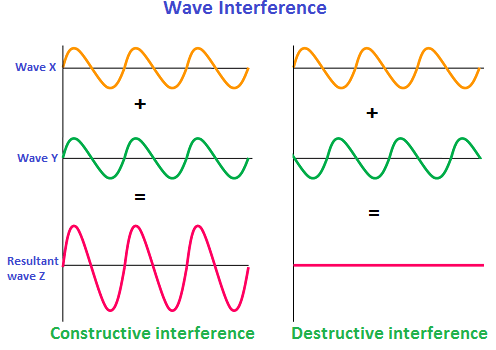
- Constructive interference (in-phase overlap → larger amplitude)
- Destructive interference (out-of-phase overlap → cancellation)
Examples:
- Young’s double-slit fringes
- Thin-film interference
- Ripple tank patterns
Phase
Phase describes the position of a point within a wave cycle.

- Measured in radians or degrees.
- One complete cycle = \( 2\pi \) radians = \( 360^\circ \).
- Two points are in phase if they reach maximum displacement at the same time.
- Two points are out of phase if their peaks do not line up.
Phase difference:
\( \phi = \frac{2\pi}{\lambda} \Delta x \)
Example (Easy)
What condition is required for two sources to be coherent?
▶️ Answer / Explanation
- Same frequency
- Constant phase difference
Example (Medium)
Two waves arrive at a point with a path difference of \( \lambda/2 \). What type of interference occurs?
▶️ Answer / Explanation
\( \Delta x = \frac{\lambda}{2} = \left(n+\frac{1}{2}\right)\lambda \) → destructive interference.
Example (Hard)
Two sources produce waves with a phase difference of \( \pi/2 \). What is the corresponding path difference?
▶️ Answer / Explanation
Use the formula:
\( \phi = \frac{2\pi}{\lambda}\Delta x \)
Substitute \( \phi = \pi/2 \):
\[ \frac{\pi}{2} = \frac{2\pi}{\lambda}\Delta x \]
Rearrange:
\( \Delta x = \frac{\lambda}{4} \)
So the path difference = \( \lambda/4 \)