
Electric Field Between Parallel Plates \( E = \dfrac{V}{d} \)
When two large, flat, parallel conducting plates are connected to a potential difference, a uniform electric field is produced between them (ignoring edge effects).
Equation for Electric Field Between Parallel Plates
The magnitude of the electric field between the plates is given by:
\( E = \dfrac{V}{d} \)
- \( E \) = electric field strength (V m⁻¹ or N C⁻¹)
- \( V \) = potential difference between the plates (V)
- \( d \) = separation between the plates (m)
Conditions for Using This Equation
- The plates are large compared to their separation.
- The plates are parallel.
- The electric field between the plates is uniform.
- Edge effects are neglected.
Direction of the Electric Field
- The electric field points from the positive plate to the negative plate.
- The field direction is the direction of force on a positive test charge.
Link with Potential Gradient
Electric field strength is the potential gradient:
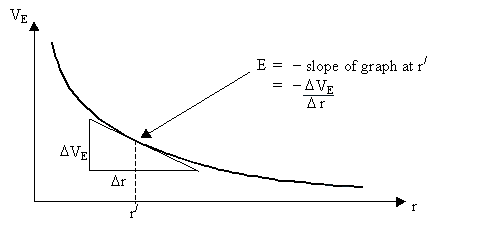
\( E = -\dfrac{\Delta V}{\Delta x} \)
For a uniform field, the potential changes linearly with distance, giving:
\( E = \dfrac{V}{d} \)
Relationship with Force on a Charge
A charge \( Q \) placed between the plates experiences a force:
\( F = EQ \)
This force is constant anywhere between the plates because the field is uniform.
Applications
- Motion of charged particles between plates
- Electron deflection in cathode-ray tubes
- Capacitors
- Particle accelerators
Example (Easy)
Two parallel plates have a potential difference of \( 200\ \mathrm{V} \) and are separated by \( 0.020\ \mathrm{m} \). Calculate the electric field strength between the plates.
▶️ Answer / Explanation
\( E = \dfrac{V}{d} = \dfrac{200}{0.020} = 1.0\times10^{4}\ \mathrm{V\,m^{-1}} \)
Example (Medium)
An electric field of strength \( 3.0\times10^{4}\ \mathrm{V\,m^{-1}} \) exists between two plates. If the plates are \( 0.015\ \mathrm{m} \) apart, find the potential difference.
▶️ Answer / Explanation
\( V = Ed = (3.0\times10^{4})(0.015) = 450\ \mathrm{V} \)
Example (Hard)
Explain what happens to the electric field strength if the potential difference is doubled while the plate separation remains constant.
▶️ Answer / Explanation
- Electric field strength is proportional to potential difference.
- Doubling \( V \) doubles \( E \).
- The field remains uniform.